
Garis Panduan CDM Edisi 2026
Application of Malaysia's CDM Regulations 2024: Which Projects and Work Are Within Scope?
CDM 2026 · 2 of 52
A practical scope guide for projects, maintenance, installation and alteration work under Malaysia's CDM Regulations.

Six-slide briefing
The guideline at a glance
Slide 1 / 6
CDM 2026
Regulation 2
Start with the project and workplace
CDM applies to every workplace where a project is carried out.
- A project includes planning and design
- Duties can start before mobilisation
- Assess the work, not the contract label
Determine scope at concept stage.
Use the buttons, dots or left/right arrow keys. This briefing summarises the guideline; the article and official source remain the detailed references.
CDM 2026 Series — Topic 2 of 52. This is general industry guidance and should be read with current legislation and DOSH directions.
Quick answer
The CDM Regulations apply to every workplace where a project is carried out. Scope cannot be decided from a contract label such as “minor work”, “maintenance” or “supply and install”. Regulation 2 must be read with the Regulation 3 definitions, particularly project, construction work, design, structure, construction phase, construction site and construction workplace. Assess the actual activity, work method, intended outcome and the degree of change to a structure.
Starting point: project and workplace
A project includes any project involving, or intended to involve, construction work. It covers planning, design, management and other work until the construction phase ends. CDM duties can therefore begin before site mobilisation. Parts I, II, III and V span the process from concept to handover. Part IV sets site requirements for construction work. The pre-construction phase can also run during construction when design changes occur.
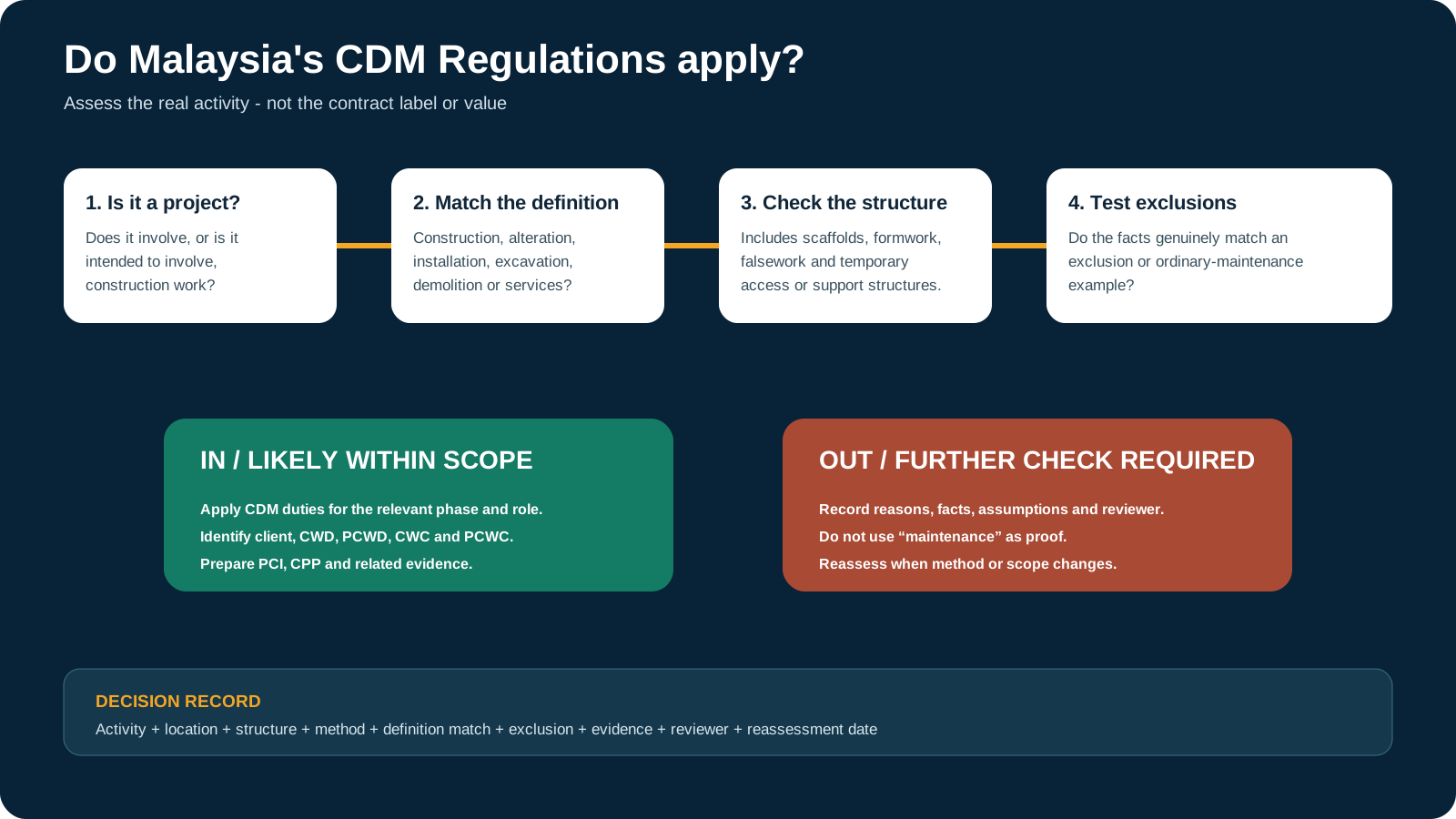
Figure 1: Assess the real activity and record the basis of the scope decision.
Work commonly included
The broad definition of construction work includes construction, alteration, conversion, fitting-out, commissioning, renovation, refurbishment, decommissioning and demolition; specified maintenance and cleaning; site investigation, excavation and preparation; installation or removal of prefabricated structural elements; removal of structures or demolition waste; and work on permanent mechanical, electrical, gas, compressed-air, hydraulic, telecommunications or computer services.
“Structure” also includes formwork, falsework, scaffolding and other temporary structures providing support or access during construction work.
Activities identified as outside the definition
The guideline examples include ordinary landscaping; movable tents or canopies not used for construction support or access; lightweight office partitions and exhibition booths; non-intrusive topographical surveys and inspections; work on ships; and off-site manufacture of standard prefabricated products. Mineral exploration or extraction and preparation at the extraction location are expressly excluded within the stated boundary.
Apply examples carefully. Moving a lightweight partition may be outside scope, but altering permanent walls, wiring, fire systems or structural supports may bring the activity within construction work.
The maintenance boundary
Ordinary maintenance of a structure or fixed plant is generally outside the definition where it is basic like-for-like work, such as replacing a worn bearing with a similar bearing, changing filters, lubricating moving parts or replacing a failed motor with the same model.
The conclusion can change where the work needs a temporary access structure, substantial dismantling, or alteration beyond ordinary maintenance. One purchase order labelled “maintenance” may therefore contain activities with different scope outcomes.
Eight-step scope assessment
- Describe the activity, location, structure, outcome and actual method.
- Decide whether it forms part of a project involving or intended to involve construction work.
- Match the work against every limb of the construction-work definition.
- Read it with the definitions of design and structure, including temporary structures.
- Check express exclusions and DOSH guideline examples.
- Identify every workplace and supporting area connected with the activity.
- Record the conclusion, reasons, evidence, assumptions and reviewer.
- Reassess when scope, access method, temporary works or dismantling changes.
Practical example: an operating food factory
The factory plans four activities. A failed motor is replaced with the same model without system changes; this is likely ordinary maintenance. A new permanent process line is installed with pipes, cables and supports; this is commonly construction work. Scaffolding is erected for facade repair; the temporary access structure and repair require construction-work assessment. Movable lightweight office partitions are relocated without altering permanent structure or services; this example may fall outside the definition.
The team does not make one decision for the entire work order. It assesses each activity and reopens the decision if the motor work later requires base-frame, wiring or support alterations.
Evidence to retain
| Question | Practical evidence |
|---|---|
| What is really being done? | Scope, drawings, photographs, access method and sequence |
| Which definition applies? | Matrix mapping Regulation 2 and Regulation 3 definitions |
| Is an exclusion relied on? | Specific reason and supporting facts |
| Who decided? | Date, reviewer, assumptions and notified parties |
| Did the work change? | Fresh review after a scope or method change |
Common failures
- Treating low contract value as an exemption.
- Relying on a work-order title instead of the actual activity.
- Assuming all maintenance is excluded.
- Ignoring temporary works, access and permanent services.
- Making one decision for a package containing different activities.
- Failing to reassess after the work method changes.
References
- DOSH Malaysia, Guidelines for the CDM Regulations 2024, 2026 Edition, especially page 7 and the commentary on Regulations 1-3.
- CDM Regulations 2024 - P.U. (A) 147/2024.
- Occupational Safety and Health Act 1994 - Act 514.
This is general industry guidance. Verify scope against the project facts, legislation and current DOSH directions.
Related articles

Garis Panduan CDM Edisi 2026
CDM 2026 · 29 of 52
Kestabilan Struktur: Kerja Sementara, Penyangga dan Urutan
Panduan Peraturan 21 untuk reka bentuk kerja sementara, laluan beban, pemeriksaan dan penanggalan terkawal.
Ir. Ts. Dr. Mohamad Syamir bin Senin.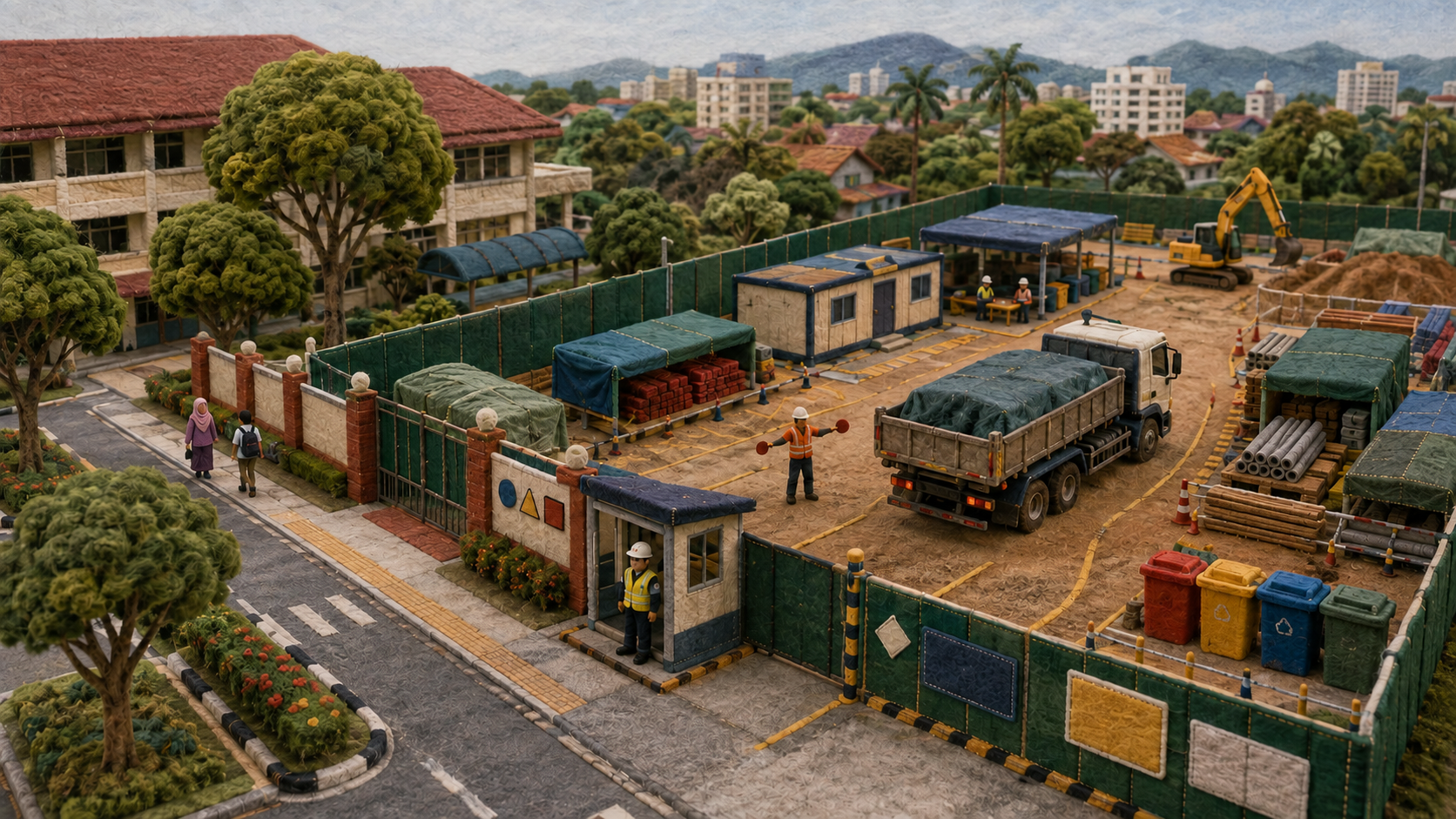
Garis Panduan CDM Edisi 2026
CDM 2026 · 28 of 52
Aturan dan Sekuriti Tapak: Lindungi Pekerja dan Orang Awam
Panduan Peraturan 20 untuk kekemasan, kebersihan, pemagaran, penandaan serta kawalan antara muka awam.
Ir. Ts. Dr. Mohamad Syamir bin Senin.
Garis Panduan CDM Edisi 2026
CDM 2026 · 27 of 52
Tempat Kerja Pembinaan Yang Selamat: Akses, Tepi dan Bukaan
Panduan Peraturan 19 untuk mengawal akses, jalan keluar, tepi, bukaan lantai dan ruang kerja mengikut keadaan sebenar tapak.
Ir. Ts. Dr. Mohamad Syamir bin Senin.