
Garis Panduan CDM Edisi 2026
Domestic Clients: Who Performs the CDM Duties?
CDM 2026 · 14 of 52
Practical guidance on who performs CDM duties for a domestic residential project.
Six-slide briefing
The guideline at a glance
Slide 1 / 6
CDM 2026
Status
Own residence, not business
Test the project’s real purpose before using the domestic-client arrangements.
- Home use
- Project purpose
- Decision evidence
A house project is not automatically domestic.
Use the buttons, dots or left/right arrow keys. This briefing summarises the guideline; the article and official source remain the detailed references.
CDM 2026 Series — Topic 14 of 52. This is general industry guidance and should be read with current legislation and DOSH directions.
A domestic client is a client whose project is for their own residence and not in the course or furtherance of business. Homestays, hotels, rental houses and rental rooms are not automatically domestic projects because the business purpose must be tested against the facts.
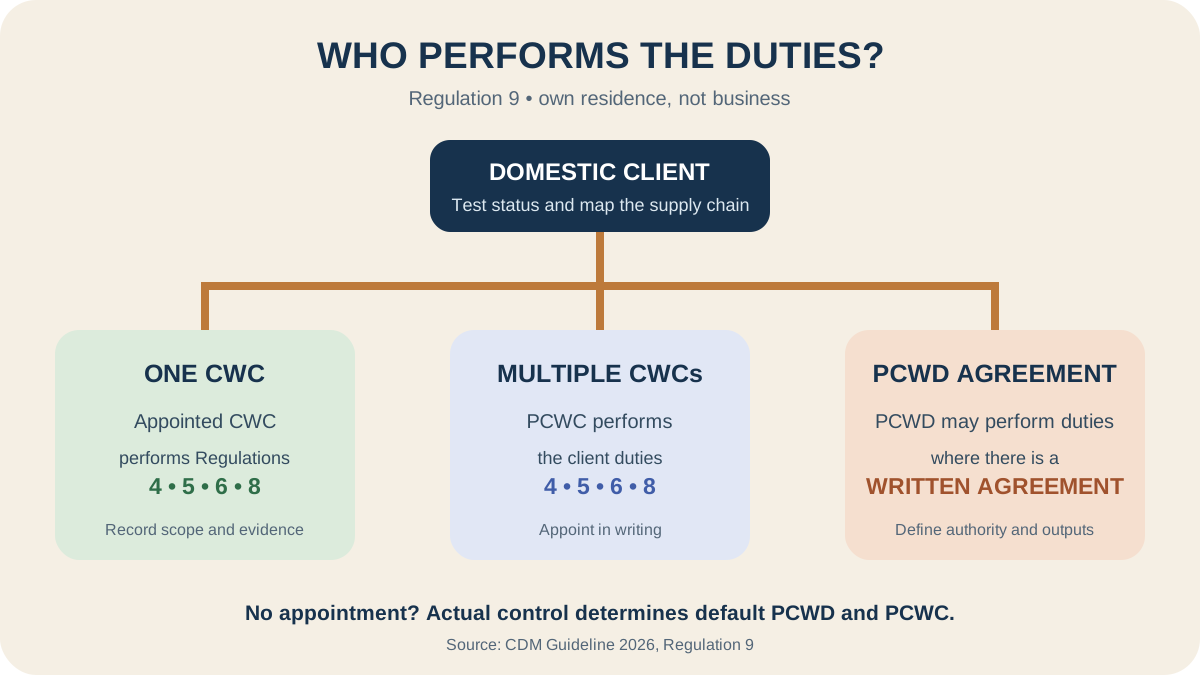
Regulation 9: where do the duties go?
For a domestic-client project, duties under Regulations 4, 5, 6 and 8 are performed through one of these routes:
| Project condition | Party performing the duties |
|---|---|
| Only one construction work contractor (CWC) | The appointed CWC |
| More than one CWC | The principal construction work contractor (PCWC) |
| Written agreement exists | The principal construction work designer (PCWD) may perform them |
The written agreement under Regulation 9(1)(c) should contain the same substance as the written appointment under Regulation 7(1)(a). Define scope, effective date, authority, resources, deliverables, interfaces and acceptance.
When principal appointments are missing
If the domestic client fails to make appointments required by Regulation 7, the CWD controlling the pre-construction phase becomes the PCWD, and the CWC controlling the construction phase becomes the PCWC. This legal default is not permission to leave roles unclear. The team should still identify actual control, communicate it and record workable arrangements.
Practical example (fictional scenario)
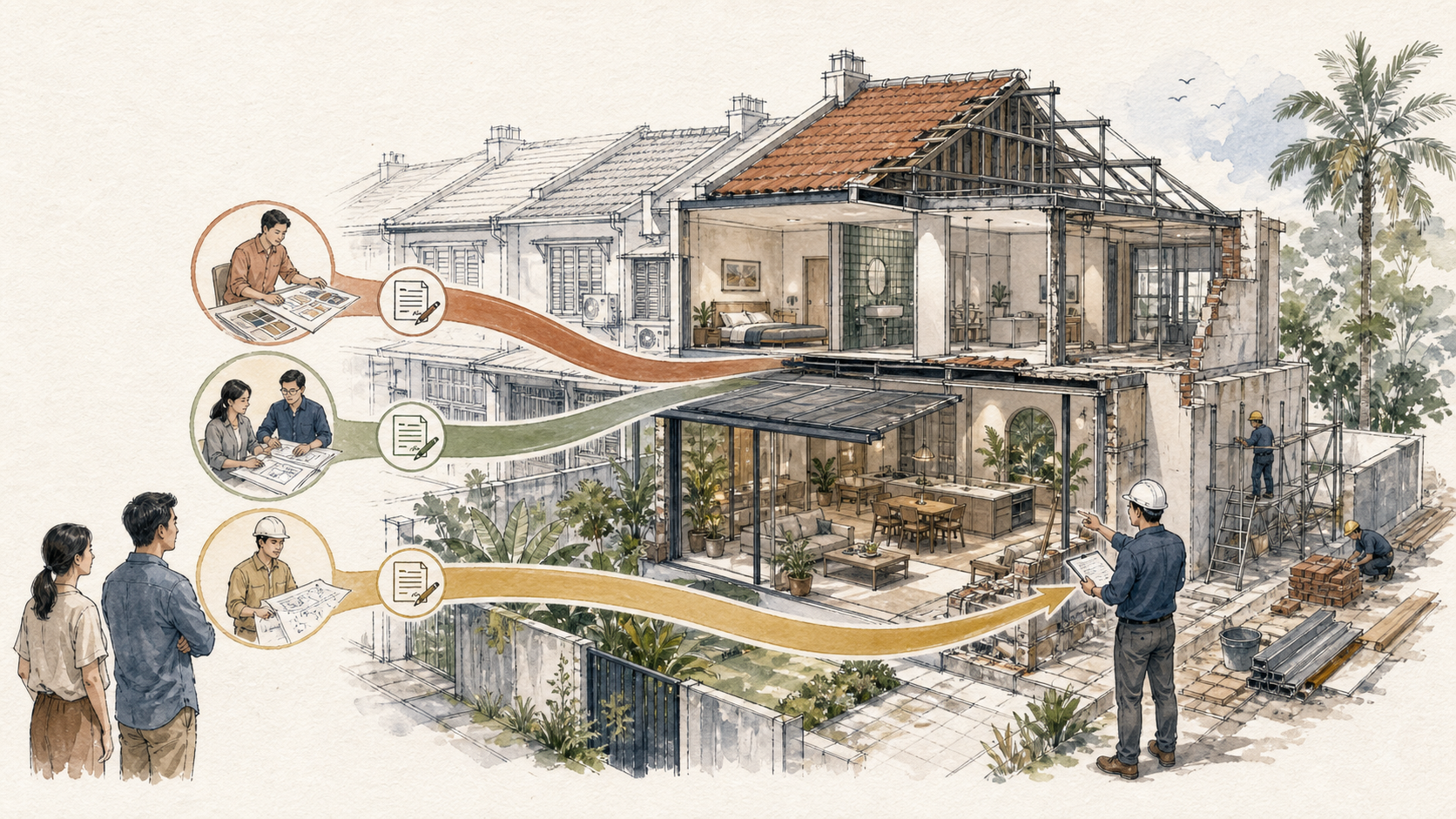
The owners of a Petaling Jaya terrace house commission structural, roof and M&E alterations for their family residence. An architect prepares the design; the main contractor appoints electrical and roofing contractors. Because multiple CWCs are expected, the main contractor is appointed PCWC. The architect is appointed PCWD, and a written agreement states that the architect will perform the Regulations 4, 5, 6 and 8 duties for the project.
The architect prepares PCI from existing drawings and a utility survey. The PCWC prepares the CPP and coordinates the CWCs. Residual risks concerning roof openings and temporary-support sequencing are passed to the PCWC. This fictional example explains task allocation; it is not legal advice for a specific project.
What to do
- verify that the project is genuinely for the client’s residence, not business;
- map every CWD and CWC involved or reasonably expected;
- determine who controls the pre-construction and construction phases;
- appoint PCWD and PCWC as soon as practicable where multiple CWCs are expected;
- if PCWD takes the Regulations 4, 5, 6 and 8 duties, execute a clear written agreement;
- assign ownership for PCI, CPP, coordination, monitoring and notification where thresholds are met; and
- review arrangements after scope, contractor or control changes.
Evidence to retain
- project-purpose and residential-status statement;
- organisation chart and CWD/CWC register;
- PCWD/PCWC appointments and Regulation 9(1)(c) agreement, where used;
- records identifying control of each phase;
- PCI, CPP, risk-coordination and performance-review records; and
- change register, deliverable acceptance and handover evidence.
Common failures
- assuming every house project is automatically domestic;
- overlooking specialist CWCs appointed by the main contractor;
- relying on an oral agreement to transfer duties to PCWD;
- treating the default rule as a substitute for coordination;
- allowing homeowner instructions on work methods to bypass the project arrangements; or
- overlooking Regulation 18 where the domestic client controls how work is carried out.
Checklist
- Is the project for the client’s own residence and not business?
- How many CWCs are involved or reasonably expected?
- Who controls pre-construction and construction?
- Are PCWD and PCWC clearly appointed?
- If PCWD takes client duties, is the written agreement complete?
- Do PCI, CPP, monitoring and notification have owners and evidence?
- Do changes trigger a role review?
Primary references
- DOSH, CDM Guideline 2026, “domestic client” definition, paragraphs 59-61, Regulation 9 and Regulation 18.
- P.U. (A) 147/2024, Regulations 3, 7, 9 and 18.
- Occupational Safety and Health Act 1994 (Act 514).
Related articles

Garis Panduan CDM Edisi 2026
CDM 2026 · 29 of 52
Kestabilan Struktur: Kerja Sementara, Penyangga dan Urutan
Panduan Peraturan 21 untuk reka bentuk kerja sementara, laluan beban, pemeriksaan dan penanggalan terkawal.
Ir. Ts. Dr. Mohamad Syamir bin Senin.
Garis Panduan CDM Edisi 2026
CDM 2026 · 28 of 52
Aturan dan Sekuriti Tapak: Lindungi Pekerja dan Orang Awam
Panduan Peraturan 20 untuk kekemasan, kebersihan, pemagaran, penandaan serta kawalan antara muka awam.
Ir. Ts. Dr. Mohamad Syamir bin Senin.
Garis Panduan CDM Edisi 2026
CDM 2026 · 27 of 52
Tempat Kerja Pembinaan Yang Selamat: Akses, Tepi dan Bukaan
Panduan Peraturan 19 untuk mengawal akses, jalan keluar, tepi, bukaan lantai dan ruang kerja mengikut keadaan sebenar tapak.
Ir. Ts. Dr. Mohamad Syamir bin Senin.