
Garis Panduan CDM Edisi 2026
Construction Phase Plan: Minimum Content and Making It Useful
CDM 2026 · 19 of 52
A project-specific CPP guide: safety and health arrangements, site rules, specific measures, implementation evidence and review after change.
Six-slide briefing
The guideline at a glance
Slide 1 / 6
CDM 2026
Regulation 13
CPP before site setup
The PCWC draws up or arranges the plan during pre-construction and before the construction site is set up.
- Safety and health arrangements
- Site rules
- Fourth Schedule specific measures
See the article for sole-contractor duty details.
Use the buttons, dots or left/right arrow keys. This briefing summarises the guideline; the article and official source remain the detailed references.
Quick answer
A construction phase plan, or CPP, should explain how safety and health are managed for the actual project, not simply collect corporate policies. Regulation 13 specifies safety and health arrangements, site rules and specific measures for applicable categories of work in the Fourth Schedule. For a project involving more than one construction work contractor, the principal construction work contractor (PCWC) draws up or arranges the plan during pre-construction and before the construction site is set up. The plan must be reviewed throughout the project. Use pre-construction information, design risks and site conditions to explain who implements controls, when they are required and how their effectiveness is checked.
Why a thick plan can still fail
On Malaysian sites, work often shares space with deliveries, public traffic, factory operations or other contractors. A plan saying only “follow safety procedures” does not explain which entrance is used, who controls deliveries or what happens when emergency access is obstructed. Generic content can also miss changing river levels, existing utilities and public movements.
A useful CPP connects management decisions with conditions at the workface. Supervisors should identify applicable rules before starting an activity, workers should understand emergency actions and managers should know which evidence to inspect. The plan does not replace risk assessments, work methods or temporary works design; it coordinates those documents so that gaps do not emerge between work packages.
Legal duties and content guidance
Under Regulation 13(1), the PCWC draws up or arranges for a CPP during pre-construction and before the site is set up. Regulation 13(2) specifies safety and health arrangements and site rules, taking account of ongoing industrial activities where necessary, and specific measures for applicable work in the Fourth Schedule. Site rules are rules for the particular site necessary for safety and health, as described in Regulation 13(6).
Regulation 13(3) requires the principal construction work designer (PCWD) to assist the PCWC with relevant information in its possession or knowledge, including pre-construction information from the client and risk information from designers. This assistance is not PCWD approval of the CPP. Regulation 13(4) requires the PCWC to review, update and revise the plan appropriately throughout the project so that it remains sufficient to ensure work is carried out, so far as is practicable, without risks to safety and health.
The client has a duty under Regulation 5(2)(a) to ensure that the CPP is drawn up before the construction phase begins. For a sole construction work contractor, Regulation 17(1)(d)(ii) requires drawing up or arranging a CPP in accordance with Regulation 13, so far as is practicable before setting up a construction site. That qualification does not remove the client's duty above. Contractors on a multi-contractor project must comply with relevant parts of the CPP under Regulation 17(1)(c)(ii).
Paragraphs 99–103 of the DOSH guideline help explain content. This guidance list does not justify claiming that every project needs the same page count, a DOSH approval form or a weekly review interval. Detail should be relevant and proportionate to the project's scale, complexity and risks.
Eight steps to a usable plan
- Define scope and responsibility. Identify the project, location, structures, work packages, main parties, programme and key dates. Identify who prepares and controls CPP versions and who verifies that arrangements have been implemented. Distinguish management responsibilities from technical inspection tasks; the document owner is not necessarily qualified to assess every design.
- Check the underlying information. Use pre-construction information, site investigations, utilities, designs and residual risks. Record outstanding information, action owners and decisions that must be deferred. Do not turn assumptions about ground strength or cable locations into facts merely because they have been entered into the plan.
- Show the layout and site rules. Mark access, deliveries, pedestrian routes, work boundaries, storage, welfare and emergency access. Explain induction, entry permission, communication and simultaneous activity controls. Where industrial operations continue, coordinate energy isolation, access and emergency arrangements with the premises operator.
- Identify significant risks and specific measures. Describe risks by location and work stage, not as a hazard list without decisions. Determine whether Fourth Schedule categories apply. For example, work exposing workers to drowning risks requires suitable specific measures; an instruction to wear a lifejacket alone does not explain fall prevention, rescue and response.
- Link implementation documents. Reference relevant risk assessments, work methods, traffic plans, lifting plans and temporary works designs, with document numbers and revisions. Assign someone to check consistency between them. Do not treat the CPP as blanket approval to lift loads or remove temporary supports.
- Provide people, welfare and emergency arrangements. Explain supervision, specific training, worker consultation, first aid, welfare facilities and incident reporting. Ensure briefings use language understood by the workforce. For water rescue, check the team, equipment, communication, access and exercises; the presence of a boat alone is not evidence that a rescue system is ready.
- Test implementation before the relevant activity. Carry out readiness checks proportionate to risk. Inspect routes, barriers, current documents, resources and supervisors' understanding. Record deficiencies, action owners and conditions for resuming work. This is recommended management practice, not a newly created statutory compliance certificate.
- Review when conditions change. Changes to design, sequence, contractors, traffic flow, weather or site discoveries may require revisions. Determine their effects before affected work continues, distribute the new version and withdraw obsolete copies. Set review frequency around the project; the legislation referenced here does not prescribe a universal weekly interval.
Illustrative scenario: bridge construction in Perak
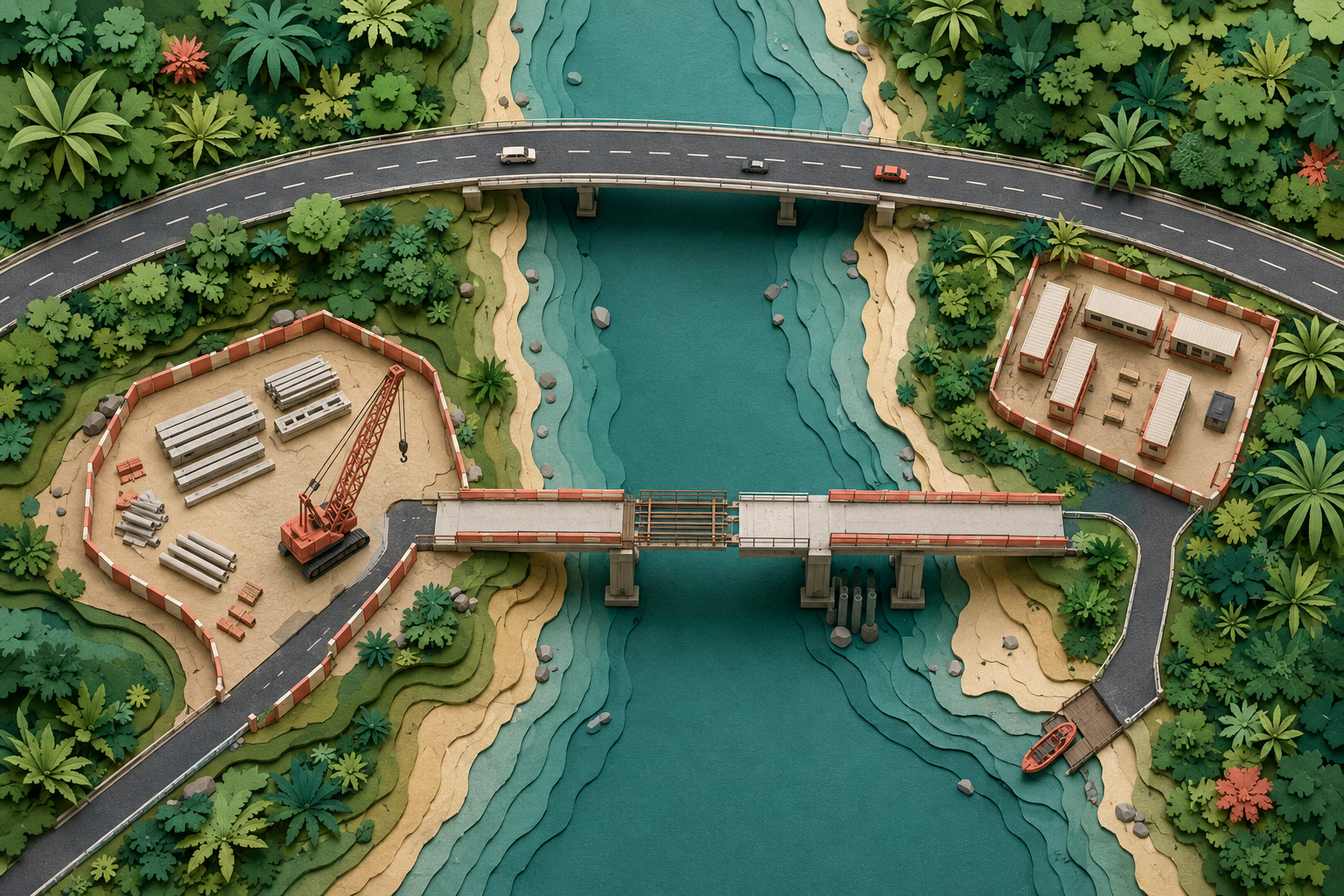
The following is a fictional training scenario, not an actual incident report or an approved engineering plan. A team is building a new bridge near a crossing still used by the public. Activities include component deliveries, lifting and work over water. The PCWC uses the CPP to coordinate these interfaces before work begins.
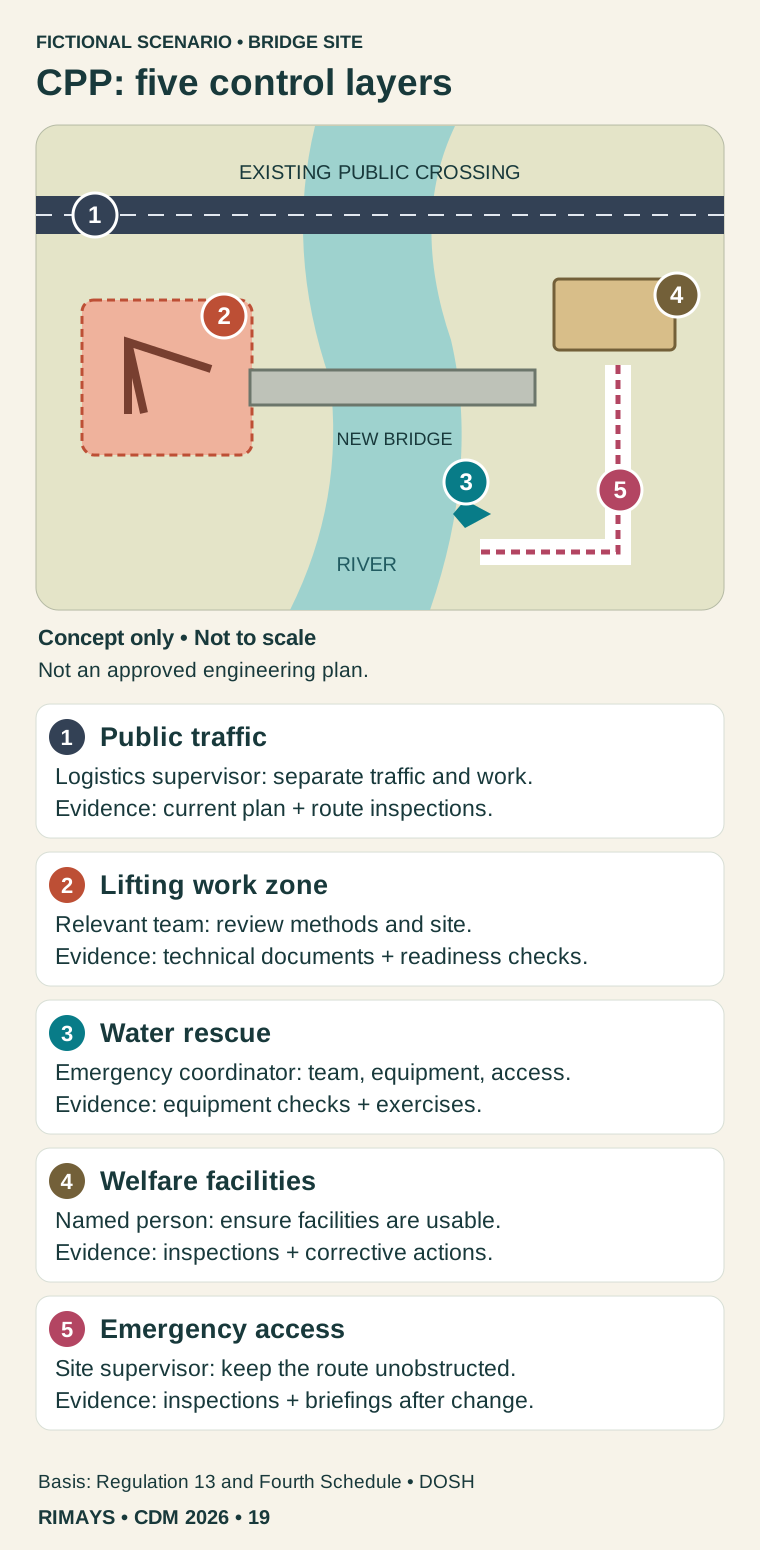
The logistics supervisor manages delivery scheduling and segregation of public traffic from construction areas. The lifting team prepares activity-specific documentation based on site conditions, equipment and relevant technical reviews. The emergency coordinator ensures rescue-team access, communication equipment and rescue exercises match the water risks. A named person checks welfare facilities and ensures that the emergency route does not become a storage area.
When a delivery is proposed through an area previously allocated for rescue access, the team does not simply move an arrow on the plan. It reassesses traffic, emergency access and work sequence, changes arrangements before the delivery and briefs affected parties. Decision records, revised layouts, inspection photographs and briefing confirmation are retained with the relevant CPP version.
This example does not prescribe a “safe” lifting radius, barrier distance, wind speed or river level. Limits and stop-work triggers must be determined through project-specific assessment, manufacturer information and relevant technical review. The illustration below only helps readers understand relationships between areas and actions.
Infographic: five bridge-site control layers
Evidence worth retaining
Keep the controlled CPP with its date, version, preparer and reasons for revision. Link pre-construction information sources, risk registers, unresolved queries, coordination records and referenced work-method documents. Implementation evidence includes site inspections, readiness checks, worker briefings, emergency exercises and action closure supported by verifiable results.
Ensure photographs have location and date context, rather than merely showing a barrier without identifying the relevant activity. Record who received the current version and how changes were explained. Set access, backup and retention arrangements according to applicable project and legal requirements; this article does not invent a statutory retention period for all CPP records.
Common failures to avoid
- Copying another project's plan so that addresses, access and actual risks no longer match.
- Listing controls without identifying who implements them or evidence of inspection.
- Allowing traffic and emergency plans to allocate the same space without coordination.
- Treating a signature on the plan as proof that every control is already available on site.
- Updating office documents while supervisors continue using obsolete versions.
Checklist before work and after change
- Have the party responsible for preparing the CPP and its preparation timing been identified?
- Are arrangements, site rules and specific measures for applicable Fourth Schedule work stated?
- Does incomplete information have an action owner and suitable interim controls?
- Are traffic, lifting, welfare and emergency arrangements coordinated on the current layout?
- Are risk assessments and implementation documents referenced by current revision?
- Do workers understand relevant rules and how to obtain assistance?
- Do inspections demonstrate implementation, rather than planning alone?
- Do changes trigger review, renewed briefings and withdrawal of obsolete versions?
Primary references and next steps
Occupational Safety and Health (Construction Work) (Design and Management) Regulations 2024, DOSH: Regulations 5(2)(a), 13, 17(1)(c)(ii), 17(1)(d)(ii) and the Fourth Schedule. Explanatory reference: DOSH Garis Panduan CDM Edisi 2026, paragraphs 99–103, printed pages 49–51, using the source copy supplied for this series.
This is general guidance, not legal advice or technical approval. Start an internal review with one real activity: identify the CPP rule, the person implementing it and the evidence at the workface. If the three cannot be matched, record the gap as an action before the relevant activity continues. Contact RIMAYS to discuss your project's training and document-coordination needs.
Related articles
Garis Panduan CDM Edisi 2026
CDM 2026 · 29 of 52
Kestabilan Struktur: Kerja Sementara, Penyangga dan Urutan
Panduan Peraturan 21 untuk reka bentuk kerja sementara, laluan beban, pemeriksaan dan penanggalan terkawal.
Ir. Ts. Dr. Mohamad Syamir bin Senin.
Garis Panduan CDM Edisi 2026
CDM 2026 · 28 of 52
Aturan dan Sekuriti Tapak: Lindungi Pekerja dan Orang Awam
Panduan Peraturan 20 untuk kekemasan, kebersihan, pemagaran, penandaan serta kawalan antara muka awam.
Ir. Ts. Dr. Mohamad Syamir bin Senin.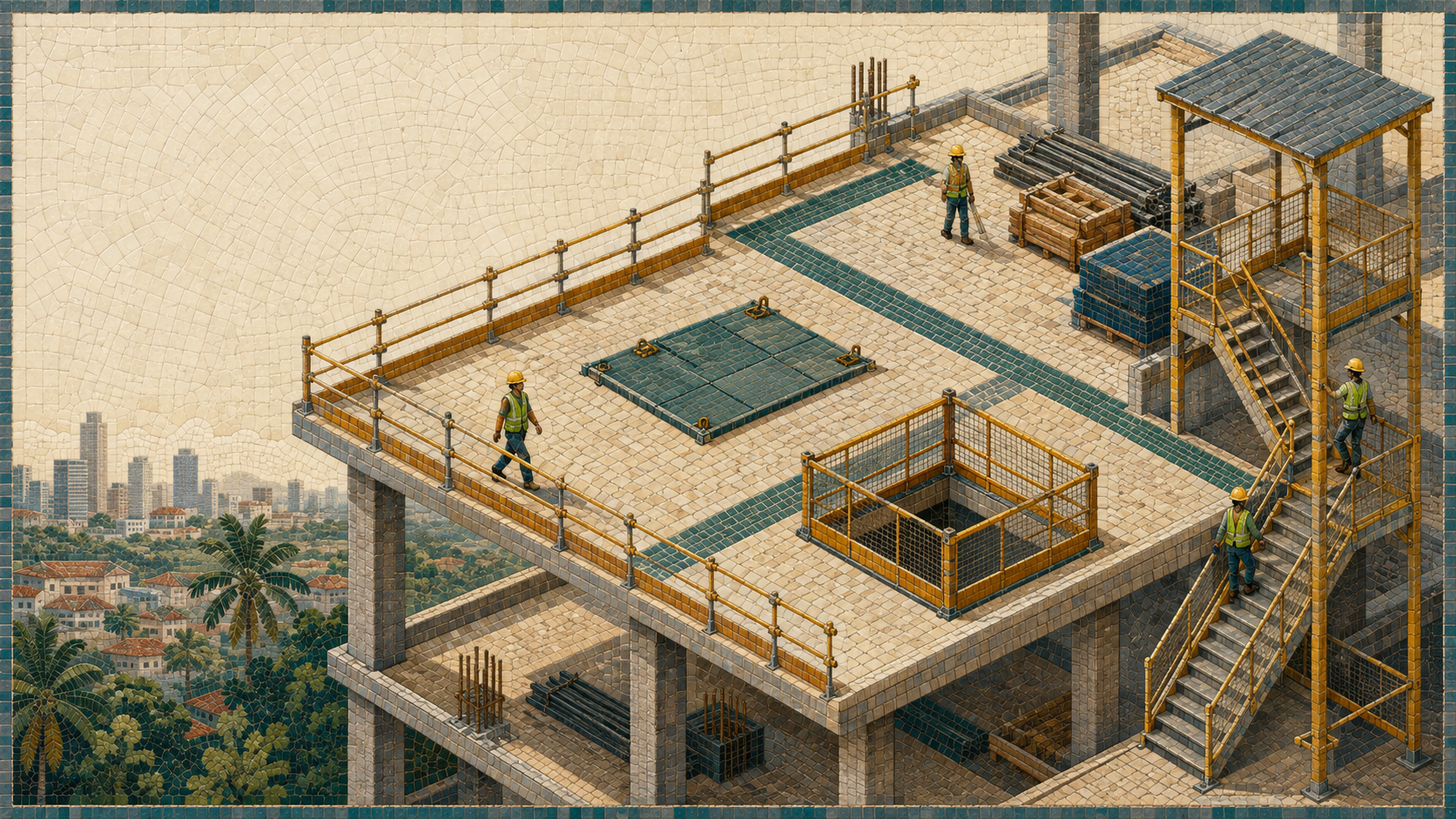
Garis Panduan CDM Edisi 2026
CDM 2026 · 27 of 52
Tempat Kerja Pembinaan Yang Selamat: Akses, Tepi dan Bukaan
Panduan Peraturan 19 untuk mengawal akses, jalan keluar, tepi, bukaan lantai dan ruang kerja mengikut keadaan sebenar tapak.
Ir. Ts. Dr. Mohamad Syamir bin Senin.