
Garis Panduan CDM Edisi 2026
Safety and Health File: Information for Future Work
CDM 2026 · 20 of 52
An SHF guide to essential information, residual risks, version control and PCWD, PCWC and client handovers for future work.

Six-slide briefing
The guideline at a glance
Slide 1 / 6
CDM 2026
Regulation 14
Information for subsequent projects
The PCWD prepares the safety and health file during pre-construction, appropriate to the project's characteristics and future safety and health needs.
- Residual risks
- As-built conditions
- Limitations and references
The file is not a copy of every site record.
Use the buttons, dots or left/right arrow keys. This briefing summarises the guideline; the article and official source remain the detailed references.
Quick answer
The safety and health file, or SHF, retains project information that may be needed to ensure safety and health in subsequent projects. It is not simply a box of handover documents or a copy of every site record. Under Regulation 14, the principal construction work designer (PCWD) prepares the file during pre-construction and ensures that it is reviewed, updated and revised appropriately. The principal construction work contractor (PCWC) supplies relevant information. At project completion, the file reaches the client through the prescribed handover route. Its value lies in information that can be found, understood and matched to the structure before future work is planned.
Why today's records matter to tomorrow's team
A team repairing the facade several years later may not know the original designers. A contractor replacing plant may be unaware that removal depends on a demountable panel, floor-load limits or particular utility isolations. An attractive drawing that omits as-built changes can give a misleading impression.
The SHF helps carry essential knowledge across changes of team. It should explain what remains hazardous, where the hazard is, the supporting information and limitations requiring verification. The file does not automatically authorise drilling, anchor use or plant lifting. Those planning new work still need to assess its scope, current conditions and suitable controls.
Who prepares, reviews and receives the file?
Regulation 14(1)(a) requires the PCWD to prepare a file appropriate to the characteristics of the project, containing information likely to be needed in subsequent projects to ensure any person's safety and health. Regulation 14(1)(b) requires appropriate review, updating and revision, taking account of the work and changes that have occurred. Preparation therefore starts during pre-construction, not during handover week.
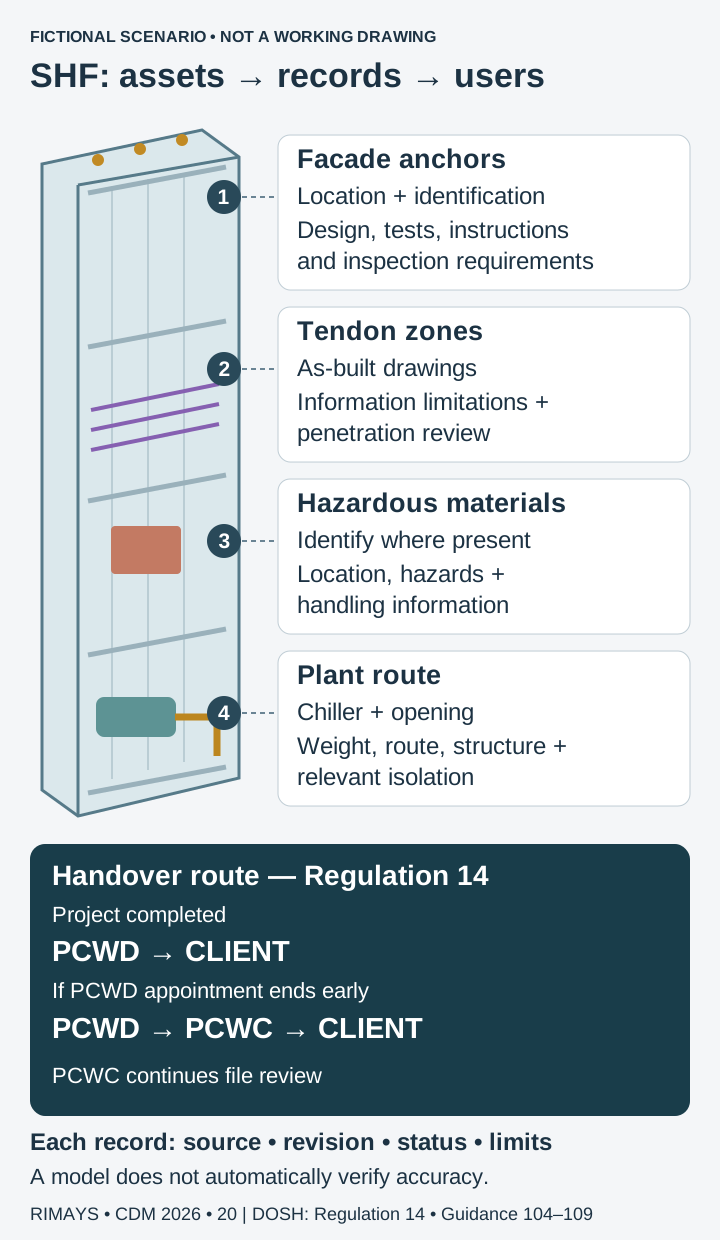
Regulation 14(2) requires the PCWC to supply relevant information in its possession to the PCWD for inclusion in the file. If the PCWD's appointment ends before project completion, Regulation 14(3) requires the file to be handed to the PCWC. The PCWC then continues review, updating and revision under Regulation 14(4). At completion, the PCWD, or where there is no PCWD, the PCWC, hands the file to the client under Regulation 14(5).
Paragraph 104 of the DOSH guideline explains that an SHF is required for projects involving more than one contractor. Also check Regulation 7 on appointments where more than one contractor is involved or reasonably foreseeable. Do not assume that contractors working at different times need not be considered. This article focuses on SHF management for projects requiring these roles; relevant safety records remain useful for other work according to applicable requirements.
Regulation 5(2)(b) places duties on the client to ensure preparation, appropriate review to incorporate relevant new information and availability for inspection by anyone who may need the file to comply with relevant legal requirements. When a client disposes of its interest in a structure, Regulation 6(2) links compliance with that availability duty to providing the file to the person taking over the interest and ensuring that person understands its nature and purpose. This is not a blanket discharge of all CDM duties.
Eight actions for a usable SHF
- Agree the file structure early. The PCWD and client establish the index, format, contributors, information submission dates and review arrangements. Use consistent locations or asset systems so that facade, structural and plant records can be matched. A digital format or information model is a management choice; Regulation 14 does not mandate a particular software product.
- Identify future users and work. Consider relevant maintenance, cleaning, alteration, plant replacement and demolition. For each activity, ask what information is needed before decisions are made. Do not merely follow contract-package order if future users will struggle to find the affected location or component.
- Collect information that genuinely matters. Paragraph 108 lists matters to consider, including site history, hazards not eliminated, ground investigations, structural principles, safe working loads, hazardous materials, utilities, plant information and as-built drawings. Select detail to suit the project; do not invent capacity values or assume that every supplier document has been verified.
- State sources and limitations. Each important record should identify its location, original document, revision, preparer and verification status. Distinguish as-built conditions from proposed design. If utility locations remain unverified, state the gap and required action; do not colour them as confirmed information in a model.
- Connect information across disciplines. A chiller replacement route may depend on doors, facade panels, structural support and M&E isolation. Link related records so users do not read one drawing without conditions contained in another document. Make residual-risk information identifiable rather than leaving it buried among thousands of pages.
- Review changes during construction. The PCWC supplies relevant information to the PCWD; reviews should capture equipment substitutions, materials, utilities and actual layout changes. Record reasons for revisions, reviewers and superseded documents. Photographs taken before work is concealed can help, but must have clear location and context.
- Test usability before handover. Ask a facilities-management representative to find one anchor record, one tendon zone and one plant replacement route. Check that links work, drawings are legible and limitations are understood. This retrieval test is recommended good practice, not a new statutory inspection form or DOSH certification.
- Hand over with an acceptance record. Clearly list the version, contents, recipient, date, access arrangements and outstanding matters. Follow the Regulation 14 route if the PCWD's appointment ends early. At completion, ensure that the client receives a usable file and understands its management. A receipt signature alone does not establish that every item is complete or correct.
Evidence worth retaining
Keep the controlled index, information register, contributor requests, review comments and revision history. For technical information, retain relevant as-built drawings, test reports, manufacturer information and the basis of use limitations. Readers should be able to distinguish original reports from summaries prepared to make retrieval easier.
Also retain records of PCWD-to-PCWC handover where applicable and final handover to the client. Access records, explanations to recipients and gap lists help establish what was actually delivered. Recommended backups, readable formats and version controls support file availability; this article does not prescribe a universal retention period or claim that a cloud folder demonstrates compliance.
Illustrative scenario: a high-rise in Kuala Lumpur
This is a fictional training scenario, not a real-project report or engineering approval. A high-rise office building has facade-maintenance anchors, post-tensioned slabs and a chiller on a plant floor. The PCWD organises the SHF by location and function so that facilities management does not receive manuals disconnected from structural risks.
The anchor record links identification and location to design, installation records, relevant tests, use instructions and inspection requirements. The tendon record links as-built drawings to information limitations and required checks before new penetrations. The plant record explains the planned removal route, demountable panels, manufacturer weight information and structural references requiring review before movement.
During construction, the chiller model changes. The PCWC supplies new information and the team reassesses the opening and replacement route. The PCWD updates linked records and marks old documents as superseded. Before handover, the client's representative tries to retrieve all three records and finds a broken test-report link. The link is repaired and retested before acceptance is recorded.
When replacement work is proposed in the future, the file becomes a starting point, not an instruction to proceed directly. Anchor condition, tendon-location accuracy, structural capacity and the suitability of the removal method still require project-specific checks. No capacity, safe distance or lifting method is determined by this example or the article's images.
Infographic: from assets to usable records
Five common failures
- Waiting until project completion, when concealed-work information and change decisions are difficult to trace.
- Including every document without an index, status or explanation of its relevance to subsequent work.
- Assuming that a digital model or tender drawing necessarily represents as-built conditions.
- Handing over a file without ensuring that recipients can open links, read formats and understand limitations.
- Ending the PCWD appointment without controlled handover to the PCWC for the remaining project.
Handover and use checklist
- Have the preparation owner, information contributors and file recipient been identified?
- Is the content appropriate to the project and useful for subsequent work?
- Are relevant residual risks, hazardous materials, utilities and structural limitations easy to find?
- Are as-built records clearly distinguished from proposals or superseded versions?
- Have changes been reviewed and information gaps assigned follow-up actions?
- Have links and formats been tested by a recipient representative, not only the preparer?
- Are PCWD, PCWC and client handovers recorded according to the project's circumstances?
- Does the client understand the file's purpose, availability and actions when the interest in the structure is transferred?
Primary references and next steps
Occupational Safety and Health (Construction Work) (Design and Management) Regulations 2024, DOSH: Regulations 3, 5(2)(b), 6(2), 7 and 14. Primary explanatory reference: DOSH Garis Panduan CDM Edisi 2026, paragraphs 104–109, printed pages 52–54, using the source copy supplied for this series.
This guidance is not legal advice or technical certification. Start with one difficult-to-maintain asset: test whether the file explains its location, risks, evidence and matters still requiring verification. Contact RIMAYS to discuss training and project-information coordination.
Related articles

Garis Panduan CDM Edisi 2026
CDM 2026 · 29 of 52
Kestabilan Struktur: Kerja Sementara, Penyangga dan Urutan
Panduan Peraturan 21 untuk reka bentuk kerja sementara, laluan beban, pemeriksaan dan penanggalan terkawal.
Ir. Ts. Dr. Mohamad Syamir bin Senin.
Garis Panduan CDM Edisi 2026
CDM 2026 · 28 of 52
Aturan dan Sekuriti Tapak: Lindungi Pekerja dan Orang Awam
Panduan Peraturan 20 untuk kekemasan, kebersihan, pemagaran, penandaan serta kawalan antara muka awam.
Ir. Ts. Dr. Mohamad Syamir bin Senin.
Garis Panduan CDM Edisi 2026
CDM 2026 · 27 of 52
Tempat Kerja Pembinaan Yang Selamat: Akses, Tepi dan Bukaan
Panduan Peraturan 19 untuk mengawal akses, jalan keluar, tepi, bukaan lantai dan ruang kerja mengikut keadaan sebenar tapak.
Ir. Ts. Dr. Mohamad Syamir bin Senin.