
Garis Panduan CDM Edisi 2026
PCWC 2: Induction, Site Security, Instructions and Welfare Facilities
CDM 2026 · 22 of 52
A PCWC guide to site-specific induction, authorised access, usable instructions and maintained welfare facilities.
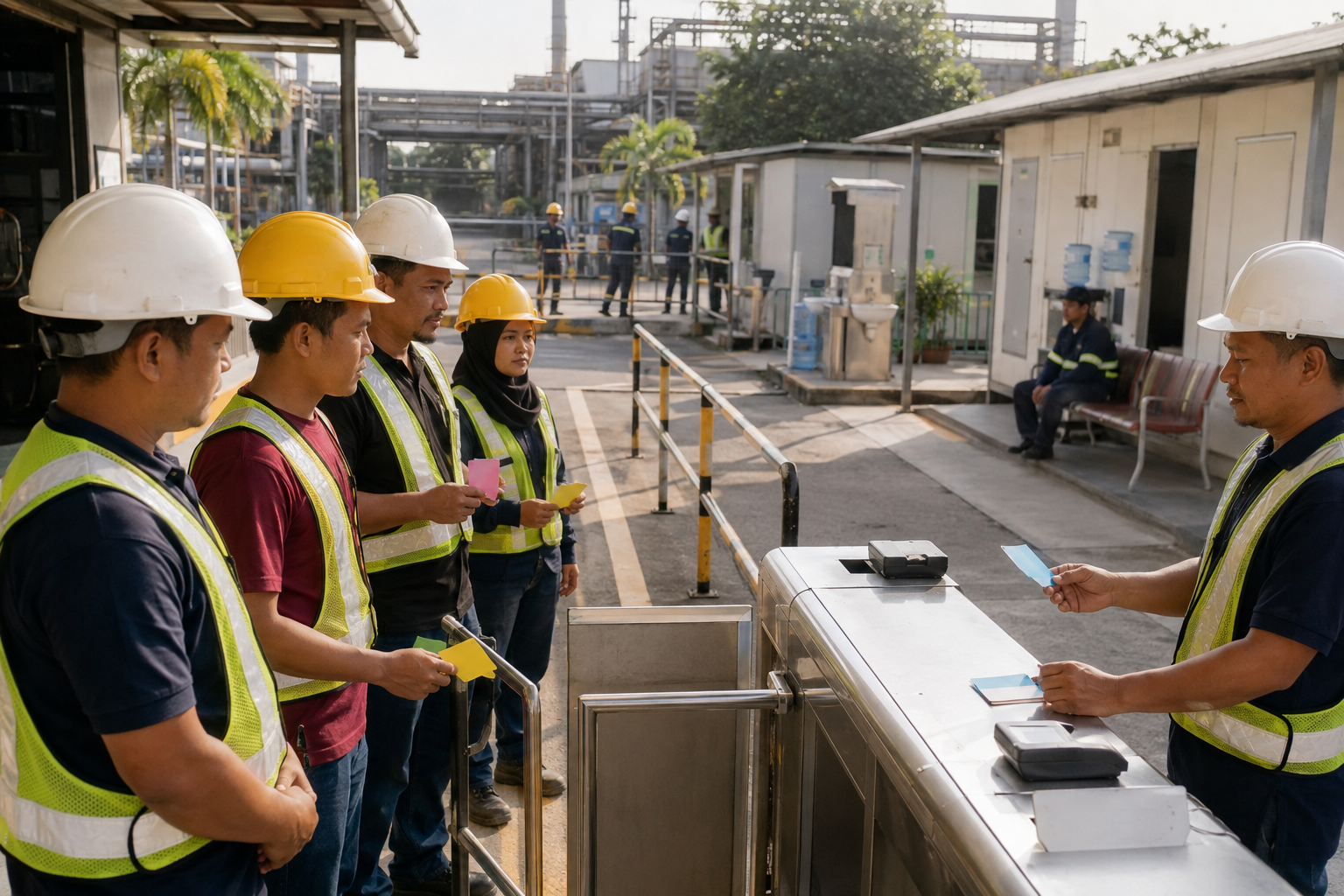
Six-slide briefing
The guideline at a glance
Slide 1 / 6
CDM 2026
Regulation 15(2)(e)
One system from the entrance
The PCWC connects site induction, authorised access and Second Schedule welfare throughout construction.
- Identify people
- Provide relevant information
- Provide facilities
Cards, signatures or cabins alone do not prove the system works.
Use the buttons, dots or left/right arrow keys. This briefing summarises the guideline; the article and official source remain the detailed references.
Quick answer
The principal construction work contractor (PCWC) must ensure that suitable site induction is provided, steps are taken to prevent unauthorised access, and welfare facilities comply with the Second Schedule throughout construction. These elements need to work as one system: a person is identified and authorised, understands site arrangements and hazards, uses the correct route, receives current instructions, and has suitable basic facilities that are maintained. An access card, induction signature or welfare cabin shown on a plan does not by itself establish compliance. The PCWC should inspect actual conditions, adapt arrangements when the workforce or site changes, and retain evidence that controls reached the people who needed them.
Legal basis and scope of this topic
Regulation 15(2)(e) uses the statutory term principal construction work contractor and requires the PCWC to ensure suitable site induction, necessary steps to prevent access by unauthorised persons, and facilities complying with the Second Schedule throughout construction. Regulation 15(1) places these requirements within the broader duty to plan, manage, monitor and coordinate construction, so far as is practicable.
DOSH guideline paragraph 120 says induction should be site-specific, explain work involving particular risks and the control measures people need to know. Its content considers the project and its management, emergency and first-aid arrangements, reporting of occupational accidents, dangerous occurrences and occupational diseases, continuing briefings, consultation, and workforce duties. The guideline also says every person entering the site for the first time should receive site induction.
Paragraphs 121–122 cover physical boundaries, steps to ensure that only authorised people enter, and special attention to rights of way, adjacent premises, occupied homes, schools, care homes, children and persons with disabilities. Paragraphs 123–124 emphasise suitable and sufficient welfare before work starts, maintained until project completion and reviewed as conditions change.
Regulation 17(1)(e)–(h) preserves construction work contractors' (CWCs') duties concerning skills, knowledge, training and experience; supervision, instructions and information; access; and the Second Schedule. PCWC coordination does not transfer every CWC duty to the PCWC. Nor does this article claim that one pass colour, induction duration, toilet ratio or entrance design suits every project. Requirements should be determined from the Regulations, the Second Schedule, risks, numbers and needs of users, and actual conditions.
Induction is not a one-off briefing
Induction provides an initial picture of the place, people, arrangements and emergency actions. It cannot replace task instruction, competence training, risk assessment, work methods or pre-work briefings. A delivery driver may need route, waiting-area and emergency instructions different from those needed by an electrician. A short-term visitor may be escorted but still needs information relevant to their exposure.
Use consistent core content, then tailor it to the site and audience. Explain boundaries between client operations and construction, pedestrian and vehicle routes, prohibited areas, assembly points, how to report an unsafe condition, and the location of first aid and welfare. For relevant particular risks, explain what that person needs to know and do; avoid burying essential instructions in unrelated technical detail.
Check understanding through questions or demonstrations, not signatures alone. Ask participants to identify their route or describe what they will do when an alarm sounds. Provide language support, visuals or delivery that the workforce can understand. Where an interpreter is used, check that critical messages were conveyed accurately. Record language support without assuming a person's ability from nationality.
When layout, emergency arrangements, materials, premises operations or risks change, decide who needs re-induction or an update. A small change may call for local instruction; a major route or emergency change may require broader communication. Distinguish initial induction, re-induction, change briefing and task instruction so the team can establish what information was actually received.
Site security is risk control, not only a gate guard
Start with a site boundary suited to the environment. Identify every entrance, shared route, temporary opening and period when control is reduced. Define authorised groups, the basis and duration of authority, who can approve it, and permitted areas. The process should cover workers, drivers, visitors, client personnel and emergency responders without obstructing escape routes.
Coloured passes can distinguish groups or zones, but colour is insufficient if gate personnel do not know its meaning or a side entrance remains open. Match identity to current authorisation, withdraw access when an appointment ends and manage lost passes. Do not display more personal information than necessary. Digital access needs fallback arrangements when power, networks or readers fail.
Inspect boundaries after work changes, weather or deliveries. Temporary fencing may be moved for plant and not restored. A public route or established right of way may cross or adjoin the site. At operating premises, factory personnel may be authorised for their workplace but not the construction zone. Coordination should produce routes, separation and escort arrangements understood by both operations.
Children, persons with disabilities and nearby occupants require particular consideration as paragraph 122 explains. Do not assume signage alone prevents entry. Check visibility, barrier continuity, possible after-hours access and environmental changes. Record findings and correct weaknesses before relying on the boundary.
Instructions and communication people can use
Build a simple matrix linking groups to information: general site induction, route instructions, zone rules, emergency actions, specific risks, changes and contacts. Define communication triggers such as first entry, employer or task change, layout alteration, a dangerous occurrence, or a new phase. This avoids placing everything into one long session that is hard to remember.
Supervisors should reinforce instructions at the workface. If route boards and spoken instructions conflict, review the work rather than expecting workers to choose. Keep versions consistent across the entrance, noticeboards, apps, CPP and briefings. Withdraw or clearly mark obsolete copies. Give night shifts and late-arriving contractors equivalent support, not merely a video with no opportunity to ask questions.
Do not use induction as universal release for all work. A person's capability, authority to enter and authority to perform a task are different decisions. An access pass permits entry to defined areas; it does not prove competence to operate plant, perform isolation or undertake particular high-risk work.
Welfare facilities: provide before work and maintain until completion
The Second Schedule covers sanitary conveniences, washing facilities, drinking water, changing rooms and lockers, and rest facilities. Read its detailed requirements when assessing suitability, sufficiency, access, ventilation, lighting, cleanliness, privacy and provision for men and women. The nature of the work can require showers. Drinking water should be identified, with suitable cups where it is not supplied through an upward jet.
Facilities should be available before construction starts and maintained until completion. An initial cabin inspection is insufficient. Define inspection ownership, frequency informed by use and risk, fault reporting, response times and temporary arrangements during repair. Check water, soap or other cleaning material, drying means, cleaning, lighting, ventilation, locks, drainage, seating and access conditions.
Provision should change with workforce numbers, shifts, gender, work location and project stage. Mobilisation can rapidly increase numbers; moved fencing can make the toilet route unsafe; a premises utility shutdown can interrupt water. The PCWC should liaise with other CWCs throughout construction. Do not assume client facilities are available without agreement, capacity, access and maintenance responsibilities.
Drinking, washing and rest facilities support health controls, but this article does not prescribe a health regime for each hazard. For specific substances or processes, check safety data sheets, health risk assessments and other applicable requirements. Do not place an eating area where dust or hazardous substances expose its users.
Fictional scenario: an operating factory in Pasir Gudang
This is a fictional training example, not an actual incident or approved site plan. A Pasir Gudang factory remains operational during utility refurbishment. Factory workers, construction contractors, delivery drivers and visitors share part of an entrance. The PCWC's review finds that new workers received general induction, but the construction route has changed and old cards can still open a side door near the work zone.
The team records action PG-22-01. The PCWC, CWCs and operations representative map user groups, arrival times and required zones. They establish a construction pedestrian route separated from factory traffic, a delivery waiting point, and review side-door access. Coloured passes are used as a local visual prompt, but identity checks and the current authorisation list remain necessary. The example does not make pass colours a DOSH standard.
Induction is updated with the current location plan, joint emergency arrangements, prohibited areas and welfare directions. Existing workers receive a change briefing, first-time entrants receive full induction, and drivers receive delivery-specific instructions and escorts where necessary. Supervisors ask a sample of participants to explain their route and emergency actions.
The welfare cabin is inspected before the shift. As workforce numbers increase, the team reviews sufficiency, cleaning, drinking water, washing and rest provision. A temporary welfare route is found to conflict with plant movement and is relocated before use. Actions close only after boundaries, access, communication and facilities are checked in the field. A later change reopens the assessment.
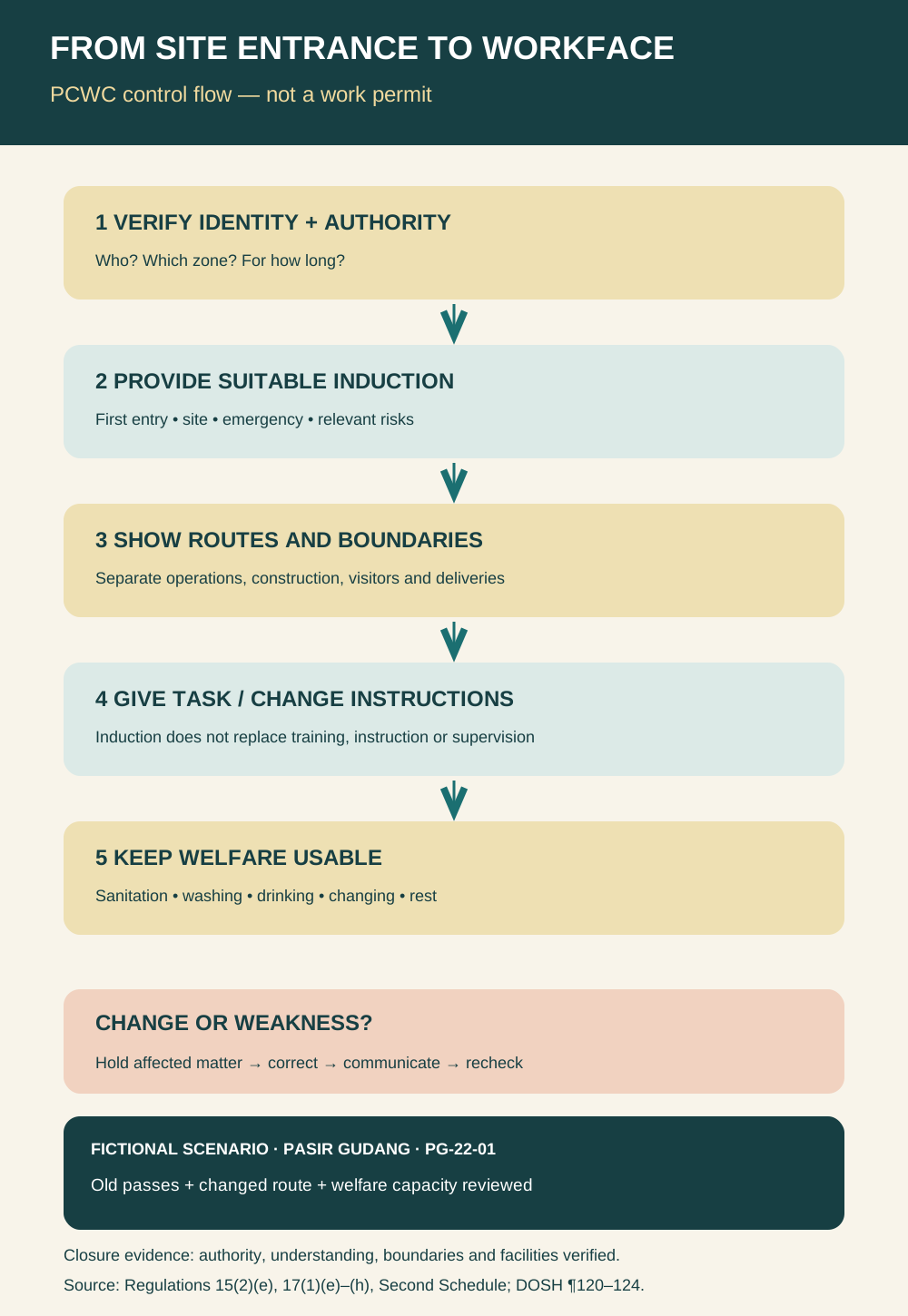
Infographic: a safe journey from entrance to workface
Evidence worth retaining
Structure evidence so a sample can be traced from entry authority to information received, permitted zones and follow-up. Sampling is more useful than merely counting cards or signatures. Check exceptions: who entered during a system failure, who was manually approved, and whether access was withdrawn. For welfare, connect inspections with complaints, repairs and field observations. Repeated defects can show unsuitable capacity, location or maintenance rather than only user carelessness. Records should allow the PCWC to establish the decision, its basis, who was informed and whether the outcome was verified.
- Scope and revision of induction material, date, presenter, participants and the method used to check understanding.
- Re-induction and change-briefing records showing the reason and affected group.
- Current boundary, entrance, zone, public or shared route and delivery plans.
- Authorisation, pass issue/return, visitor, escort, lost-pass and access-termination records, with personal data minimised.
- Inspections of fencing, gates, lighting, signs and routes, and correction evidence.
- Welfare assessment, inspection, cleaning, defect, complaint, repair and temporary-arrangement records.
- Reviews after changes to workforce, shift, layout, utilities or premises operations.
Set retention, access and disposal under applicable law and project requirements. This article does not invent one statutory retention period for every record.
Six common failures
- Using generic induction that omits current routes, site risks or emergency arrangements.
- Assuming an attendance signature proves understanding and competence.
- Controlling the main gate while side doors, temporary fencing or after-hours access remain weak.
- Leaving old cards active after workers or contractors leave the project.
- Providing welfare on mobilisation but failing to maintain or expand it when conditions change.
- Assuming client facilities are available without confirming agreement, access, sufficiency and maintenance responsibility.
PCWC checklist
- Is induction site-specific and at the current revision?
- Who is entering for the first time, changing task or affected by change, and what communication do they need?
- How is understanding, not merely attendance, checked?
- Are identity, authority, zone and access duration matched?
- Are all boundaries, side gates, shared routes and after-hours arrangements inspected?
- Do emergency access and escape routes remain functional?
- Are Second Schedule facilities suitable, sufficient, clean, accessible and maintained?
- Does provision reflect workforce size, shifts, gender, work nature and site changes?
- Do weaknesses have owners, risk-appropriate deadlines and closure evidence?
- Do CWCs, the client or premises operator receive and understand interface arrangements?
Primary references and next steps
Occupational Safety and Health (Construction Work) (Design and Management) Regulations 2024, DOSH: Regulations 15(1), 15(2)(e), 17(1)(e)–(h) and the Second Schedule. Primary explanatory reference: DOSH Garis Panduan CDM Edisi 2026, paragraphs 120–124, printed pages 58–59.
This is general guidance, not legal advice or a site-security design. Check project-specific requirements and the complete Second Schedule. Contact RIMAYS to discuss training, induction and site-document coordination.
Related articles

Garis Panduan CDM Edisi 2026
CDM 2026 · 29 of 52
Kestabilan Struktur: Kerja Sementara, Penyangga dan Urutan
Panduan Peraturan 21 untuk reka bentuk kerja sementara, laluan beban, pemeriksaan dan penanggalan terkawal.
Ir. Ts. Dr. Mohamad Syamir bin Senin.
Garis Panduan CDM Edisi 2026
CDM 2026 · 28 of 52
Aturan dan Sekuriti Tapak: Lindungi Pekerja dan Orang Awam
Panduan Peraturan 20 untuk kekemasan, kebersihan, pemagaran, penandaan serta kawalan antara muka awam.
Ir. Ts. Dr. Mohamad Syamir bin Senin.
Garis Panduan CDM Edisi 2026
CDM 2026 · 27 of 52
Tempat Kerja Pembinaan Yang Selamat: Akses, Tepi dan Bukaan
Panduan Peraturan 19 untuk mengawal akses, jalan keluar, tepi, bukaan lantai dan ruang kerja mengikut keadaan sebenar tapak.
Ir. Ts. Dr. Mohamad Syamir bin Senin.