
Garis Panduan CDM Edisi 2026
Part IV: Determining Who Controls Site Requirements
CDM 2026 · 26 of 52
Guidance for mapping actual control, coordinating responsibility and verifying Part IV requirements at construction sites.

Six-slide briefing
The guideline at a glance
Slide 1 / 6
CDM 2026
Regulation 18
Part IV follows effect and control
A CWC complies where requirements affect it, workers under its control or matters within its control.
- Test the facts
- Identify effect
- Record boundaries
A package name does not determine actual control.
Use the buttons, dots or left/right arrow keys. This briefing summarises the guideline; the article and official source remain the detailed references.
Short answer
Regulation 18 says Part IV applies to construction sites. A construction work contractor (CWC) carrying out construction work must comply with Part IV requirements so far as they affect the CWC or workers under its control, or relate to matters within the CWC's control. A package name or general contract clause therefore does not determine who must act. The project should identify actual control over place, people, plant, access, sequence and condition, then verify that action is implemented.
On a single-CWC project, that CWC cannot assume somebody else will manage site requirements. On a multi-CWC project, the PCWC coordinates the construction phase, but each CWC still complies with Part IV for matters affecting it, workers under its control or matters within its control. Coordination does not remove the CWC duty.
Legal basis and topic boundary
Regulation 18(1) says Part IV applies to construction sites. Regulation 18(2) defines the CWC's compliance scope through effect and control. Regulation 18(3) concerns a domestic client controlling how construction work is carried out by a person at work, so far as the matter is within the client's control. Paragraph 153 of DOSH's 2026 CDM Guidelines says Part IV compliance should refer to relevant regulations, industry codes of practice, recognised guidelines and construction-industry standards.
Part IV contains general requirements for all construction sites, beginning with Regulation 18. Later regulations set specific substantive requirements. Regulation 19, for example, addresses safe and sufficient access and egress, a site that is safe and without health risk, floor openings and adequate work space. This topic explains how to identify control ownership and implementation evidence. It does not replace review of every applicable Part IV regulation or other law.
Distinguish appointment, coordination and control
Appointment shows who receives a role or contract scope. Coordination connects parties and activities. Control is the real ability to make or implement a decision affecting conditions. The three can sit with different parties at one interface. A PCWC may coordinate site routes, a logistics CWC may control barriers in one zone, and another CWC may control plant crossing the route.
Ask factual questions: (1) who can open, close or alter the area; who directs workers; (2) who provides and maintains controls; (3) who holds current information; (4) who can stop use; and (5) who can correct the condition. Record multiple parties when control is shared. Do not name two parties “jointly responsible” without dividing decisions, actions and acceptance.
Control changes over time. A zone controlled by an earthworks CWC may be handed to a structural CWC, then become a shared route. The control matrix needs an effective stage or time, handover conditions and acceptance evidence. If handover has not been accepted, the project cannot assume control transferred because the programme shows a new date.
Map Part IV requirements to real conditions
List each area and activity: gate, pedestrian route, plant route, unloading place, openings, edges, work space, temporary structures, welfare area, storage and emergency routes. For each, state the applicable requirement, exposed people, party controlling the condition, maintainer, inspector, acceptance criteria and escalation route.
The map should show interfaces, not merely colour contract boundaries. A route can start in a PCWC zone, pass a mechanical CWC area and end on a platform controlled by a structural CWC. Safe condition depends on combined lighting, separation, housekeeping, capacity, surface condition and work change. Ownership of each element should be clear.
For matters affecting more than one CWC, the PCWC should coordinate overall arrangements through the construction phase plan (CPP), interface meetings, look-ahead programme and change communication. Each CWC should determine how those arrangements affect its workers and implement parts within its control.
Single-CWC projects
On a single-CWC project, the list of parties is shorter but the duty is not smaller. The CWC must plan, provide, maintain, monitor and correct Part IV requirements relevant to its work. If the premises owner controls access outside the work area or an existing system, document that interface. The CWC cannot leave a gap by assuming a building manager or supplier will act without clear agreement.
Before work, establish who has keys, who may close a route, who permits deliveries, who inspects the area and who responds after rain, supply interruption or work change. Ensure that person has authority and resources. A small contract or short duration does not make this unnecessary.
Multi-CWC projects
On a multi-CWC project, create an interface register connecting zones, activities and stages. Identify action owners for shared site controls and local control owners for each package. A PCWC may set traffic arrangements while a delivery CWC follows the route and controls its vehicle movement. A CWC creating an opening should manage protection within its control and coordinate before handing over the area.
PCWC instructions should be specific, usable and communicated to affected parties. A CWC should notify changes or failures that may affect others. When two activities require the same area, stop the conflict and decide sequence, separation owner and release conditions. Do not rely on meeting minutes that are not translated into barriers, access, instructions and inspection at the site.
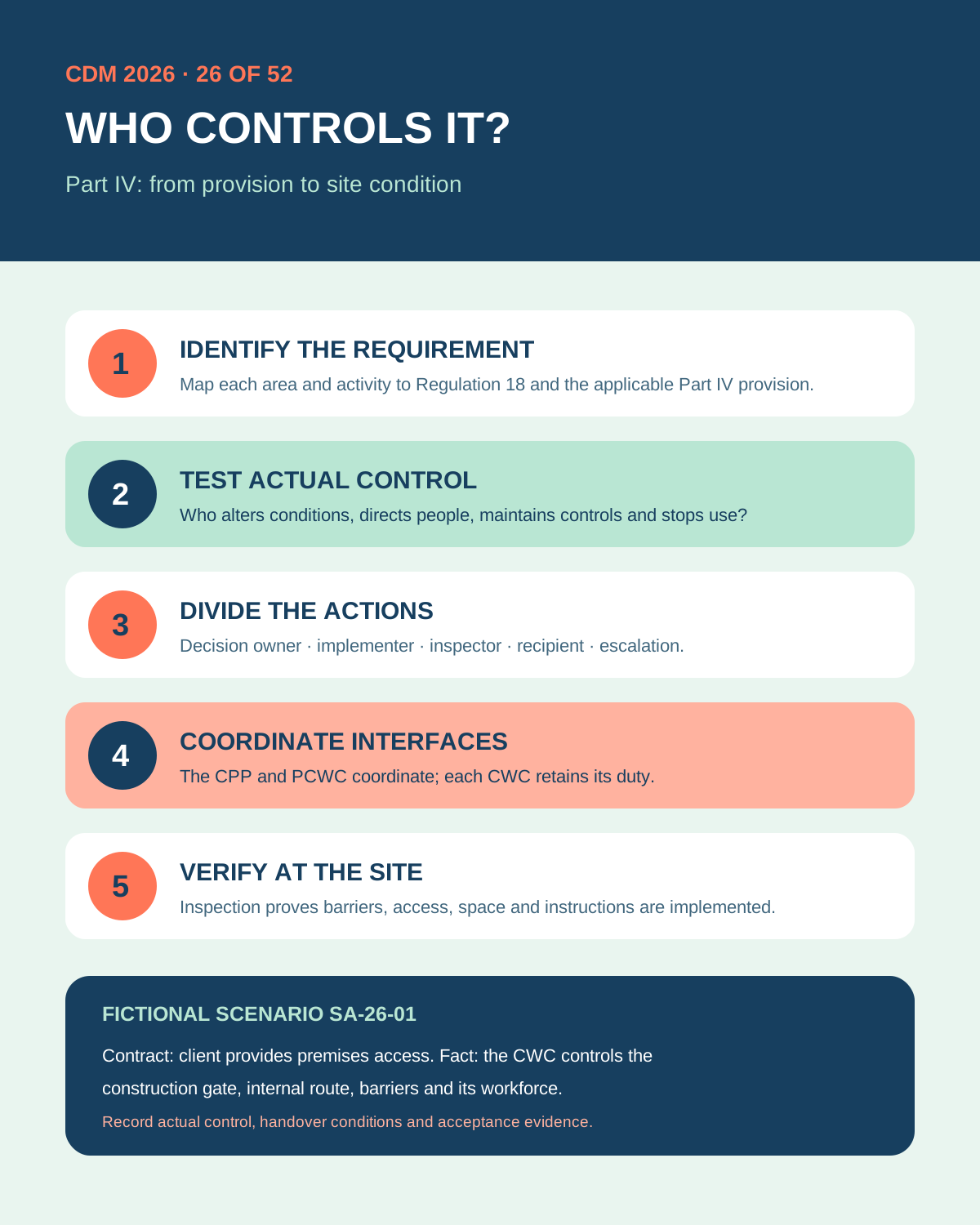
Fictional example: warehouse upgrade in Shah Alam
This is a fictional training example. It is not a real incident, statistic or legal conclusion. A warehouse in Shah Alam is upgraded by one CWC while client operations continue outside the construction area. The team opens control record SA-26-01 for the route from the premises gate to the workface.
The contract says the client provides premises access, but the CWC controls the construction-area gate, barriers, internal route and its workers' movement. The control map separates premises access from construction-site access. Client and CWC agree the handover point, delivery communication and action when the premises route changes. The CWC defines inspection for the part under its control and records corrections.
After material layout changes, the internal route space reduces. The supervisor stops deliveries to that zone, updates the map, moves storage and verifies the route before reuse. SA-26-01 closes after field conditions and instructions agree. The example shows that a contract sentence does not replace analysis of actual control.
Compliance actions
- Identify each Part IV requirement relevant to the site and work.
- Map who controls people, place, plant, information and change.
- Divide shared control into clear decisions and actions.
- Set stages, handover conditions and acceptance evidence.
- Coordinate interfaces through the CPP and PCWC arrangements on multi-CWC projects.
- Provide resources, authority, inspection and corrective action.
- Reassess when scope, layout, parties or conditions change.
- Verify implementation at the site, not in the matrix alone.
Evidence worth retaining
- Register of Part IV requirements mapped to provisions.
- Zone and route maps showing activities, exposed people and interfaces.
- Control matrix with decision owner, implementer, inspector and escalation.
- CPP, PCWC instructions, coordination minutes and acknowledgement.
- Inspection records, located photographs, findings, corrections and verification.
- Zone handover records with conditions and effective time.
- Layout, work, plant or party changes and reassessment records.
This article sets no universal retention period. Apply relevant law, contract and project systems.
Common failures
- Copying contract allocation without testing who controls the real condition.
- Assuming the PCWC performs every Part IV requirement for every CWC.
- Naming “all parties” without one action owner and recipient.
- Ignoring control changes during zone or stage handover.
- Producing a coloured map without acceptance criteria or field evidence.
- Allowing status records and site conditions to conflict.
- Closing findings when action is promised rather than verified.
Part IV control checklist
- Is every area and activity mapped to the applicable requirement?
- Who controls the condition and who controls exposed people?
- Who has authority and resources to correct the condition?
- Is shared control divided into specific actions?
- Does a single-CWC project recognise the CWC's own duty?
- Does PCWC coordination on a multi-CWC project preserve each CWC duty?
- Does zone handover have conditions, timing and acceptance?
- Does change trigger review of the map and CPP?
- Does inspection prove the real condition follows arrangements?
- Are actions closed only after implementation is verified?
Primary references
The primary reference is the Occupational Safety and Health (Construction Work) (Design and Management) Regulations 2024, DOSH, particularly Regulation 18 and applicable Part IV regulations. The explanatory reference is DOSH's 2026 CDM Guidelines, paragraph 153 and printed pages 69-70, read with later Part IV explanations. Contact RIMAYS to discuss site-control mapping for Malaysian projects.
Related articles

Garis Panduan CDM Edisi 2026
CDM 2026 · 29 of 52
Kestabilan Struktur: Kerja Sementara, Penyangga dan Urutan
Panduan Peraturan 21 untuk reka bentuk kerja sementara, laluan beban, pemeriksaan dan penanggalan terkawal.
Ir. Ts. Dr. Mohamad Syamir bin Senin.
Garis Panduan CDM Edisi 2026
CDM 2026 · 28 of 52
Aturan dan Sekuriti Tapak: Lindungi Pekerja dan Orang Awam
Panduan Peraturan 20 untuk kekemasan, kebersihan, pemagaran, penandaan serta kawalan antara muka awam.
Ir. Ts. Dr. Mohamad Syamir bin Senin.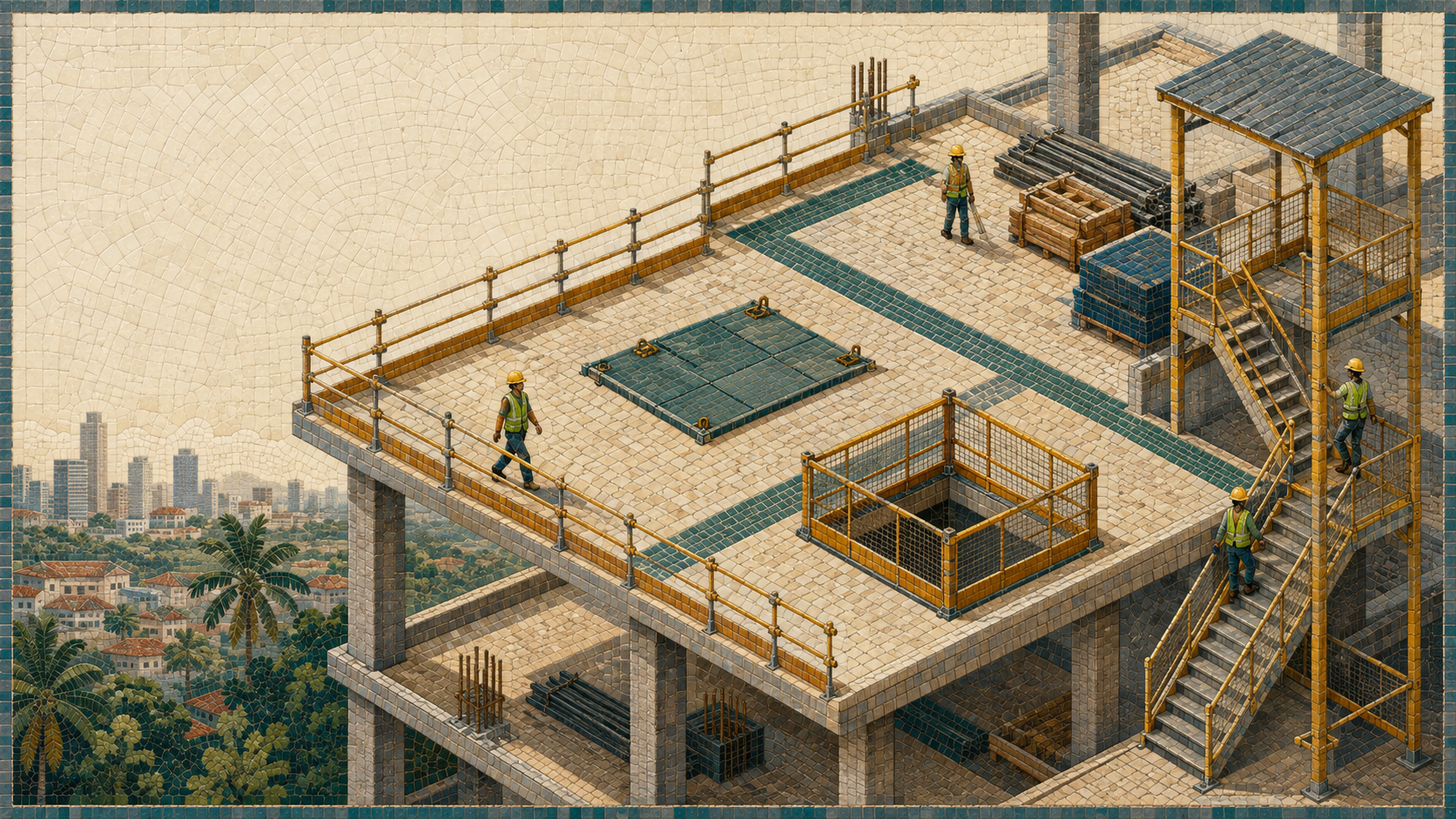
Garis Panduan CDM Edisi 2026
CDM 2026 · 27 of 52
Tempat Kerja Pembinaan Yang Selamat: Akses, Tepi dan Bukaan
Panduan Peraturan 19 untuk mengawal akses, jalan keluar, tepi, bukaan lantai dan ruang kerja mengikut keadaan sebenar tapak.
Ir. Ts. Dr. Mohamad Syamir bin Senin.