
Garis Panduan CDM Edisi 2026
PCWC 1: Planning, Managing, Monitoring and Coordinating the Site
CDM 2026 · 21 of 52
A PCWC guide to simultaneous work, resources, inspections and action closure supported by evidence of actual site conditions.

Six-slide briefing
The guideline at a glance
Slide 1 / 6
CDM 2026
Regulation 15(1)
Manage construction, not just documents
The PCWC plans, manages and monitors construction and coordinates safety and health, so far as is practicable.
- Sequence and location
- Resources and supervision
- Verified implementation
Controls must match actual conditions.
Use the buttons, dots or left/right arrow keys. This briefing summarises the guideline; the article and official source remain the detailed references.
Quick answer
The principal construction work contractor (PCWC) does not fulfil its role simply by preparing a construction phase plan or collecting contractors' reports. Regulation 15(1) requires the PCWC to plan, manage and monitor the construction phase and coordinate safety and health matters to ensure, so far as is practicable, that work is carried out without risks to safety and health. In practice, decisions about sequence, location, resources and simultaneous activities must become verifiable controls. When conditions change or controls fail, the team must act, review arrangements and verify corrections before affected work continues. Evidence should show what happened on site, not merely what was planned.
Why each contractor's controls are not enough
On a site with several work packages, one activity can change conditions for another party. Welding may be well planned by one contractor, but another contractor's delivery of flammable materials can make the area unsuitable. Work overhead can affect people below even when both supervisors hold their own method statements.
The problem is not simply missing documents. Information about timing, location, control boundaries and changes does not necessarily reach decision-makers. The PCWC must bring that information together and resolve conflicts. A coordination meeting that records progress without safety decisions does not close this gap.
At premises that remain operational, the client's employees, visitors and the public may also be affected. Emergency routes, energy supplies, deliveries and maintenance access may be shared. Responsibilities therefore need clear boundaries, but those boundaries must not become an excuse to ignore effects on adjacent areas. Coordination must connect the project manager, package supervisors and premises operator.
Legal basis and limits of the role
The statutory role is the principal construction work contractor. Regulation 7 addresses appointment where more than one construction work contractor is involved or reasonably foreseeable. The role concerns control and coordination of the construction phase, not merely a name on an organisation chart.
Regulation 15(1) retains the qualification so far as is practicable. This article does not turn it into a guarantee that every risk can be eliminated. Equally, the qualification is not a reason to accept unimplemented controls or leave work conflicts unresolved.
Regulation 15(2)(a) requires consideration of the general principles of prevention when deciding design, technical and organisational aspects of simultaneous or successive work, and estimating the time needed for completion. Regulation 15(2)(b)–(d) covers contractor cooperation, coordination of legal compliance, the general principles of prevention, Part IV and, where required, the construction phase plan. Regulation 15(2)(f) requires cooperation and relevant information sharing with the principal construction work designer (PCWD).
Regulation 15 also covers induction, prevention of unauthorised access and welfare facilities. These remain PCWC duties even though this article concentrates on the management and coordination cycle. Regulation 17(1)(b)–(c) preserves contractors' duties for their own work, applicable instructions and relevant parts of the construction phase plan. PCWC coordination does not remove other contractors' duties.
Paragraphs 110–119 of the DOSH guideline explain planning, resources, supervision and monitoring. The operational steps below are practical management methods; they do not claim that legislation mandates one application, permit form or uniform daily meeting for every project.
Eight steps connecting the plan with actual work
- Define responsibility and decision authority. Name the parties coordinating areas, reviewing schedule conflicts, controlling access and verifying corrections. Establish escalation for issues supervisors cannot resolve themselves. Ensure that project arrangements make the authority to stop unsafe activities understood, including who assesses conditions for resuming work. Avoid a situation where everyone can sign a form but nobody owns the decision. Check cover during leave and shift changes. This recommended management approach must match the organisation and actual duties; it does not transfer the PCWC's entire responsibility to a safety officer.
- Build a time-and-location picture of the work. Combine contractors' programmes with the current site layout, storage areas, traffic routes and premises operations. Identify activities that can affect each other, including successive work leaving hazards for the next team. Review changes so meetings do not become reports about yesterday alone. For each overlap, record the decision: eliminate the hazardous activity where possible, change the method, separate time or location, or establish suitable additional controls. Do not assume that two colours on a plan demonstrate effective separation. Boundaries and actual conditions must be checked.
- Match resources to the controls required. Review supervision, workforce capability, plant, equipment, preparation time and technical assistance. A programme allowing only for the main activity can omit barrier installation, energy isolation, inspection and area reinstatement. If resources are unavailable, change arrangements before work starts; do not replace necessary controls with an instruction to “take extra care”. Guideline paragraphs 112–114 emphasise effort proportionate to project size, progress and risks, and the capability of appointed parties. Resource reviews should concern actual activities rather than monthly headcount alone.
- Turn the construction phase plan into usable instructions. Link the construction phase plan (CPP) to relevant risk assessments, work methods, location plans and project rules. Identify revisions and where documents can be obtained. Explain changes to supervisors and workers in a language they understand, then check understanding through questions about actual actions. Attendance at a briefing does not necessarily demonstrate comprehension. If the project uses work permits, ensure that each permit addresses specific conditions and activities. A permit is a control tool within suitable arrangements; a signature does not automatically make an area safe or replace inspection of the conditions to which it applies.
- Resolve conflicts before releasing an activity. Package supervisors must share changes to deliveries, materials, methods, energy and work areas. The PCWC determines coordination actions with relevant parties rather than simply telling each contractor to manage its own problem. Where a decision needs design review, obtain input from the PCWD and relevant designers. Do not make structural-capacity or technical-isolation decisions beyond the team's capability. Record outstanding verification and affected work. At operating premises, involve a client representative who can confirm operational conditions instead of assuming equipment stops after office hours.
- Inspect implementation at the workface. Select checks around risks, changes and previous control failures. Look for clear routes, correctly positioned barriers, separation of incompatible activities and workers using current information. Ask supervisors what would trigger stopping or reviewing the work. Combine physical inspection with document checks; either alone can give an incomplete picture. Paragraph 117 distinguishes proactive and reactive approaches. Preventive checks should not wait for an incident, while incident investigations should produce more effective controls rather than merely identify someone to blame.
- Close actions with evidence and verification. Each finding should state the location, condition, risk, immediate action, responsible party and required outcome. Deadlines must suit the risk; an action needed before an activity cannot be deferred simply because the next meeting is distant. Review correction evidence and actual conditions before marking closure. Distinguish “material ordered”, “installed” and “verified as functioning”. If findings recur, examine management causes such as sequence, procurement, supervision or communication. Repeating the same briefing without addressing the cause may not improve control.
- Review again when conditions change. Design, weather, workforce, premises operations, access or delivery changes can invalidate earlier decisions. Assess effects on other parties, review the CPP under Regulation 13(4), update relevant documents and explain revisions before affected work continues. Ensure the next shift receives current conditions, not just a list of completed tasks. Information relevant to the PCWD must be shared through a clear route. This cycle continues throughout construction; closing one action does not mean that no residual risk remains or that monitoring is no longer needed.
Evidence that management actually happened
Use a coordination register linking activities, locations, affected parties, decisions and evidence. Useful records can include the controlled CPP, risk assessments, method statements, combined programmes, area plans, action-focused minutes, briefings, inspections and correction verification. Retain original-document references so decisions remain connected to their technical basis.
Photographs need time, location and inspection context. One barrier photograph does not prove that every route is controlled. Likewise, a “no issues” report needs a clearly defined inspection scope. Record areas or activities not inspected and follow-up action rather than suggesting that the entire site has been verified.
For changes, retain the reason, risk review, consulted parties, decision, new revision and communication method. Set access and retention according to relevant project and legal requirements. This article does not prescribe one statutory retention period for every record. Protect personal information and avoid putting unnecessary worker data on an action board accessible to everyone.
Illustrative scenario: hot work and material delivery in Shah Alam
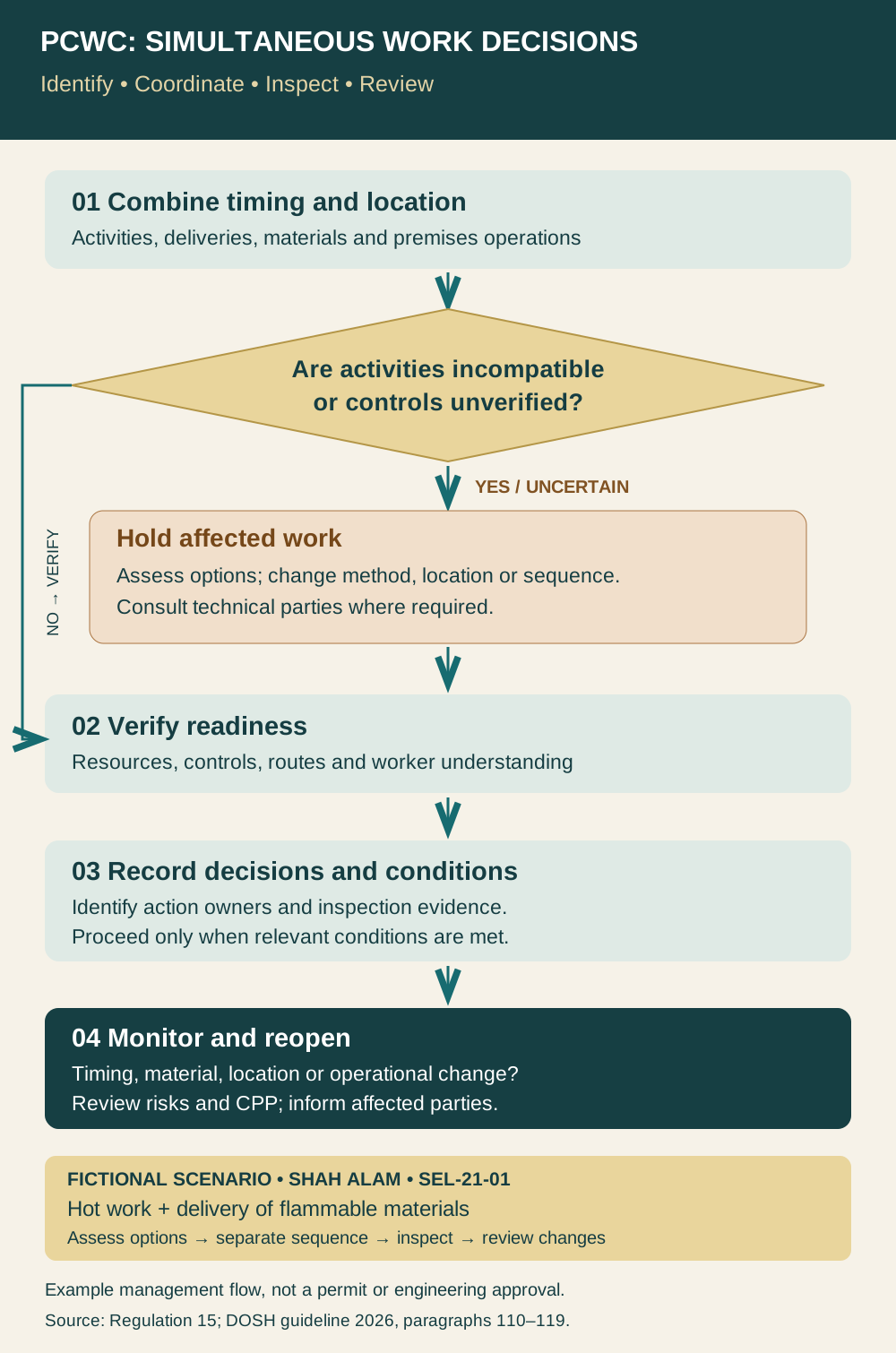
The following is a fictional training example, not an actual incident or approved work plan. A warehouse extension in Shah Alam involves steel installation and finishing work while part of the premises remains operational. The steel contractor proposes hot work, meaning activities such as welding that produce heat or sparks. During the same period, the finishing contractor plans delivery of materials identified as flammable through relevant product information.
During a combined-programme review, a supervisor notices that the proposed delivery holding area is near the hot-work area. The team does not assume that an earlier hot-work permit remains sufficient. The PCWC asks both contractors and the premises operations representative to review options, including methods avoiding hot work at that location, relocation of the work area and sequence changes.
In this example, the team chooses separate sequencing and a storage area assessed as suitable. The logistics supervisor changes the route and material-receiving arrangements. The hot-work supervisor reviews activity arrangements with relevant technical parties, including flammable materials, openings, adjacent spaces, monitoring and emergency response. This example sets no universal separation distance or monitoring period; activity-specific assessment, product information and applicable requirements determine those details.
Before the activity is released, a site check confirms that the delivery has not entered the affected area, emergency access remains available and the team understands the changes. Decisions and conditions reach the people receiving the delivery, not just the steel supervisor. When delivery timing changes again, the coordination decision is reopened. The board's plan is not treated as overriding actual site conditions.
The example record can use action identifier SEL-21-01. Record the location, two overlapping activities, reason for incompatibility, sequence decision, action owners and inspection evidence. Closure is recorded only after the required outcome is verified. If evidence is insufficient, the status remains open and dependent work is not treated as released. This is a recommended management workflow, not an official DOSH permit number or standard.
Infographic: decisions before simultaneous work
Five easily missed failures
- Assuming that each contractor's own risk assessment has already resolved risks between work packages.
- Using a progress programme that omits locations, deliveries or adjacent premises activities.
- Closing findings on promises or old photographs without verifying the outcome.
- Passing every issue to the safety officer when the decision needs resources, sequencing or design review.
- Updating the office CPP while supervisors, workers and the next shift use obsolete information.
Checklist for meetings and site inspections
- Which activities could affect others today or at the next stage?
- Have timing, location, resources and control boundaries been coordinated with relevant contractors?
- Were the general principles of prevention considered before relying on instructions and personal protective equipment?
- Who decides when conditions change, and who must be informed?
- Do the CPP, risk assessments, methods and location plans describe the same current conditions?
- Do workers understand controls and what to do when those controls are unavailable?
- What evidence demonstrates that corrections have been implemented and are effective?
- Have matters needing PCWD or technical specialist input been referred before the relevant work?
Start a useful review without adding bureaucracy
Choose one high-risk interface to test at the next project meeting. Ask two supervisors to explain their activities, then compare location, timing, energy, materials and access. Where answers conflict, record the required decision and who will resolve it. This is more useful than adding unread forms or measuring success by the number of signatures alone.
Adapt the method to project scale. A small site may use a printed plan and simple action register; a larger site may need a digital system and area coordinators. Both should produce clear decisions, information reaching its users and evidence of implementation. Sophisticated systems do not replace the capability of those exercising judgment. Use inspection findings to improve subsequent planning, including preparation time and resources that have previously been inadequate.
Primary references and next steps
Occupational Safety and Health (Construction Work) (Design and Management) Regulations 2024, DOSH: Regulations 7, 13(4), 15, 17(1)(b)–(c) and the First Schedule. Primary explanatory reference: DOSH Garis Panduan CDM Edisi 2026, paragraphs 110–119, printed pages 54–58; Regulation 15 text on pages 55–56.
This is general guidance, not legal advice, a work permit or technical certification. Check activity-specific requirements before selecting controls. Contact RIMAYS to discuss training and project-document coordination.
Related articles

Garis Panduan CDM Edisi 2026
CDM 2026 · 29 of 52
Kestabilan Struktur: Kerja Sementara, Penyangga dan Urutan
Panduan Peraturan 21 untuk reka bentuk kerja sementara, laluan beban, pemeriksaan dan penanggalan terkawal.
Ir. Ts. Dr. Mohamad Syamir bin Senin.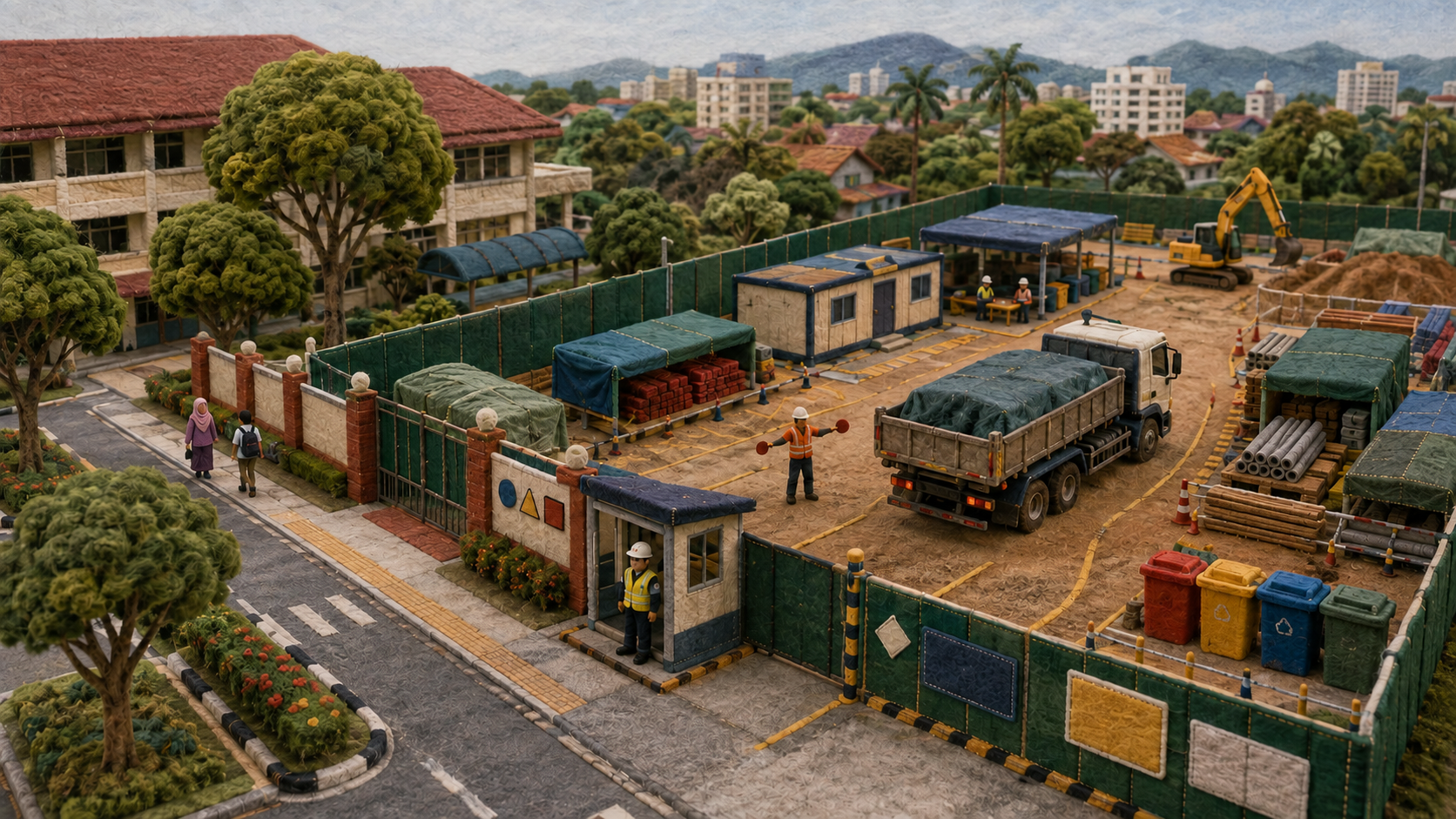
Garis Panduan CDM Edisi 2026
CDM 2026 · 28 of 52
Aturan dan Sekuriti Tapak: Lindungi Pekerja dan Orang Awam
Panduan Peraturan 20 untuk kekemasan, kebersihan, pemagaran, penandaan serta kawalan antara muka awam.
Ir. Ts. Dr. Mohamad Syamir bin Senin.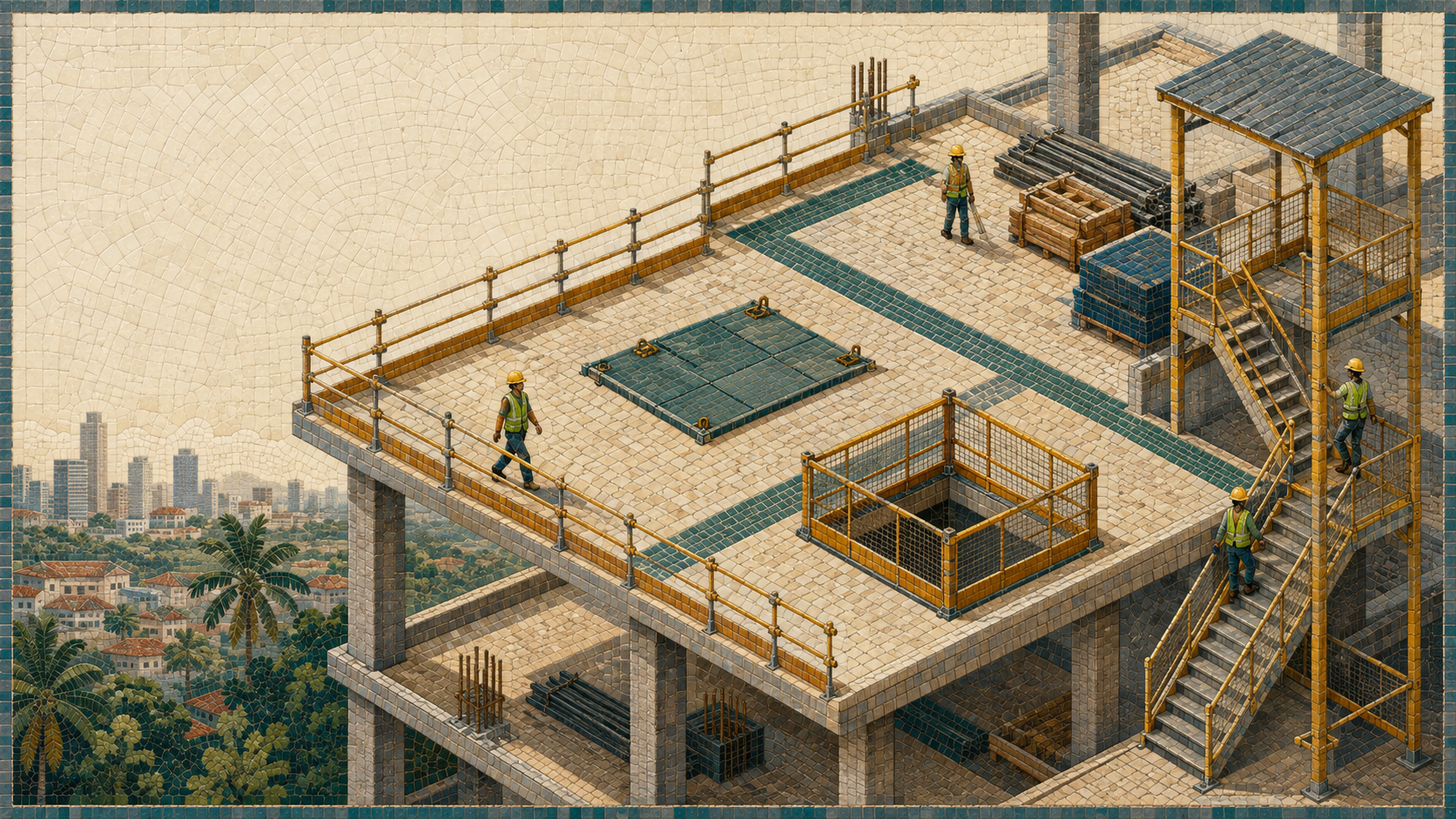
Garis Panduan CDM Edisi 2026
CDM 2026 · 27 of 52
Tempat Kerja Pembinaan Yang Selamat: Akses, Tepi dan Bukaan
Panduan Peraturan 19 untuk mengawal akses, jalan keluar, tepi, bukaan lantai dan ruang kerja mengikut keadaan sebenar tapak.
Ir. Ts. Dr. Mohamad Syamir bin Senin.