
Garis Panduan CDM Edisi 2026
Cofferdams and Caissons: Design, Water and Rescue
CDM 2026 · 33 of 52
Regulation 25 guidance for PEPC design, water monitoring, pumps, access, inspection and rescue.
SIX-SLIDE BRIEFING
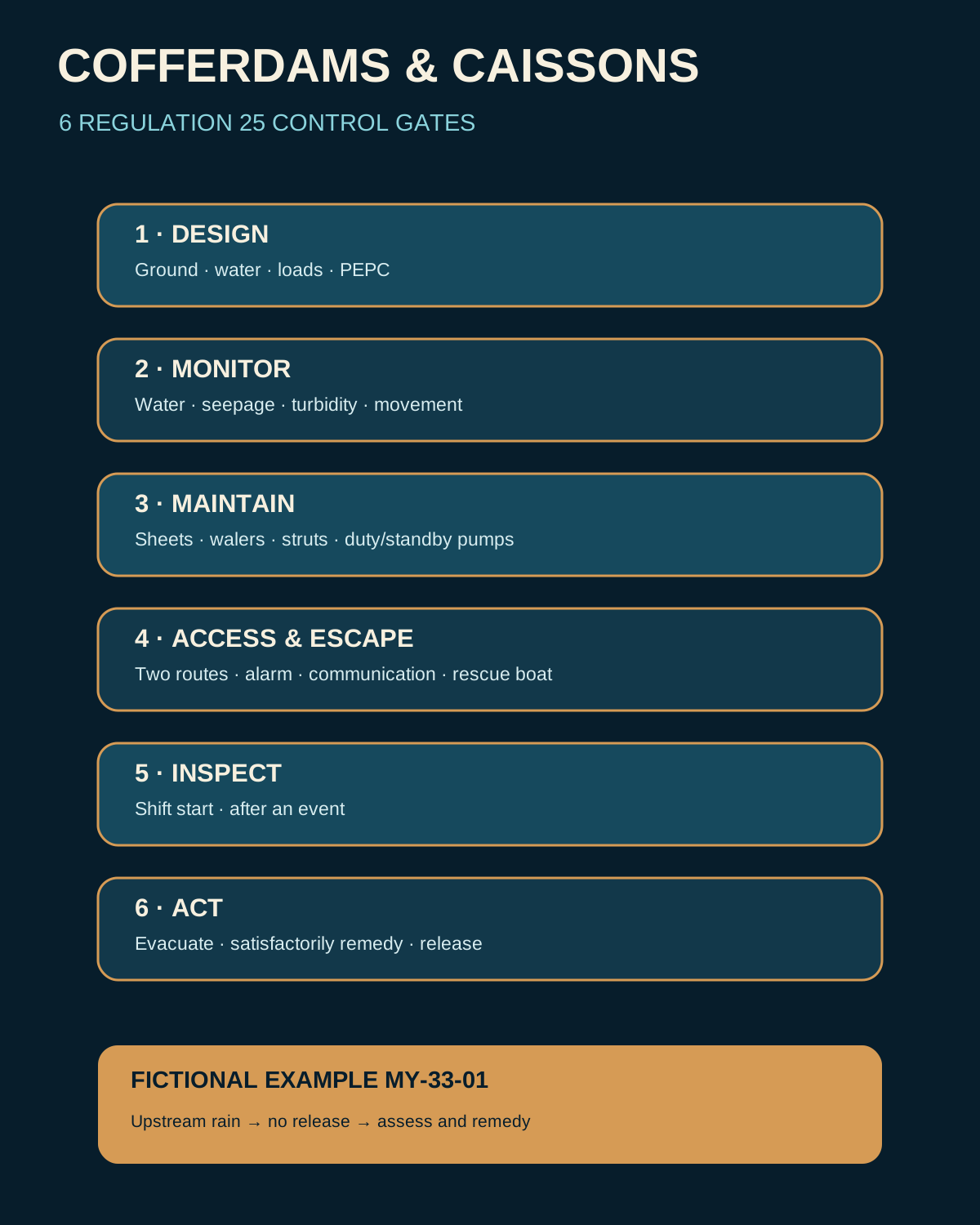
Cofferdam controls at a glance
Slide 1 / 6
Regulation 25
Design and construct suitably
Ground and water · PEPC check · Operating limits
Control drawings and change.
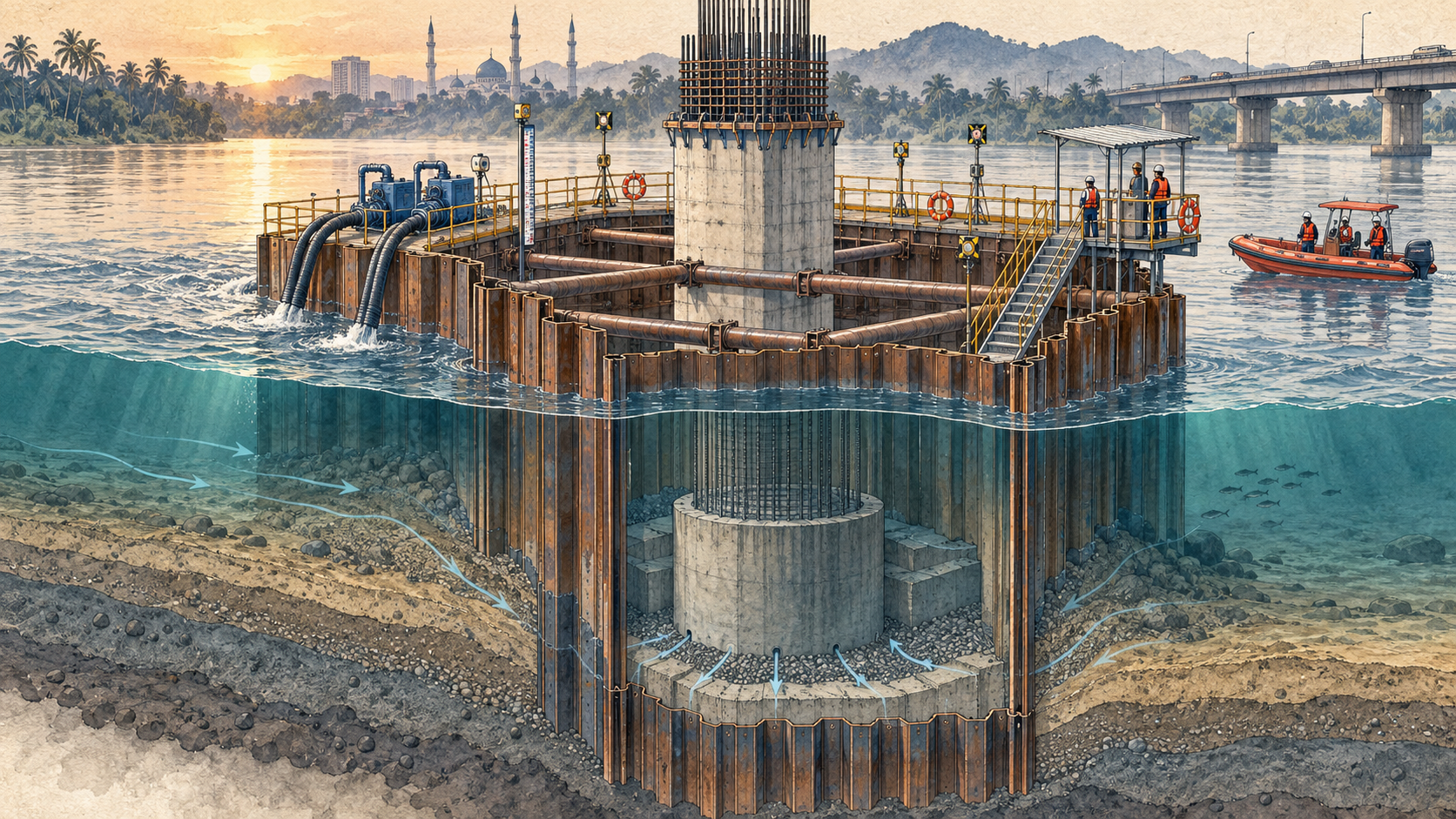
Cofferdams and caissons allow work in or beside water, but their safety depends on connected design, construction, maintenance and inspection controls. River level, seepage, scour, sheet-pile movement, pump failure or floating debris can change conditions quickly.
Exact requirements of Regulation 25
Regulation 25(1) requires a cofferdam or caisson to be of suitable design and construction; suitably equipped so workers can gain shelter or escape if water or material enters; and properly maintained. It cannot be used for construction work unless the cofferdam or caisson, and plant and objects that could affect its safety, have been inspected by the designated person at the start of the shift and after any event likely to affect its strength or stability.
The designated person must be satisfied that construction work can safely proceed. Where dissatisfaction concerning Regulation 25(1) is reported, construction work may not proceed inside until the matter has been satisfactorily remedied. DOSH Guideline paragraphs 176–178 state that the CWC should establish a safe work procedure from its risk assessment covering construction, maintenance and an emergency action plan; the design should be checked and certified by a Professional Engineer with Practising Certificate (PEPC).
Treat design as a temporary-works system
Give the designer adequate geotechnical and hydrological information: ground profile, water levels, tidal or river range, current, scour potential, plant loads, work sequence and neighbouring structures. Design should address penetration, sheet piles, walers, struts, connections, base stability, uplift, piping and conditions during installation and removal. State operating limits, movement tolerances, dewatering, inspection and stop-work triggers.
Site changes such as cutting a strut, moving a pump, adding a crane or deepening excavation are not minor adjustments. Assess their effect and obtain design confirmation before implementation. Control drawings so the team works from the latest revision.
Control water, seepage and stability
Monitor external and internal water levels, seepage rate, turbidity, structural movement, settlement and base condition. Increased seepage carrying soil may indicate piping; do not merely add pumping capacity without investigating the cause. Protect discharge so it does not erode banks or return water to the workplace.
Provide duty and standby pumps with suitable power. Test auto-start, high-level alarms, hoses, valves and fuel. Capacity should follow credible inflow and failure scenarios defined by design, not a universal assumption. After heavy rain, rising river level, vessel or debris impact, power interruption, seepage change or movement beyond limits, evacuate where necessary and reinspect.
Access, isolation and safe work
Provide stable guarded access and egress that does not rely on one route vulnerable to flooding. Control open edges, falling materials, lifting and plant movement. Restrict entry to briefed people. Where confined spaces, compressed-air caissons or hazardous atmospheres may exist, determine the specific legal and technical controls that apply; Regulation 25 does not replace atmospheric or diving controls.
Coordinate work with weather forecasts, upstream releases, river traffic and relevant authorities. Identify who monitors conditions, who can order evacuation and how alarms are communicated over plant noise.
Rescue must be workable
The emergency action plan must be location-specific. Define evacuation triggers such as high water, loss of both pumps, movement beyond limits, strut failure or loss of access. Provide alarms, communications, emergency lighting, lifebuoys, personal flotation devices and a rescue boat where risk assessment requires them. A boat needs a competent operator and a practical launch route.
Drills should test escape, headcount, plant shutdown and external-team communication. Rescuers must not enter an unstable structure or hazardous water without a suitable system. Record lessons and close gaps before work resumes.
Fictional example MY-33-01
Fictional example — not a real incident, statistic or legal conclusion.
A river-pier project in Johor uses a sheet-pile cofferdam. Its PEPC-certified design specifies two duty pumps, one standby pump, high-level alarm, movement targets and a rescue boat. After upstream rain, seepage increases and one target approaches its alert limit. The designated person does not release the shift. The CWC evacuates, increases monitoring and obtains designer assessment. A pump connection is repaired and approved reinforcement installed. Work resumes only after a recorded inspection and the matter is satisfactorily remedied.
Compliance actions
- Complete risk assessment and obtain ground, water and load data.
- Obtain a design checked and certified by the PEPC.
- Define limits, instrumentation, monitoring frequency and actions.
- Provide duty/standby pumps, power, alarms and safe discharge.
- Establish procedures for construction, maintenance and change.
- Provide access, shelter or escape equipment and an emergency plan.
- Appoint the designated person and inspect at statutory triggers.
- Stop work until dissatisfaction is satisfactorily remedied.
Evidence to retain
Retain ground and hydrology reports; design, calculations and PEPC certification; controlled drawings; risk assessment; safe work procedure; emergency action plan; installation records; water-level, seepage and movement logs; pump, power and alarm tests; weather records; designated-person appointment; inspection reports; defects, stop instructions and close-out evidence; briefings and rescue drills.
Common failures
- Treating extra pumping as a substitute for investigating seepage.
- Altering struts or sequence without designer confirmation.
- Having no genuinely tested standby pump or power.
- Relying on one escape route vulnerable to flooding.
- Recording readings without action limits or ownership.
- Missing reinspection after rising water or impact.
- Providing a boat without operator, launch access or drill.
- Signing an inspection report without actual observation.
Supervisor checklist
- Are current design drawings and limits available?
- Are struts, walers, connections and sheet piles sound?
- Are water, seepage, turbidity and movement normal?
- Have duty/standby pumps and alarms been tested?
- Are access, guards and escape routes clear?
- Have weather, current, plant and load changes been assessed?
- Are rescue equipment and people ready?
- Is the shift or post-event inspection complete?
- Has every dissatisfaction been satisfactorily remedied?
Primary JKKP/DOSH references
Refer to Regulation 25, P.U. (A) 147/2024, the *CDM Guidelines, First Edition 2026*, paragraphs 176–178, and the 2017 DOSH construction-industry excavation guideline. This article does not replace project-specific design or site assessment.
Related articles
Garis Panduan CDM Edisi 2026
CDM 2026 · 32 of 52
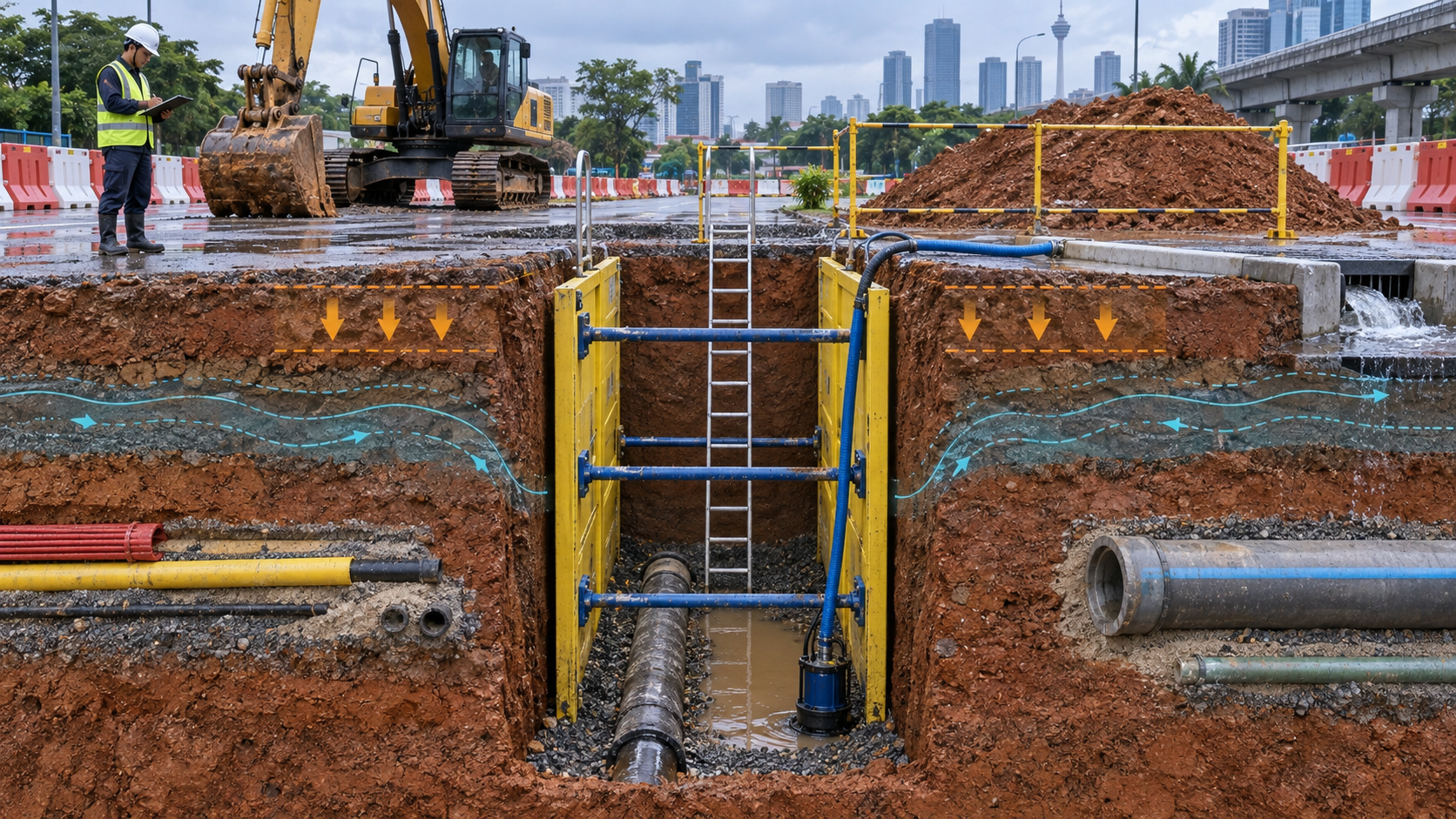
Pengorekan: Cegah Runtuhan, Air dan Kerosakan Utiliti
Panduan Peraturan 24 untuk utiliti, sokongan, air, beban tepi, akses dan pemeriksaan sebelum masuk.
Ir. Ts. Dr. Mohamad Syamir bin Senin.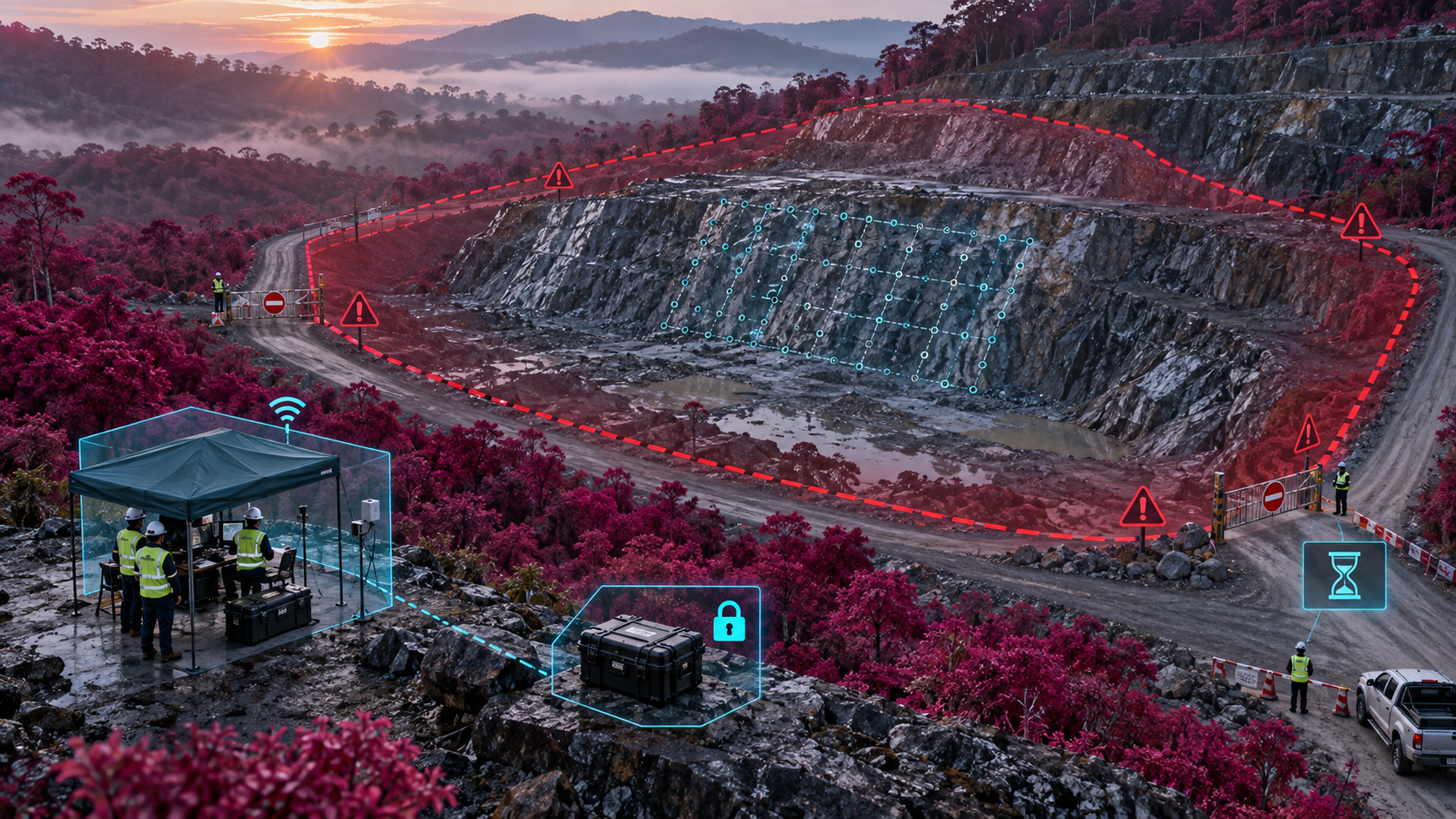
Garis Panduan CDM Edisi 2026
CDM 2026 · 31 of 52
Bahan Letupan: Kawalan Daripada Stor Hingga Misfire
Panduan Peraturan 23 untuk kuasa, inventori, pengangkutan, perimeter, firing, pelepasan dan misfire.
Ir. Ts. Dr. Mohamad Syamir bin Senin.
Garis Panduan CDM Edisi 2026
CDM 2026 · 30 of 52
Perobohan: Survei, Pengasingan dan Urutan Selamat
Panduan Peraturan 22 untuk survei, pengasingan utiliti, kestabilan, zon larangan dan perkiraan bertulis.
Ir. Ts. Dr. Mohamad Syamir bin Senin.