
Garis Panduan CDM Edisi 2026
Safe Construction Workplaces: Access, Edges and Openings
CDM 2026 · 27 of 52
Regulation 19 guidance for controlling access, egress, edges, floor openings and working space against actual site conditions.
Six-slide briefing
The guideline at a glance
Slide 1 / 6
CDM 2026
Regulation 19
Check the complete journey
Access and egress must be safe, suitable and sufficient from the site to provided places and between workplaces.
- Gate to workface
- Emergency routes
- Welfare facilities
The plan must follow actual journeys.
Use the buttons, dots or left/right arrow keys. This briefing summarises the guideline; the article and official source remain the detailed references.
Regulation 19 brings together several site fundamentals that must exist in practice: safe access and egress, a site that is safe and without risks to health, protection of floor openings, prevention of access to non-compliant areas, and adequate working space. Compliance is not achieved merely by drawing a route on a plan. The construction work contractor (CWC) needs to define acceptance conditions, inspect actual conditions and respond when the layout changes.
What Regulation 19 actually requires
Regulation 19(1) requires a CWC, so far as is practicable, to provide safe, suitable and sufficient access and egress. Its scope covers the connection from every construction site to every other place provided for the use of people at work, and from every construction workplace to every other place within the site to which workers have access. The review therefore cannot stop at the main gate. Routes to the site office, canteen, rest area, work platform and working levels also matter.
Regulation 19(2) requires a construction site, so far as is practicable, to be made and kept safe for, and without risks to the health of, people at work there. “Kept” matters: a route that was safe in the morning may no longer be safe after a material delivery, rain, excavation work or scaffold alteration.
Regulation 19(3) requires every floor opening that could expose a person to a risk of falling to be suitably and sufficiently guarded. Regulation 19(4) requires action, so far as is practicable, to ensure that nobody uses access or egress, or gains access to a site, that does not meet paragraphs (1), (2) or (3). Regulation 19(5) requires sufficient working space, suitably arranged, taking account of plant likely to be used.
Start with actual journeys
An access plan should follow how people travel, not merely contractual boundaries. Mark gates, registration points, pedestrian routes, vehicle crossings, stairs, material lifts, platforms, emergency routes, welfare facilities and assembly points. For every journey, record users, time of use, level changes, surface conditions, lighting, likely interference and the party able to correct a condition.
The route must be wide enough for its real use. When workers carry long materials, turning space and distance from an edge need assessment. Where moving plant shares an area, define physical separation, controlled crossing points and communication arrangements. Floor paint or arrows alone do not remove a collision interface. The CWC should select controls that can be observed and verified in the field.
Paragraphs 154–156 of the DOSH Guidelines explain unobstructed access, suitable working space, early planning, clear marking, lighting, access for all, inspection and maintenance, training and communication. Entry and exit records or head counts also support emergency accountability. These measures need to be proportionate to the project’s size, phase and risks.
Control edges and openings as a system
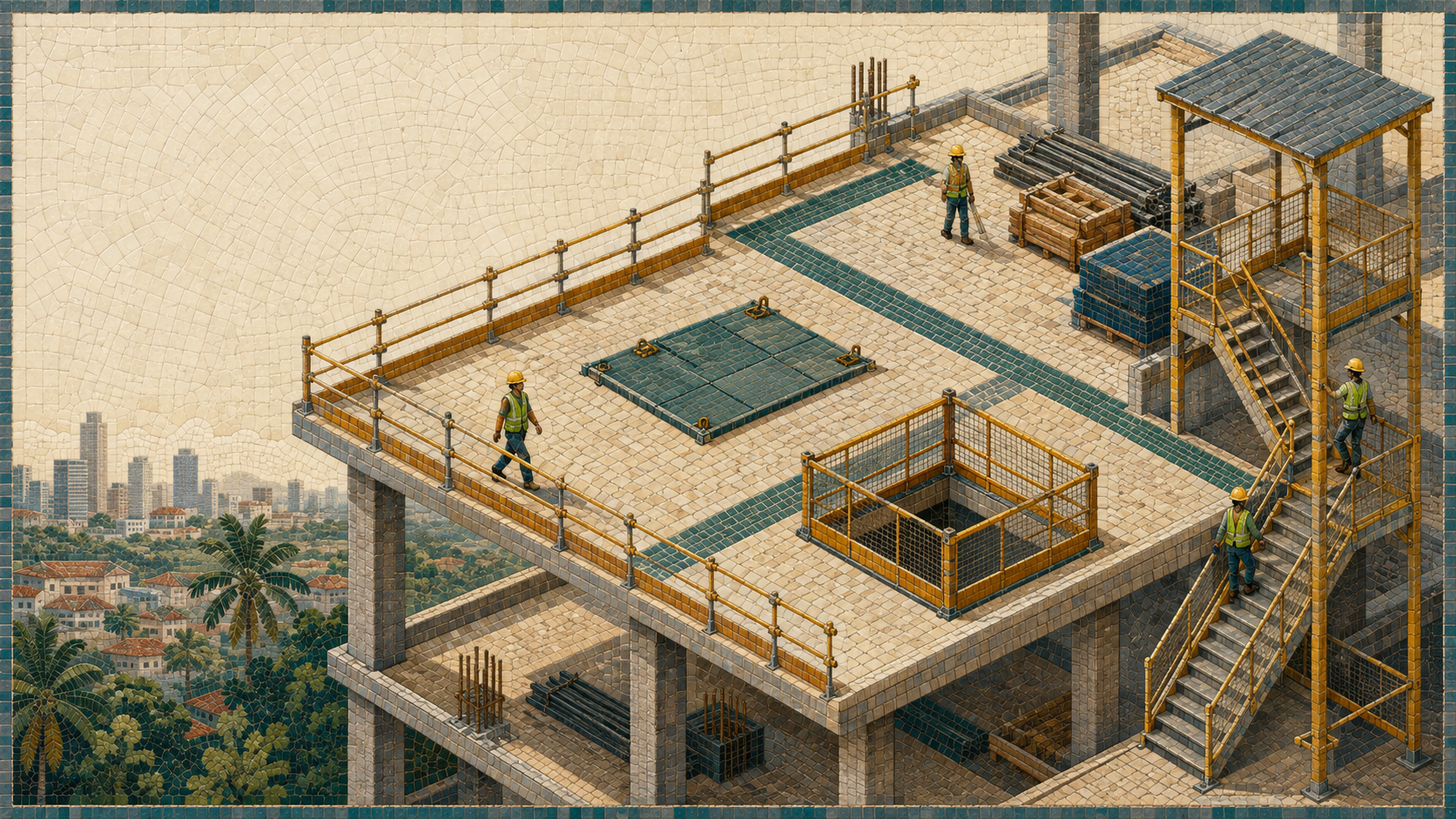
An opening is not safe merely because a cover is placed over it. The cover should suit the size and reasonably foreseeable load, be secured against displacement, appear on the plan and be inspected after activities that could disturb it. Where the opening must be used, rigid guarding and a controlled opening-and-closing arrangement are needed. When the task ends, protection should be restored immediately and verified.
For open edges, choose collective protection suited to the work and exposure period. Temporary edge protection needs adequate stability and strength. The Guidelines identify BS EN 13374:2013 as an example reference; using a standard still requires the design, installation and inspection to suit actual conditions. Do not assume that guard colour, warning tape or harness use alone proves an edge has been suitably and sufficiently guarded.
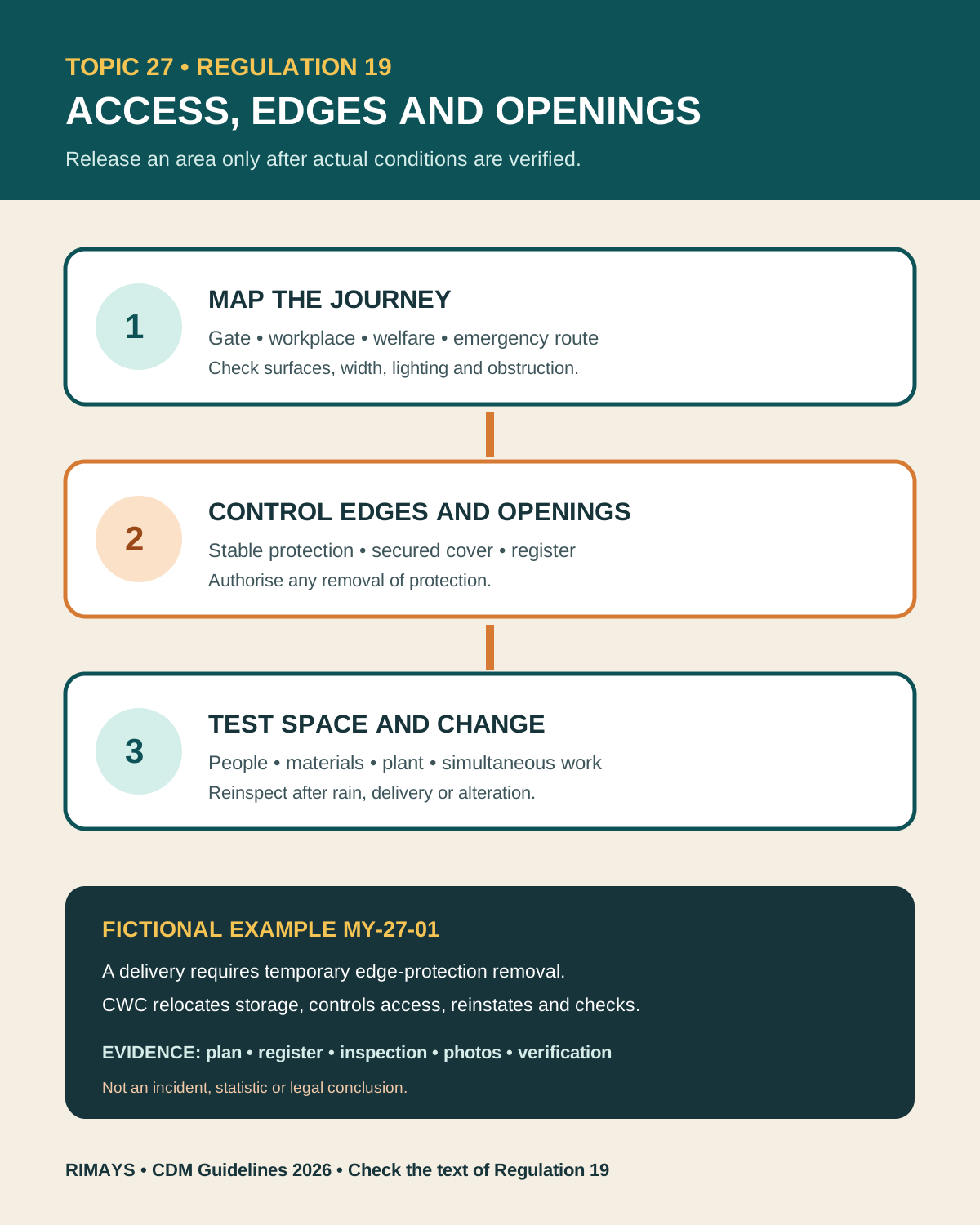
Control changes. New openings may arise when services are cored; edge protection may be removed for delivery; and a cover may be displaced by another work package. Use an edge and opening register that states location, control type, owner, inspection date and status. Any removal should be authorised, supported by temporary controls and closed through verified reinstatement.
Working space must suit the task and plant
A space that appears clear may be unsuitable once materials, leads, mobile platforms or a plant slewing radius are considered. Check space for working posture, movement, material handling, exit and rescue. Materials should not narrow a route or force workers towards an edge. Work sequencing also requires review because two activities that are safe separately can create an unsafe interface when undertaken together.
Housekeeping is an operational control, not cosmetic preparation for a visit. Set storage zones, waste-removal frequency, responsibility for clearing obstructions and a method for reporting damage. After rain, spills, deliveries or night work, surface conditions and lighting should be rechecked before the route is released.
Fictional training example MY-27-01
Fictional example — not a real incident, statistic or legal conclusion. A commercial building project in Johor Bahru is installing mechanical services on level six. The route from the stair tower to the work zone passes a delivery area, a covered service opening and a slab edge. The CWC records the route on the level access plan. The opening cover is designed for the expected service load, secured against displacement and entered in the inspection register. The slab edge has a complete temporary edge-protection system.
Before a ductwork delivery, the supervisor identifies that stored material would narrow the route and require a section of edge protection to be removed. The work is not released. The CWC changes the storage zone, provides a guarded delivery point and specifies written authorisation for temporary removal. While protection is removed, access is controlled and other work excluded. After delivery, protection is reinstated, inspected and recorded before the route reopens. The example demonstrates a decision based on actual conditions and sequence, rather than reliance on the original plan alone.
Practical compliance actions
- Map every access route, egress route, workplace and welfare area for each phase.
- Define acceptance criteria for surfaces, width, obstructions, lighting, separation and emergency routes.
- Register every open edge and floor opening; state the control, owner and inspection frequency.
- Verify that covers or guards are suitable, sufficient, stable and resistant to displacement.
- Prevent access to areas that do not yet comply through physical barriers and authorisation control.
- Assess working space with people, materials, posture, equipment and plant in view.
- Inspect after changes, weather, deliveries, removal of controls or reported damage.
- Explain routes and emergency arrangements to workers and visitors during induction and task briefing.
- Close corrective actions with evidence of actual conditions, not a signature alone.
Evidence worth retaining
Retain revision-controlled access and logistics plans; edge and opening registers; protection designs or specifications; installation records; pre-use and periodic inspections; dated photographs; removal permits or authorisations; reinstatement evidence; lighting records where relevant; housekeeping reports; complaint and correction records; induction, briefing and visitor communications; and layout-change records. Evidence should show who checked, what was checked, the condition found, the action, closure date and verifier.
Common failures
- A route appears on the plan but is blocked by materials or cables in the field.
- An edge is marked only with tape rather than suitable physical protection.
- An opening cover is unsecured, not assessed for loading or not identified.
- Protection is removed for delivery without authorisation, area exclusion and reinstatement.
- Inspections follow a calendar but are not repeated after a change or rain.
- Working space is assessed without plant, materials and simultaneous activities.
- A correction is closed on a form without verification at the location.
- Visitors receive verbal directions but lack a controlled route or suitable escort.
Supervisor checklist
- Is the route from the entrance to every workplace and facility safe, clear and unobstructed?
- Can surfaces, level changes, lighting and emergency egress be used safely?
- Does every edge and opening have suitable and sufficient protection?
- Are covers secured and suitable for reasonably foreseeable loading?
- Is access to a non-compliant area prevented?
- Is working space sufficient for workers, materials and plant?
- Has today’s change triggered a new inspection?
- Are corrections verified before the area is reopened?
- Can current records be shown to those coordinating and inspecting the work?
Primary JKKP/DOSH references
Refer to Regulation 19 of the Occupational Safety and Health (Construction Work) (Design and Management) Regulations 2024, P.U. (A) 147, together with the Guidelines on Occupational Safety and Health (Construction Work) (Design and Management) Regulations 2024, First Edition 2026, particularly paragraphs 154–156 and Figure 3. Review other provisions applicable to the specific work. This guide supports implementation and does not replace the legislation or project-specific professional advice.
Related articles

Garis Panduan CDM Edisi 2026
CDM 2026 · 29 of 52
Kestabilan Struktur: Kerja Sementara, Penyangga dan Urutan
Panduan Peraturan 21 untuk reka bentuk kerja sementara, laluan beban, pemeriksaan dan penanggalan terkawal.
Ir. Ts. Dr. Mohamad Syamir bin Senin.
Garis Panduan CDM Edisi 2026
CDM 2026 · 28 of 52
Aturan dan Sekuriti Tapak: Lindungi Pekerja dan Orang Awam
Panduan Peraturan 20 untuk kekemasan, kebersihan, pemagaran, penandaan serta kawalan antara muka awam.
Ir. Ts. Dr. Mohamad Syamir bin Senin.
Garis Panduan CDM Edisi 2026
CDM 2026 · 26 of 52
Bahagian IV: Menentukan Siapa Mengawal Keperluan Tapak
Panduan memetakan kawalan sebenar, menyelaras tanggungjawab dan mengesahkan keperluan Bahagian IV di tapak pembinaan.
Ir. Ts. Dr. Hj. Mohd Fairuz Ab Rahman (PMP)Ir. Ts. Dr. Mohamad Syamir bin Senin.