
Garis Panduan CDM Edisi 2026
Inspection Reports: When Work Must Stop
CDM 2026 · 34 of 52
Regulation 26 guidance for risk notification, closure, 24-hour reporting, remedy and release.
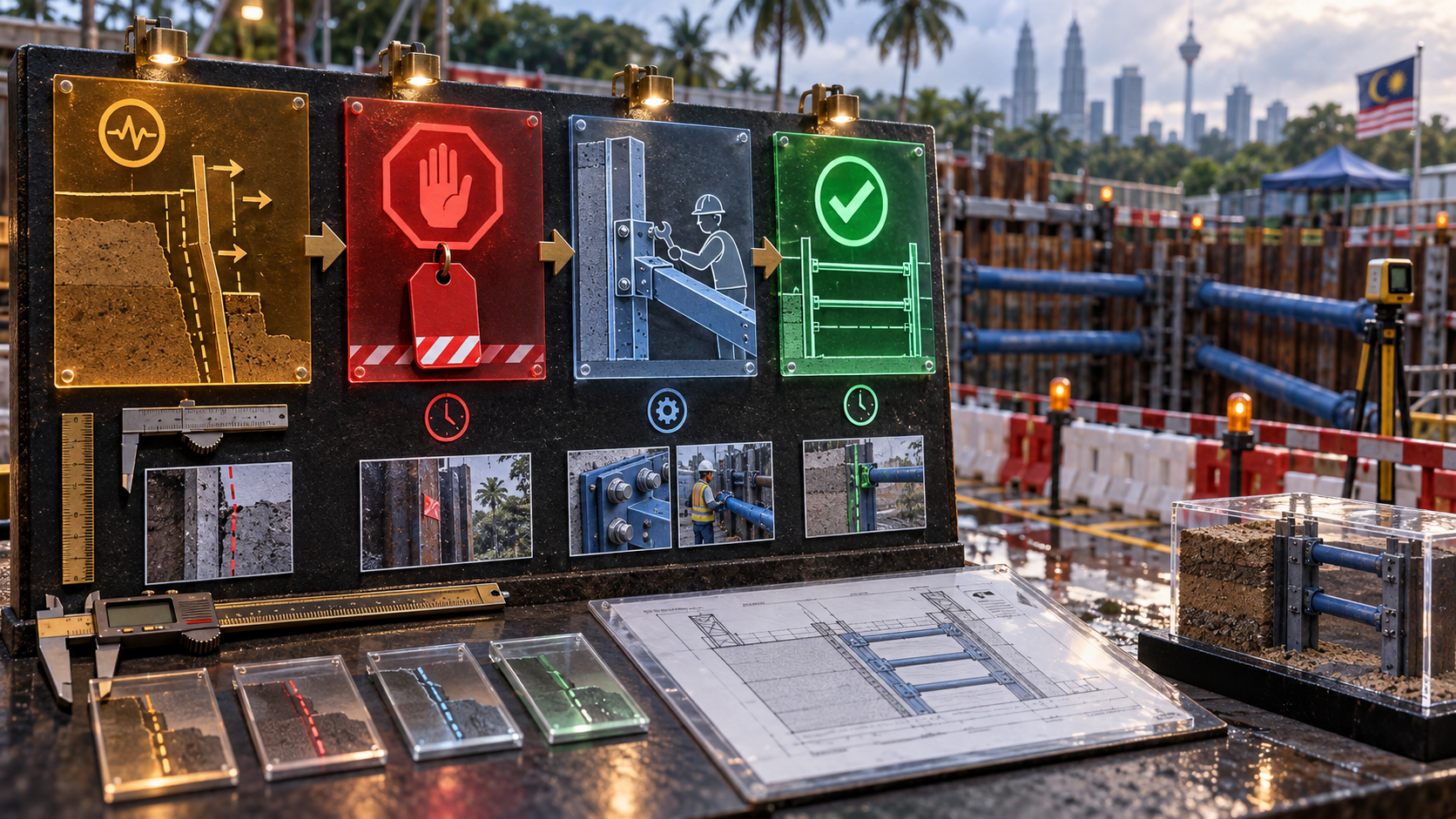
SIX-SLIDE BRIEFING
Inspection reporting at a glance
Slide 1 / 6
Trigger
No work can safely proceed
The designated person decides from actual observation.
An inspection report is not paperwork completed after the job. Under Regulation 26 it connects a designated person’s finding to risk notification, closure, correction and the decision on whether work can resume. Its scope is specifically inspections under Regulation 24 for excavations and Regulation 25 for cofferdams or caissons.
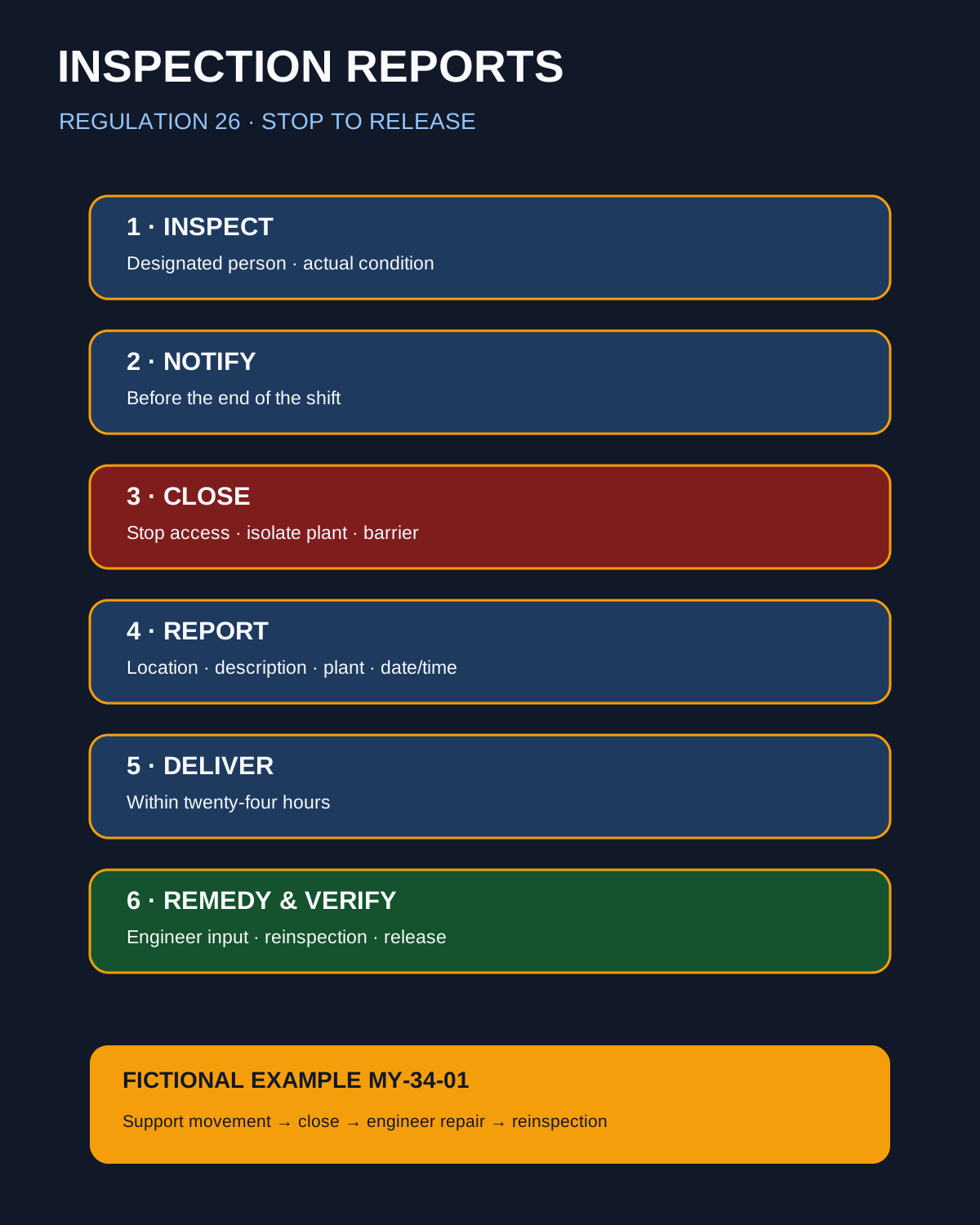
When is Regulation 26 triggered?
If the designated person carrying out an inspection under Regulations 24 and 25 is satisfied that no construction work can be carried out safely at the place inspected, that person must inform the person on whose behalf the inspection was carried out before the end of the shift. The notification concerns matters that could create a risk to any person’s safety.
This is not permission to wait until shift end before controlling danger. In practice, stop access to the unsafe area immediately, establish barriers and notify the party controlling the work. “Before the end of the shift” is the statutory deadline for the specified notification, not a tolerance period for continued work.
Report content and delivery
The designated person must prepare an inspection report. Regulation 26 specifies details including the name and address of the person on whose behalf the inspection was carried out, the location of the construction workplace inspected, a description of the workplace or part inspected including plant and objects, and the inspection date and time. The report or a copy must be sent to the person on whose behalf the inspection was carried out within twenty-four hours after completion.
Use an unambiguous location: grid, chainage, level, bay, excavation face or particular cofferdam. Describe the observed defect and relevant measurement rather than merely writing “unsafe”. State the closed area, temporary controls, notified parties and photographic evidence. Avoid conclusions beyond the inspector’s capability; obtain the designer or engineer for design decisions.
Who is responsible?
The CWC should appoint the designated person for the relevant inspections. If that person carries out inspection work under another person’s control, whether as an employee or otherwise, the controlling person must ensure compliance with Regulation 26(1). Organisational responsibility does not disappear because a form is handed to the inspector.
The person on whose behalf the inspection was carried out must keep the report or copy available for inspection by an officer: at the construction site until construction work is complete and for three months after completion. Extracts or copies must be sent to the officer when requested.
One report within seven days
Regulation 26(4) says that where inspections under subparagraph 24(2)(a)(i) or 25(2)(a)(i) are carried out more than once within seven days, the designated person need only prepare and submit one report for that period. This does not remove the duty to inspect at every shift start or after the other triggers specified in Regulations 24 and 25.
It should not be used to delay notification of a defect that makes the place unsafe. Daily operational records, notifications and site controls should still show what was inspected, when conditions changed and when access stopped.
Close, remedy and verify
Once unsafe conditions are identified, apply visible physical controls: suspend the permit or release, remove people, isolate plant, install barriers and mark status. Enter the defect in an action register with an owner and correction period. For support movement, seepage, cracking or changed geometry, consult the designer before altering the system.
Re-release needs evidence that the matter has been satisfactorily remedied under the applicable Regulation 24 or 25. Inspect actual conditions after repair, compare them with approved design or instruction, close the action and record who made the decision. A repair photograph alone does not establish stability.
Fictional example MY-34-01
Fictional example — not a real incident, statistic or legal conclusion.
At shift start, a designated person inspects a utility excavation in Selangor and observes movement at one waler after rain. The person is satisfied that no construction work can safely proceed in that part. Access stops immediately and the CWC is informed before shift end. The report identifies the grid, support section, reading, time, photographs and isolation.
An engineer assesses the condition and issues a repair instruction. The team installs approved reinforcement and controls water. The designated person reinspects after repair; work is released only when the condition matches the instruction and the matter has been satisfactorily remedied. This example sets no universal movement limit.
Compliance actions
- Appoint the designated person and define scope and authority.
- Provide a form capturing statutory details without replacing observation.
- Establish notification before the end of the shift.
- Stop access and isolate the unsafe place.
- Prepare and send the report within twenty-four hours.
- Obtain design input where a defect concerns stability.
- Reinspect the remedy and record release.
- Keep reports on site and for three months after completion.
Evidence to retain
Retain appointment and capability evidence; inspection schedule; reports; location identification; original photographs; readings; notification and receipt times; evacuation, barrier or isolation records; defect register; engineer’s instructions; approved drawings; repair evidence; reinspection; release decision; proof of delivery within 24 hours; and the report-retention register.
Common failures
- Waiting for the written report before stopping access.
- Writing “unsafe” without location, description or evidence.
- Allowing a supervisor to remove an inspector’s finding.
- Closing action from photographs without reinspection.
- Altering support without design instruction.
- Treating one seven-day report as a substitute for shift inspection.
- Missing the 24-hour report deadline.
- Removing reports from site before retention ends.
Supervisor checklist
- Is the inspector the designated person for this scope?
- Are the place, plant and objects identified precisely?
- Was the relevant person notified before shift end?
- Has access stopped and is isolation effective?
- Was the report delivered within 24 hours?
- Are the correction owner and action recorded?
- Was engineer instruction obtained where necessary?
- Was the remedy reinspected before release?
- Is the report available on site with clear retention control?
Primary JKKP/DOSH references
Refer to Regulation 26, P.U. (A) 147/2024, the *CDM Guidelines, First Edition 2026*, printed pages 87–88 and paragraph 179, and Appendix 3’s sample Excavation / Cofferdam / Caisson Inspection Report.
Related articles
Garis Panduan CDM Edisi 2026
CDM 2026 · 52 of 52
Practical Appendices: Excavation Inspection, Site Scope and Supervisor Guidance
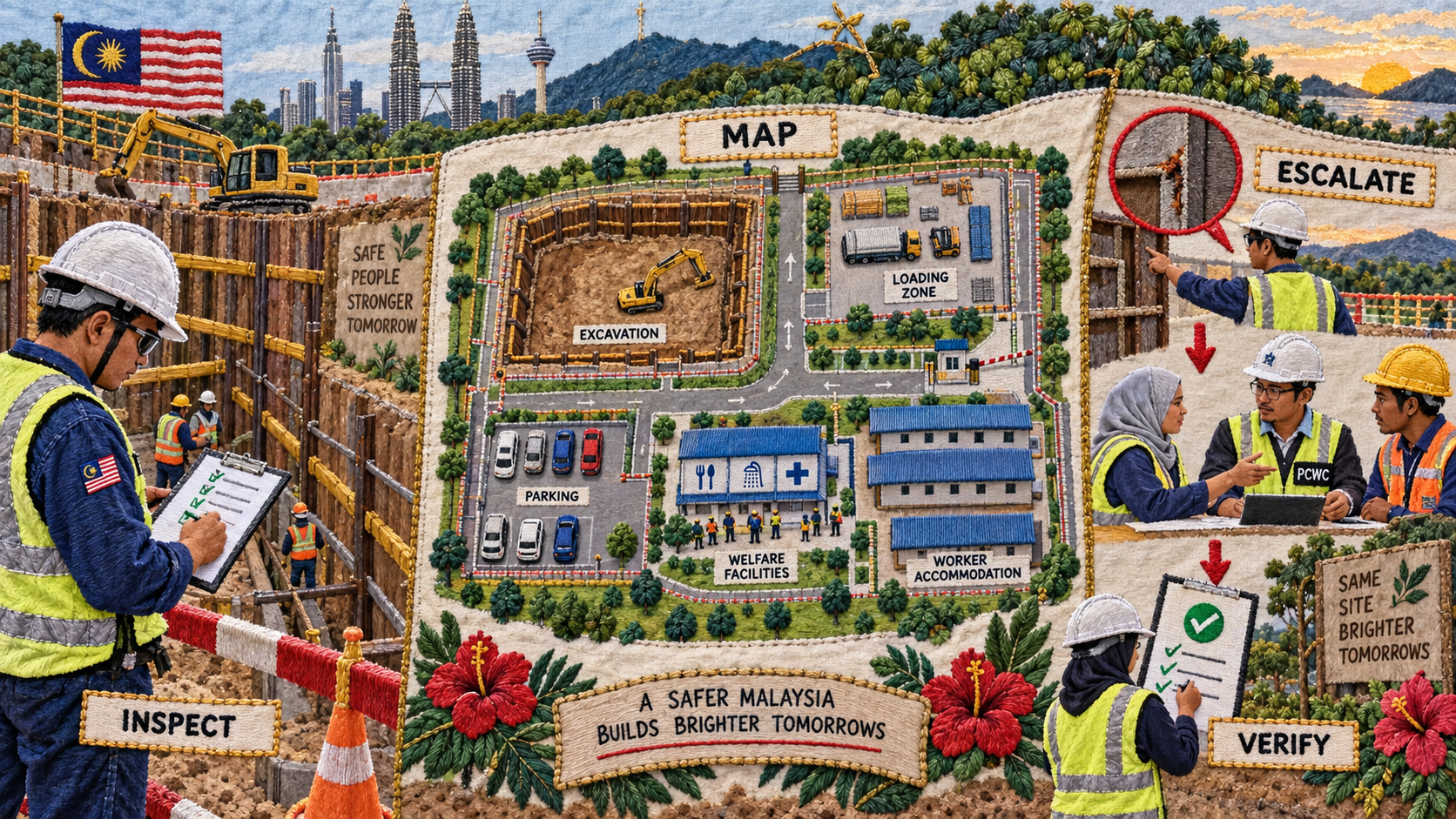
Connect inspection reports, whole-workplace mapping and SSS supervision to action, escalation and verified closure.
Ir. Ts. Dr. Mohamad Syamir bin Senin.
Garis Panduan CDM Edisi 2026
CDM 2026 · 51 of 52
Duty-Holder Checklists and RAG: How to Use Them Without Fooling Yourself
Use Appendices 1 and 2 as evidence-led decision controls with owners and dates—not decorative status colours.
Ir. Ts. Dr. Mohamad Syamir bin Senin.
Garis Panduan CDM Edisi 2026
CDM 2026 · 50 of 52
Third and Fourth Schedules: Notification and Work Involving Particular Risks
Practical guidance for completing project notification and connecting work involving particular risks to the PCI and CPP.
Ir. Ts. Dr. Mohamad Syamir bin Senin.