
Garis Panduan CDM Edisi 2026
Third and Fourth Schedules: Notification and Work Involving Particular Risks
CDM 2026 · 50 of 52
Practical guidance for completing project notification and connecting work involving particular risks to the PCI and CPP.

SIX-SLIDE BRIEFING
Notification and particular risks at a glance
Slide 1 / 6
Threshold
Decide whether notification is required
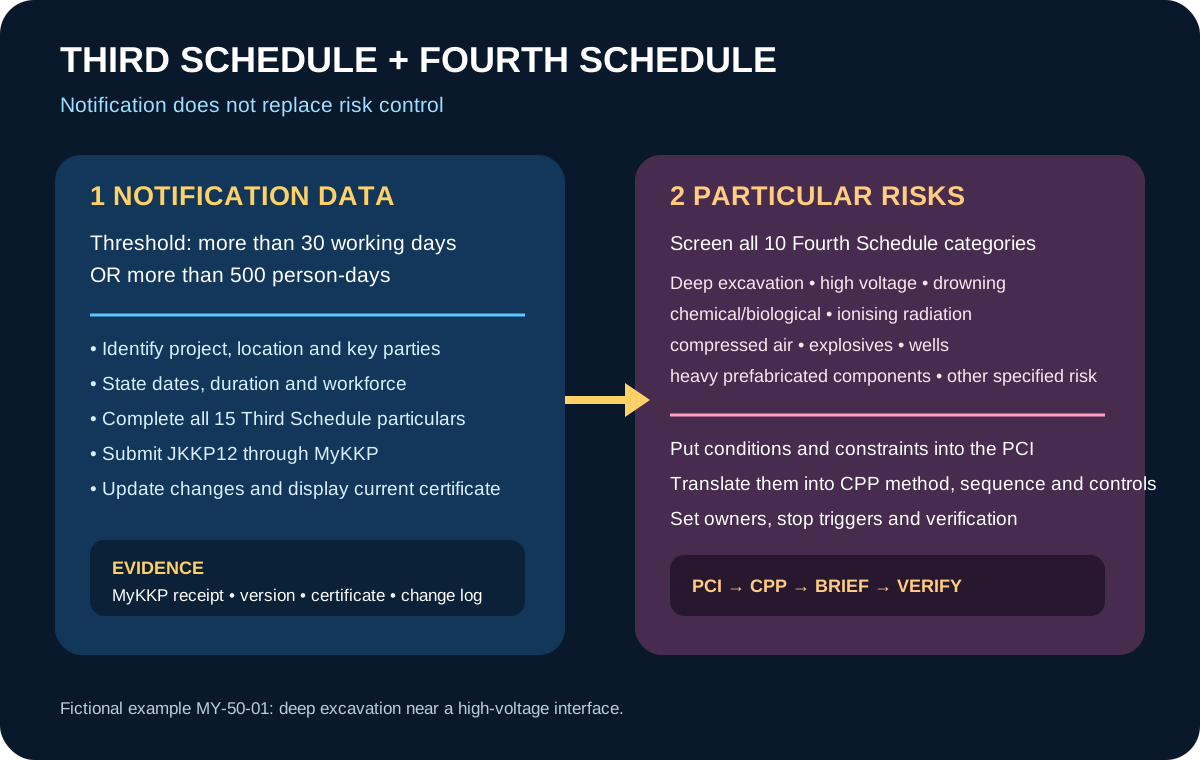
More than 30 working days or more than 500 person-days: the client notifies the Director General in writing as soon as practicable before the construction phase.
The Third and Fourth Schedules perform different functions that must be connected in project management. The Third Schedule specifies particulars to be notified under Regulation 8 for a project meeting the notification threshold. The Fourth Schedule identifies categories of work involving particular risks for consideration in the construction phase plan (CPP) under Regulation 13. Notification is not approval of risky work, and identifying a category does not replace activity-specific assessment and control.
When notification is required
Regulation 8 states that where construction work on a construction site is scheduled to last longer than thirty working days or exceed five hundred person days, the client must notify the Director General in writing as soon as practicable before the construction phase begins. “Person day” and “working day” have specific Regulation 8 definitions; do not turn the threshold into a workforce-headcount estimate alone.
The 2026 CDM Guidelines explain submission of JKKP 12 through MyKKP. If a project was initially expected not to require notification but later changes cross the threshold, the client should notify as soon as practicable. The client may ask another person to notify on its behalf, but this does not remove the client's duty.
The Third Schedule's fifteen particulars
The Third Schedule covers the notice submission date; site address or precise location description; local authority; brief project description; contact particulars of the client, PCWD and PCWC; planned start date; time allocated by the client; planned construction-phase duration; estimated maximum workforce; planned number of CWCs; names and addresses of appointed CWCs and CWDs; and a signed declaration that the client is aware of its duties.
Compile the particulars from one controlled master register. Confirm entity names, CDM roles, addresses, contacts, programme and workforce forecast with data owners. Do not copy stale tender information. When information changes, resubmit changes or updates as DOSH explains. A change of project ownership requires particular attention; the Guidelines state that JKKP 12 should be resubmitted to the Department.
The current notification should be prominently displayed in an understandable form readable by workers involved. The Guidelines refer to the Construction Work Notification Certificate generated by MyKKP being displayed at site offices, welfare facilities and accommodation. Where workers cannot read the national language, the Guidelines state that the certificate should be translated into their native language. Control versions and withdraw obsolete copies.
Fourth Schedule: ten work categories
The categories cover work exposing workers to burial under earthfalls, engulfment in swampland or falls from height where aggravated by work, process or environment; chemical or biological substances presenting a particular hazard or requiring health monitoring; ionising radiation; work near high-voltage power lines; drowning risk; wells, underground earthworks and tunnels; diving with an air-supply system; caissons with compressed-air atmosphere; explosives; and assembly or dismantling of heavy prefabricated components.
Do not label every activity “high risk” without analysis. During design and planning reviews, map actual activities against the Fourth Schedule wording. State location, phase, exposed people, trigger, interfaces and unknown information. Then connect the result to PCI, risk assessment, design, sequence, resources, competence, supervision, emergency arrangements and specific CPP measures.
Fictional example MY-50-01
A fictional learning example, not a real incident, official form or legal determination. An urban utility project plans a deep excavation near a high-voltage power-line corridor. Programme review indicates that the Regulation 8 threshold is expected to be met. The client verifies Third Schedule data, PCWD and PCWC appointments, duration, allocated time and workforce forecast before JKKP 12 submission.
The team flags excavation potentially involving burial risk and the high-voltage interface as relevant Fourth Schedule categories. Action MY-50-01 connects the locations to PCI, utility verification, excavation-support design, applicable approach controls, relevant isolation or system controls, sequence, inspection, supervision and rescue. The CPP states specific measures and owners. When the alignment and date change, the team checks effects on both datasets, updates the CPP and determines the notification update required. This example sets no universal electrical distance or excavation method.
Compliance actions
- Determine the Regulation 8 threshold from a traceable programme and person-day forecast.
- Assign an owner to each Third Schedule particular and a review date before submission.
- Retain the current certificate, withdraw obsolete copies and ensure worker readability.
- Screen scope, design and changes against every Fourth Schedule category.
- Connect relevant categories to specific CPP measures rather than labels alone.
- Review after changes in ownership, appointment, programme, workforce, location, method or design.
Evidence to retain
- Threshold calculation, programme assumptions and person-day forecast sources.
- Third Schedule dataset, checks, confirmations, declaration and JKKP 12 submission record.
- Current Construction Work Notification Certificate, display locations, translations and withdrawal of old versions.
- Change register stating date, reason, owner and resubmission decision.
- Fourth Schedule matrix linking activity, location, phase, PCI, assessment and CPP references.
- Relevant design, buildability, utility, competence, briefing, inspection and emergency-review evidence.
Common failures
- Assuming no notification is required without recalculating after programme change.
- Retaining tender-stage names or contacts after appointments change.
- Displaying an old certificate or a copy workers cannot understand.
- Treating notification as DOSH approval of a work method.
- Copying ten categories into the CPP without project-specific measures.
- Identifying excavation or high voltage only after design and sequence are frozen.
- Updating notification while leaving conflicting PCI or CPP information.
Checklist
- Was the Regulation 8 threshold calculated using the correct definitions?
- Are all fifteen particulars complete, current and verified?
- Is the declaration signed by or on behalf of the client?
- Were changes and ownership transfer assessed for resubmission?
- Is the current certificate displayed and understood by worker groups?
- Were all ten Fourth Schedule categories screened against actual scope?
- Does every relevant category have specific CPP measures?
- Are PCI, design, assessment, CPP and change records consistent?
Primary JKKP/DOSH references
- Occupational Safety and Health (Construction Work) (Design and Management) Regulations 2024, P.U. (A) 147: Regulations 8 and 13, and the Third and Fourth Schedules.
- DOSH 2026 CDM Guidelines: paragraphs 51–58 and 99–103, and the Third and Fourth Schedule text on printed pages 131–132.
This guidance is not confirmation of notification status, a technical method or legal advice for a project. Check project facts and current DOSH/MyKKP directions.
Related articles
Garis Panduan CDM Edisi 2026
CDM 2026 · 52 of 52
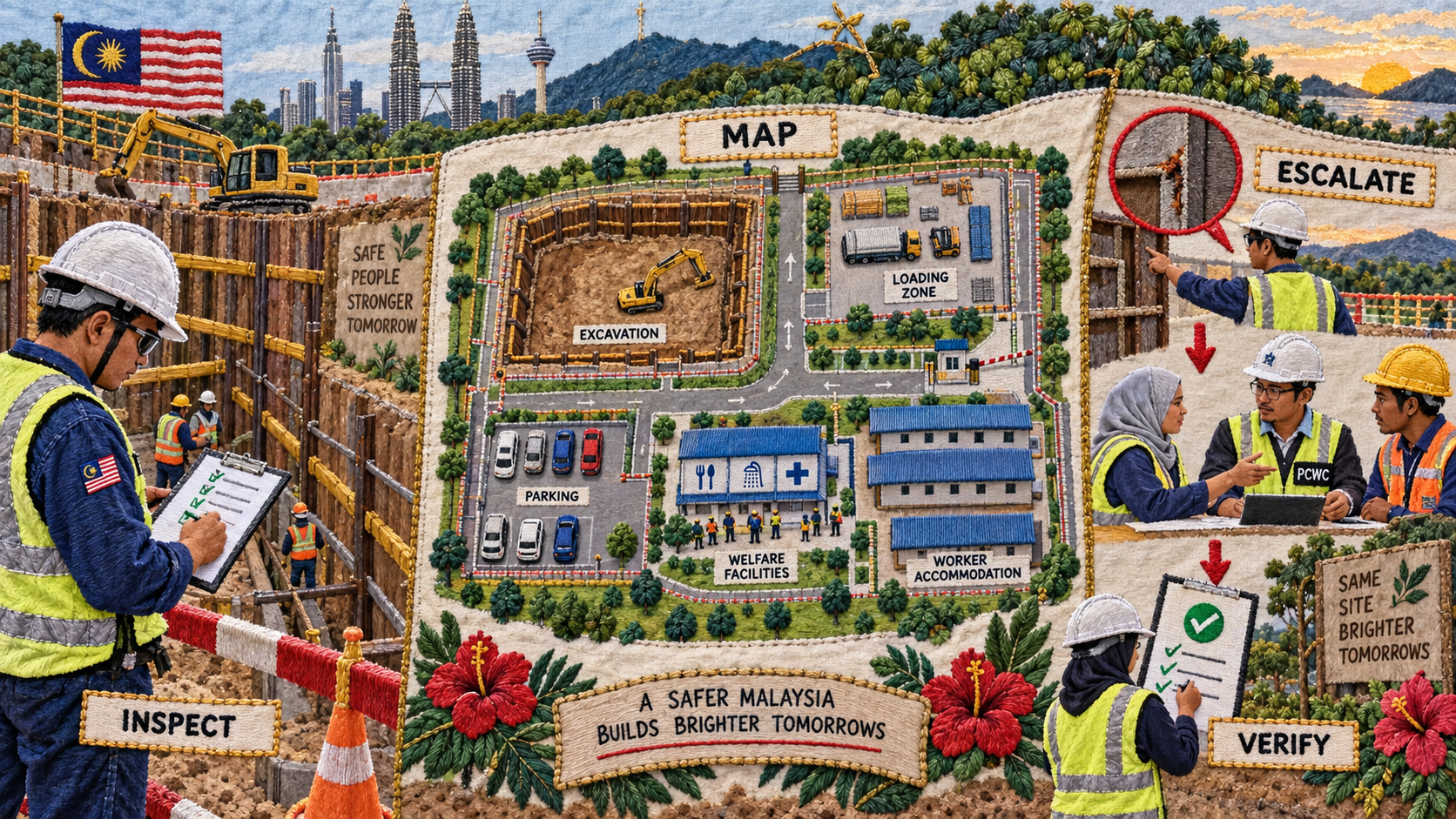
Practical Appendices: Excavation Inspection, Site Scope and Supervisor Guidance
Connect inspection reports, whole-workplace mapping and SSS supervision to action, escalation and verified closure.
Ir. Ts. Dr. Mohamad Syamir bin Senin.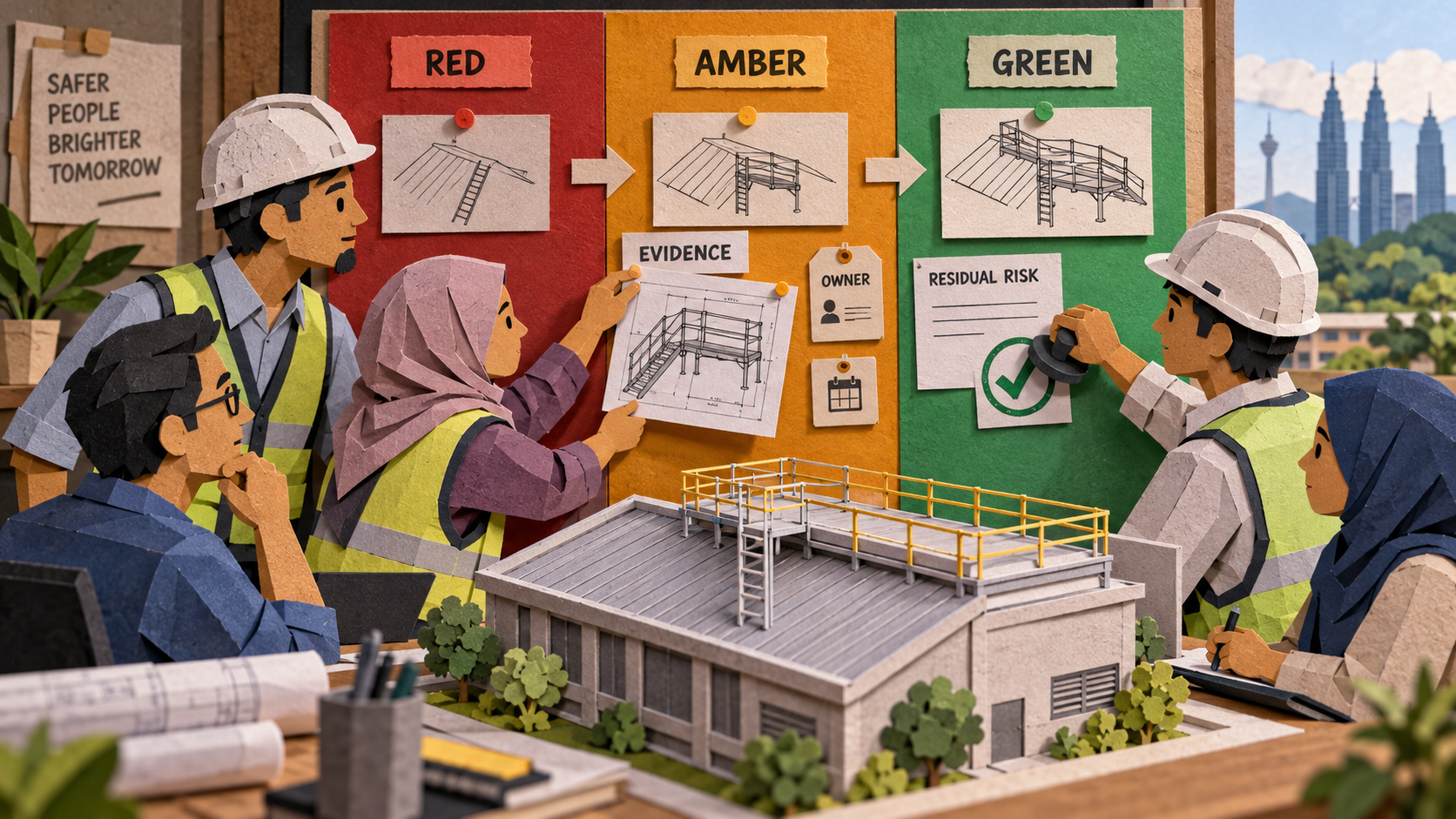
Garis Panduan CDM Edisi 2026
CDM 2026 · 51 of 52
Duty-Holder Checklists and RAG: How to Use Them Without Fooling Yourself
Use Appendices 1 and 2 as evidence-led decision controls with owners and dates—not decorative status colours.
Ir. Ts. Dr. Mohamad Syamir bin Senin.
Garis Panduan CDM Edisi 2026
CDM 2026 · 49 of 52
Minimum Welfare Facilities: What Must Be Ready from Day One
Second Schedule guidance for providing, commissioning, cleaning, maintaining and expanding site welfare capacity.
Ir. Ts. Dr. Mohamad Syamir bin Senin.