
Garis Panduan CDM Edisi 2026
Practical Appendices: Excavation Inspection, Site Scope and Supervisor Guidance
CDM 2026 · 52 of 52
Connect inspection reports, whole-workplace mapping and SSS supervision to action, escalation and verified closure.
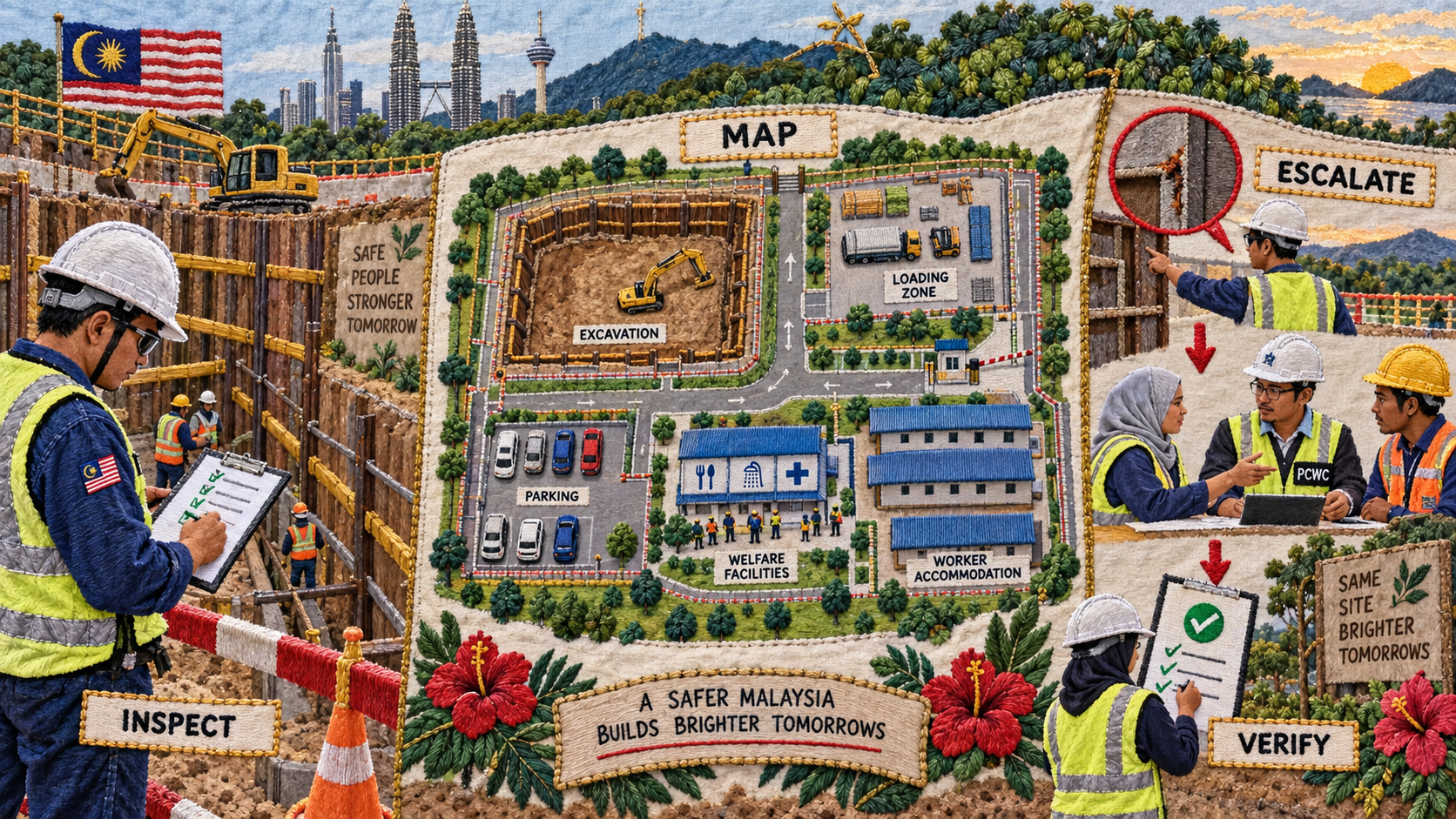
SIX-SLIDE BRIEFING
Field evidence cycle at a glance
Slide 1 / 6
Appendix 3
A form structures evidence
State inspector, place, time, scope, hazard, risk, immediate action and further action.
Appendices 3 to 5 of the 2026 CDM Guidelines connect three matters often managed separately: excavation inspection records, the boundaries of a construction site and construction workplace, and the work of the site safety supervisor (SSS). Use a form to structure evidence, not replace competent judgement. Map the whole workplace—including excavation, loading, parking, welfare, worker accommodation and their interfaces. The SSS should inspect actual conditions, report non-compliance to the PCWC, coordinate corrective action and verify closure. The PCWC remains responsible for planning, managing and monitoring the construction phase; neither a document nor an appointment transfers that duty.
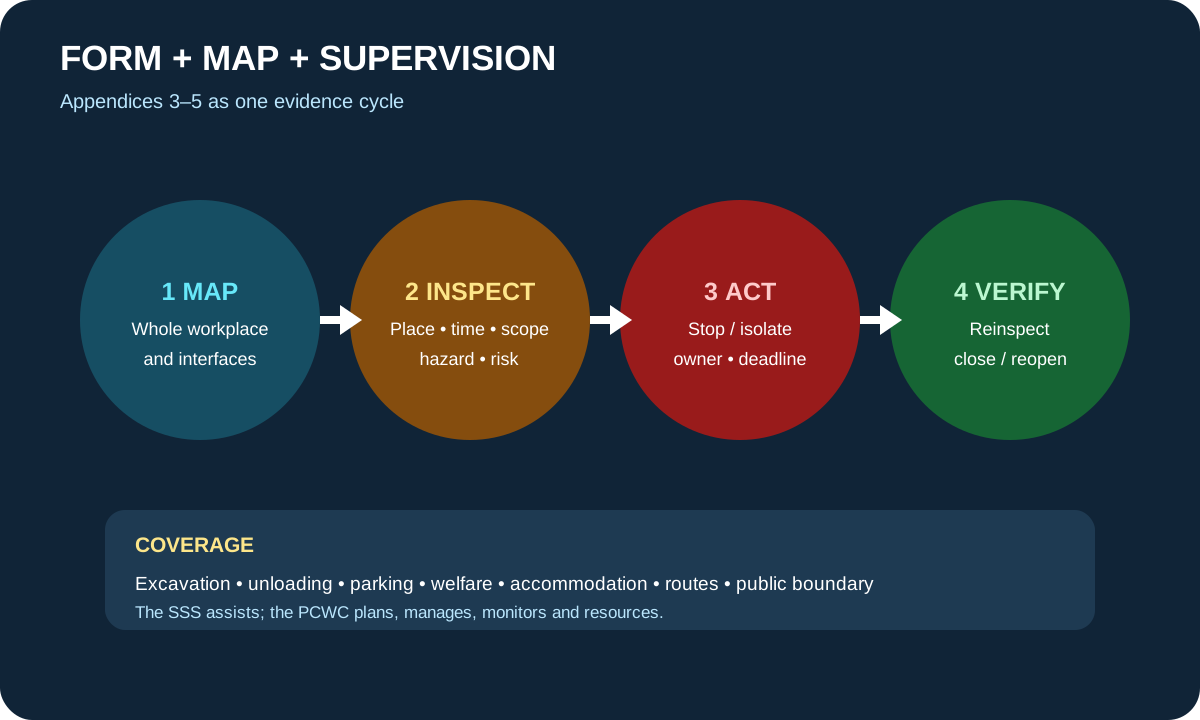
Why the three appendices belong together
Appendix 3 provides a sample Excavation / Cofferdam / Caisson Inspection Report. Part A records the inspecting party, location, date, time, scope and additional description. The sample scope includes excavation-wall stability, retaining or strutting systems, safe access and egress, dewatering, air testing where relevant, barriers and signage, and cofferdam or caisson structure. Part B separates location and hazard, identified risk, immediate action and proposed further action. Part C records report confirmation.
Appendix 4 explains the distinction between a construction site and construction workplace for Regulation 19. Its diagram places the main work beside unloading, parking, offices, welfare facilities and accommodation. The practical message is that inspection cannot end at the excavation or structure being built. People and vehicle routes, deliveries, temporary electricity, sanitation, rest, accommodation and public interfaces can all generate risks requiring planning and monitoring.
Appendix 5 explains SSS assistance to the PCWC, including CPP input, physical supervision and inspection, briefings, documentation, emergencies, communication and cooperation. Together the appendices form a cycle: scope, inspect, record, act immediately, escalate, close and review again.
Legal scope and limits
Regulation 19 concerns the safety of construction workplaces and safe access. Regulation 26 requires inspection reports for excavations, cofferdams and caissons in circumstances specified by the Regulation; consult the full text for the actual triggers and periods. Regulation 39 requires the PCWC to appoint a competent person who is a site safety supervisor to assist with compliance. Appendix 5 states that the SSS appointment is in writing and that the SSS is registered with the Director General of DOSH Malaysia as a competent person under section 31C of the Act and holds a valid certificate of qualification.
The Appendix 3 sample does not determine that conditions are safe. A name, date and signature do not prove stability. The inspector needs suitable information, access, time and competence and must consider support design, ground, water, weather, adjacent loads, changes and actual observations. When an immediate hazard is found, protective action does not wait for the typed report.
Compliance workflow
- Define the construction-site boundary and every construction workplace; mark all support areas and interfaces.
- Develop inspection coverage by phase, risk, regulatory trigger, design, change, weather and ground condition.
- Before excavation inspection, gather support drawings, sequence, ground and utility data, previous records and changes.
- Confirm inspector, date, time, exact location and scope. Avoid a generic description such as “site area”.
- Inspect walls, support/strutting, edges, access, dewatering, atmosphere where relevant, barriers, loads and adjacent activity.
- For every finding, separate hazard, risk, immediate action and further action. Name the owner and deadline.
- Stop or isolate where needed; report non-compliance and unsafe conditions to the PCWC through the defined escalation route.
- Update the CPP, method statement, permit, traffic plan, welfare or emergency arrangements when findings show inadequate control.
- Verify closure through reinspection and suitable technical evidence. Do not close from a distant photograph alone.
- Analyse recurrence and extend the review to similar places across the construction workplace.
Fictional example MY-52-01
This is a fictional learning example, not a real incident or legal determination. An urban utility project in Selangor has a supported excavation beside a delivery gate. Its related workplaces also include parking, welfare facilities and temporary accommodation elsewhere within the site.
During inspection, the SSS records the specific location on the wall beside the delivery route, new water seepage and material stored near the edge. Immediate MY-52-01 action is to stop access to the affected zone, move people and plant away and notify the PCWC. The relevant engineer reviews support and dewatering; further action, owner and deadline are recorded. The traffic plan changes so deliveries do not add conflict or nearby loading.
The SSS does not stop at the excavation. The revised route is inspected through unloading, parking, toilets and accommodation to check segregation, lighting, surfaces and emergency access. The PCWC coordinates affected CWCs, updates the CPP and communicates the change. Closure occurs only after reinspection confirms that physical work and documents agree. This example sets no universal support design or safe distance.
Evidence to retain
- Boundary plan and construction-workplace register including support areas and public interfaces.
- Complete, legible Appendix 3 report or equivalent, identifiable by place and time.
- Relevant drawings, calculations, engineer instructions, ground, utility, dewatering and design-change data.
- Dated, location-marked before-and-after photographs supported by observations and measurements where needed.
- Immediate-action, isolation, stop-work, owner, deadline, escalation and PCWC receipt records.
- Reinspection and verified-closure evidence.
- Written SSS appointment, registration and valid certificate of qualification.
- Updated CPP, briefing, permit and plan versions following change.
Common failures
- Copying the Appendix 3 example without adapting location, condition or scope.
- Marking every box satisfactory without evidence or observation details.
- Combining hazard, risk and action in a vague sentence with no owner.
- Inspecting excavation while ignoring deliveries, parking, welfare or accommodation.
- Treating a photograph as closure although support or dewatering is unverified.
- Making the SSS sole owner of correction while PCWC management makes no decision.
- Failing to reopen inspection after rain, ground, loading, sequence or damage changes.
Field checklist
- Are location, time, inspector and scope exact?
- Were the previous report, design and changes reviewed?
- Were support/strutting, access, water, atmosphere, edges and adjacent activity inspected?
- Does every hazard have separate immediate and further actions?
- Who owns each action and what is the deadline?
- Did the PCWC receive escalation and resource the correction?
- Does coverage include the whole construction workplace and its support areas?
- Were the CPP and worker information updated?
- Did an appropriate person verify closure at the location?
- Does change or recurrence trigger a new inspection?
Primary JKKP/DOSH references
- Occupational Safety and Health (Construction Work) (Design and Management) Regulations 2024, P.U. (A) 147: Regulations 19, 26 and 39.
- DOSH 2026 CDM Guidelines: Appendix 3 printed pages 141–142, Appendix 4 page 143, and Appendix 5 pages 144–148.
This guidance does not replace engineering design, inspection by an appropriate person or project-specific legal advice. Verify current requirements with DOSH.
Related articles
Garis Panduan CDM Edisi 2026
CDM 2026 · 51 of 52
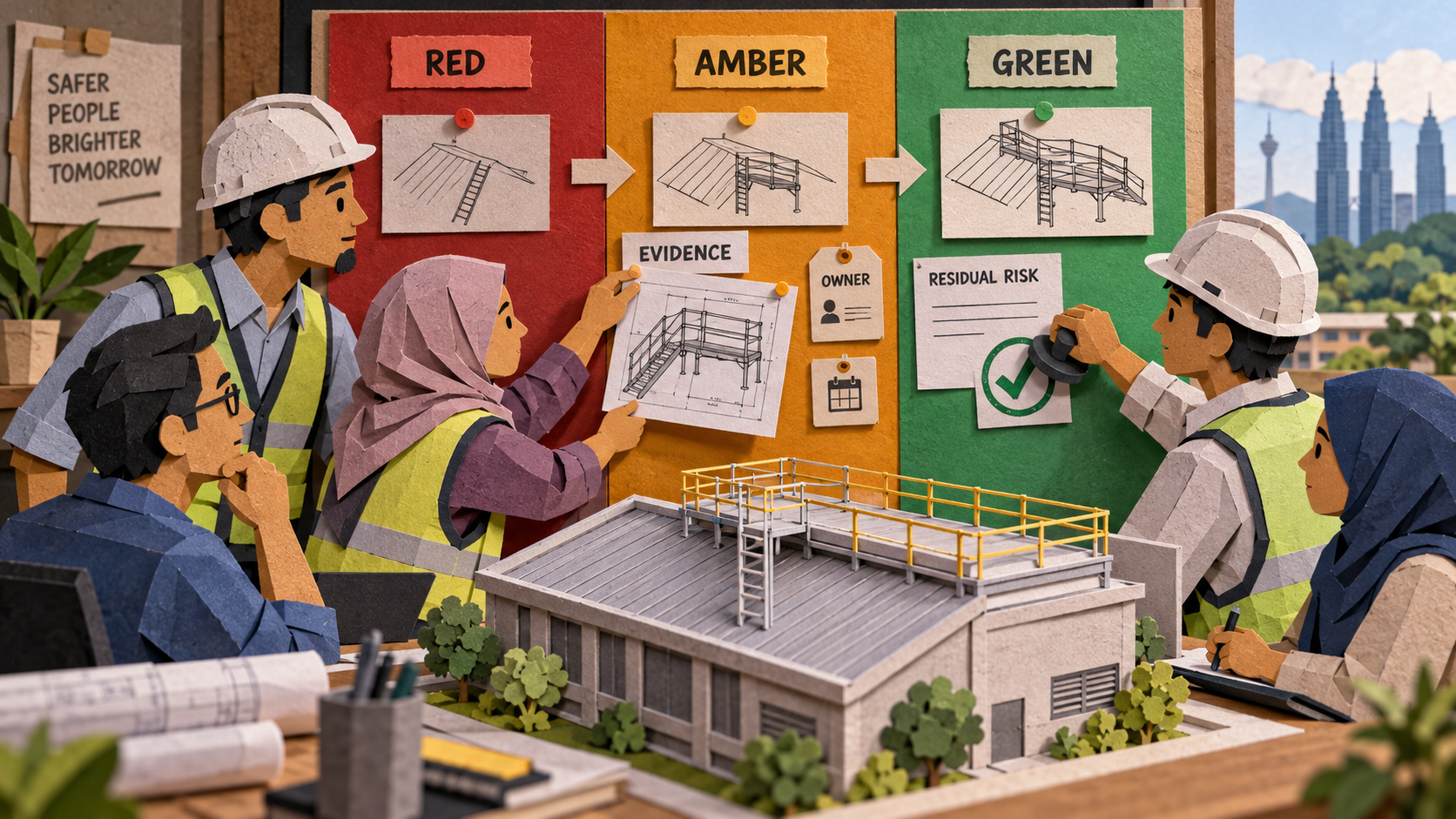
Duty-Holder Checklists and RAG: How to Use Them Without Fooling Yourself
Use Appendices 1 and 2 as evidence-led decision controls with owners and dates—not decorative status colours.
Ir. Ts. Dr. Mohamad Syamir bin Senin.
Garis Panduan CDM Edisi 2026
CDM 2026 · 50 of 52
Third and Fourth Schedules: Notification and Work Involving Particular Risks
Practical guidance for completing project notification and connecting work involving particular risks to the PCI and CPP.
Ir. Ts. Dr. Mohamad Syamir bin Senin.
Garis Panduan CDM Edisi 2026
CDM 2026 · 49 of 52
Minimum Welfare Facilities: What Must Be Ready from Day One
Second Schedule guidance for providing, commissioning, cleaning, maintaining and expanding site welfare capacity.
Ir. Ts. Dr. Mohamad Syamir bin Senin.