
Garis Panduan CDM Edisi 2026
Duty-Holder Checklists and RAG: How to Use Them Without Fooling Yourself
CDM 2026 · 51 of 52
Use Appendices 1 and 2 as evidence-led decision controls with owners and dates—not decorative status colours.
SIX-SLIDE BRIEFING
Evidence-led RAG at a glance
Slide 1 / 6
Foundation
Start with the duty holder
Use Appendix 1 to identify who must act and which duty is being tested.
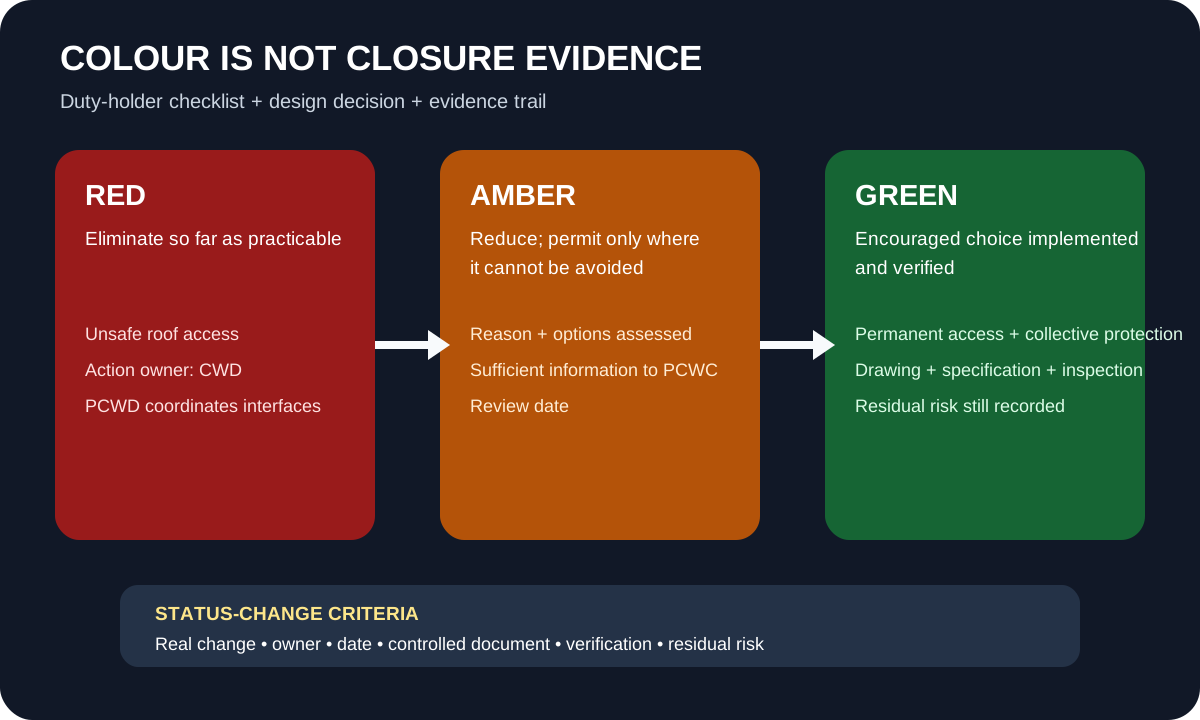
The duty-holder checklists in Appendix 1 and the Red, Amber, Green (RAG) lists in Appendix 2 of the 2026 CDM Guidelines are design-control and discussion tools. They are not compliance certificates, risk scores or a way to colour issues until they look closed. Use the checklists to test who must act and which duty is engaged. Use RAG to eliminate Red choices so far as practicable, eliminate or reduce Amber choices so far as practicable, and encourage Green choices that improve safety and health throughout the project life cycle. Every status change needs an owner, date, decision and evidence. Residual risk must still be assessed, controlled and communicated.
Why these tools are needed
Projects readily fall into two traps. First, meetings list issues without connecting them to the duties of the client, PCWD, CWD, PCWC or CWC. Second, status colours change because the next meeting is approaching, not because the design or process has changed. Appendix 1 helps teams examine appointment, skills, knowledge and experience, organisational capability, cooperation, pre-construction information (PCI), the General Principles of Prevention, information transfer and the safety and health file (SHF). Appendix 2 provides examples of products, processes and procedures to eliminate, reduce or encourage.
Both tools must be used with real project records. RAG does not replace risk assessment, design decisions, the CPP, inspection, permits or supervision. “Green” does not mean zero risk; it means an encouraged option has been adopted and evidenced while residual risks are managed through the appropriate project information.
Legal scope and limits
The appendices are guidance supporting the Occupational Safety and Health (Construction Work) (Design and Management) Regulations 2024. Duties still arise from the Regulations. For example, Regulation 10 addresses skills, knowledge and experience and organisational capability; Regulation 11 sets CWD duties; Regulation 12 sets PCWD duties; Regulation 13 concerns the CPP; and Regulation 14 concerns the SHF. A checklist does not transfer a duty and a colour does not create a legal conclusion.
Appendix 2 describes Red as dangerous procedures, products or processes to be eliminated from the project so far as practicable. Amber covers choices to be eliminated or reduced so far as practicable and specified or permitted only where they cannot be avoided; an Amber item must be accompanied by sufficient information for the PCWC. Green covers choices encouraged because they can improve safety and health across the project life cycle. Apply those meanings consistently and do not turn Amber into automatic approval.
Compliance workflow
- Define the review scope: decision, product, process, location, stage and people who may be affected.
- Identify the duty holder and use the relevant Appendix 1 checklist item; do not assign every action to the OSH officer.
- Record foreseeable hazards and the initial option. Use Red, Amber and Green examples as question prompts, not an exhaustive list.
- Try to eliminate a Red choice through the brief, design, material, location, installation or method.
- For Amber, record why it cannot yet be avoided, options assessed, reduction measures, information for the PCWC and review date.
- For a proposed Green choice, verify that it exists in a drawing, specification, model, order or completed work—not merely in meeting minutes.
- Assign one decision owner, action owner, deadline, information recipient and evidence criterion to every item.
- Examine effects on PCI, CPP, other CWD designs, construction, maintenance, cleaning, use and SHF.
- Close only after the named reviewer verifies evidence. Reopen when design, contractor, method or site conditions change.
Fictional example MY-51-01
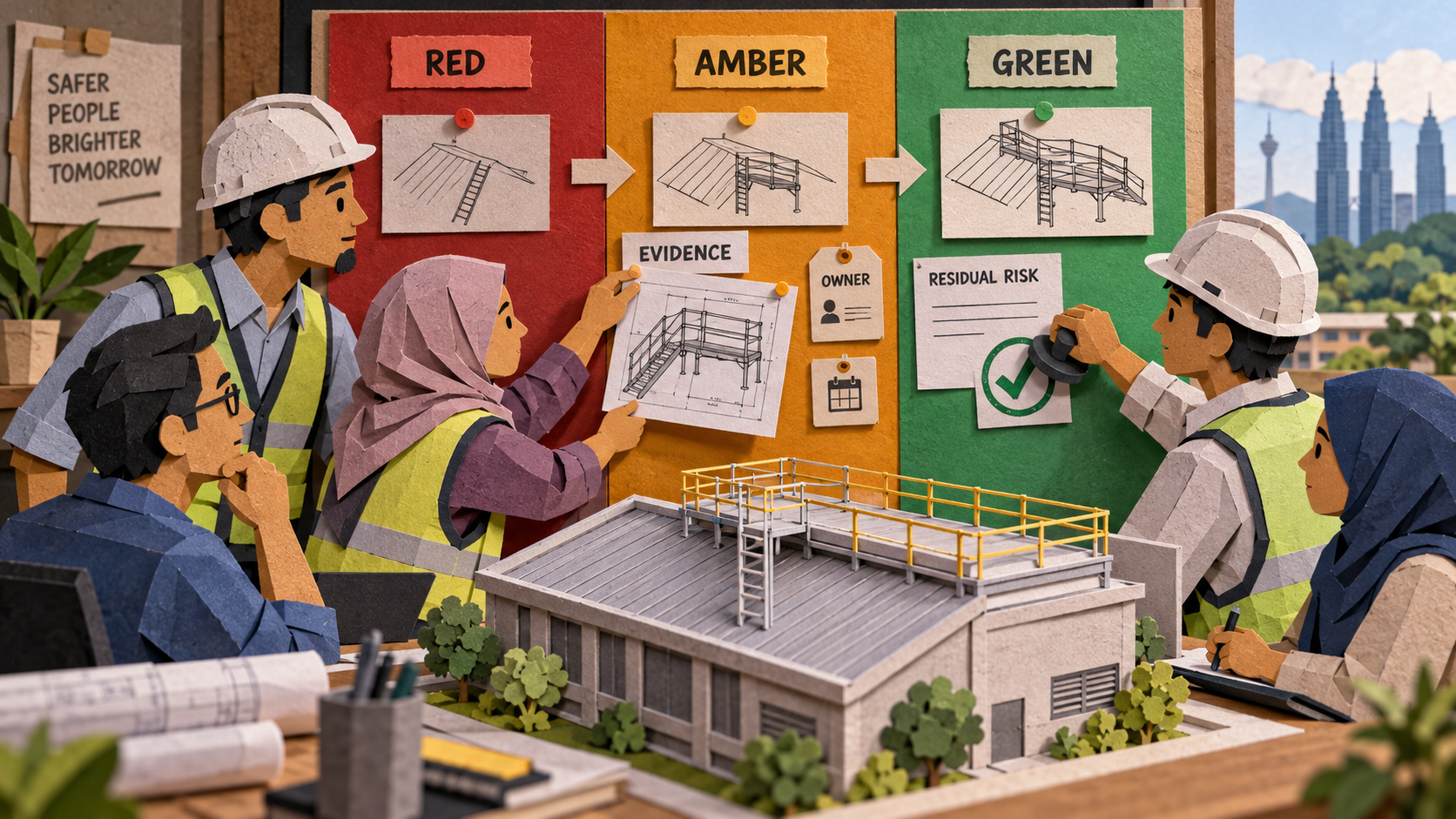
This is a fictional learning example, not a real incident or legal determination. A logistics centre in Johor requires periodic access to rooftop equipment. The initial concept shows a portable ladder close to the roof edge without a permanent maintenance route. The team marks it Red because safe access has not been provided. The architectural CWD owns the action, while the PCWD coordinates structural, M&E and maintenance input.
A second proposal provides an access point but still requires workers to step over an obstruction and depend on a personal system. The item remains Amber. The record states the option not yet avoided, spatial constraint, residual-risk information and review with the PCWC. It does not become Green merely because a drawing was issued.
The third design relocates equipment and provides a fixed stair, work platform, clear route and collective edge protection. The team verifies dimensions and interfaces through the model, construction drawings, specification, maintenance review and installation inspection. Only then is it classified Green. Residual matters such as access control, weather and maintenance of the protection are recorded in PCI, CPP or SHF as appropriate. MY-51-01 demonstrates that the colour moved because the design and evidence moved.
Evidence to retain
- RAG register with item number, location, version, origin, duty holder and date.
- Completed Appendix 1 checklist with decisions and evidence references, not empty ticks.
- Brief, PCI, drawings, models, calculations, specifications and assessed options.
- Design-review minutes recording reasons, consultees, owners and deadlines.
- Evidence that Amber information reached the PCWC and relevant CWDs or CWCs.
- CPP, method statement, inspection or commissioning records verifying implementation.
- Identifiable residual-risk records and versioned SHF updates.
- Dated photographs may support physical verification but do not replace required specifications or inspections.
Common failures
- Making every Red item appear Green before a meeting without changing the design.
- Treating RAG as a likelihood-and-severity matrix although Appendix 2 is a design/process list.
- Permitting Amber without reasons, sufficient information or review.
- Marking Green when an action is only promised by the contractor.
- Having no single owner, deadline, version or closure criterion.
- Closing a roof issue while transferring risk to installation, cleaning or maintenance.
- Copying a checklist without testing organisational capability and project conditions.
Meeting checklist
- Are scope, location and design version identified?
- Is the correct duty holder present or consulted?
- Which Red choices have been eliminated so far as practicable?
- For each Amber item, are the reason, reduction and information to PCWC recorded?
- Is every Green item in controlled documents and verified on site where applicable?
- Who owns the action, decision and closure review?
- Does the deadline precede design freeze, procurement and construction sequence commitments?
- Are changes consistent across PCI, CPP and SHF?
- Is residual-risk information given to those who need it without generic clutter?
- Is the item reopened when assumptions or designs change?
Primary JKKP/DOSH references
- Occupational Safety and Health (Construction Work) (Design and Management) Regulations 2024, P.U. (A) 147: particularly Regulations 10–14 and the First Schedule.
- DOSH Guidelines for the Occupational Safety and Health (Construction Work) (Design and Management) Regulations 2024, 2026 Edition: Appendix 1, printed pages 134–137, and Appendix 2, printed pages 138–140.
This guidance is not confirmation of compliance or a technical solution for a particular project. Check project facts, the Regulations and current DOSH directions before deciding.
Related articles
Garis Panduan CDM Edisi 2026
CDM 2026 · 52 of 52
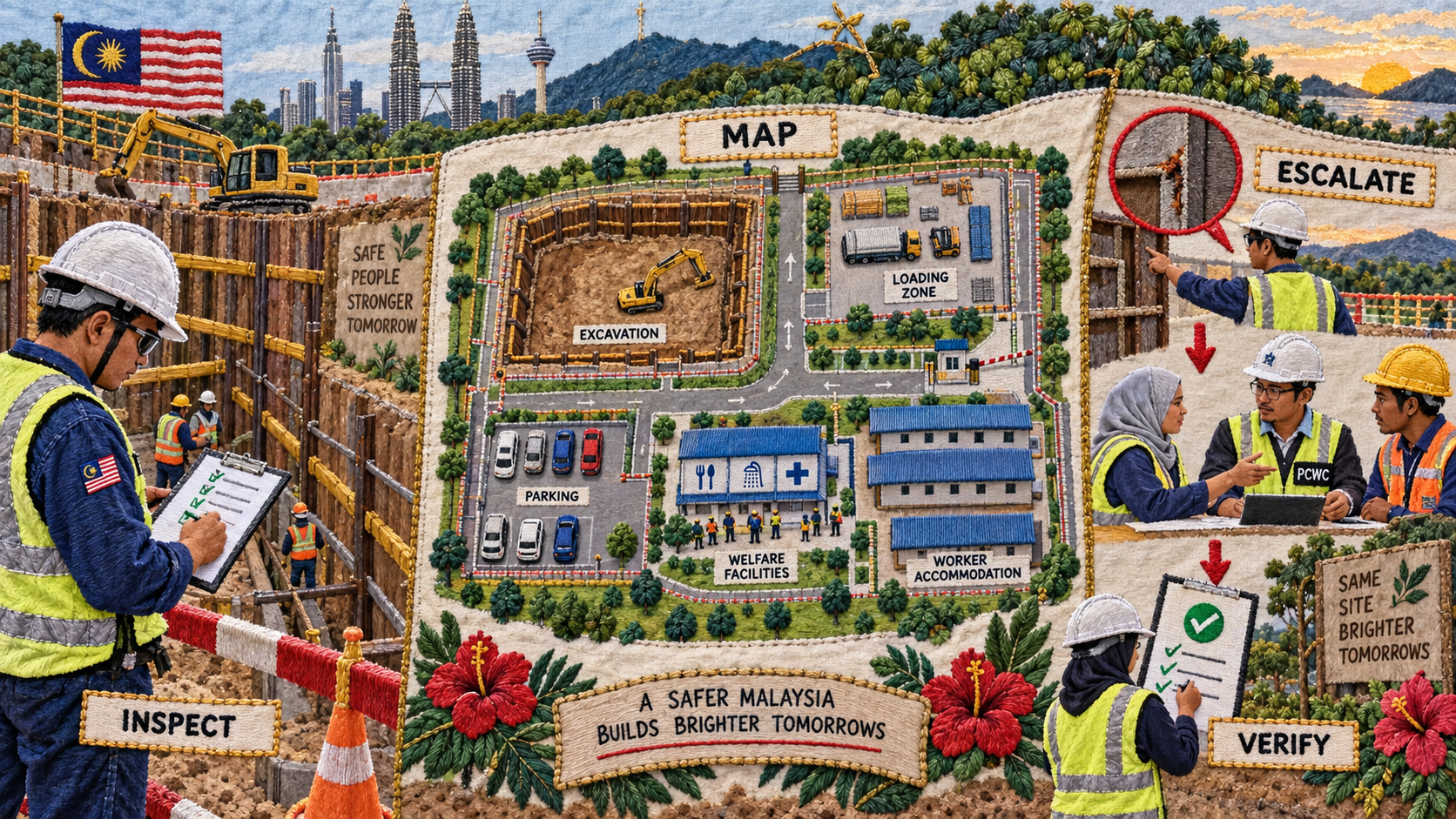
Practical Appendices: Excavation Inspection, Site Scope and Supervisor Guidance
Connect inspection reports, whole-workplace mapping and SSS supervision to action, escalation and verified closure.
Ir. Ts. Dr. Mohamad Syamir bin Senin.
Garis Panduan CDM Edisi 2026
CDM 2026 · 50 of 52
Third and Fourth Schedules: Notification and Work Involving Particular Risks
Practical guidance for completing project notification and connecting work involving particular risks to the PCI and CPP.
Ir. Ts. Dr. Mohamad Syamir bin Senin.
Garis Panduan CDM Edisi 2026
CDM 2026 · 49 of 52
Minimum Welfare Facilities: What Must Be Ready from Day One
Second Schedule guidance for providing, commissioning, cleaning, maintaining and expanding site welfare capacity.
Ir. Ts. Dr. Mohamad Syamir bin Senin.