
Garis Panduan CDM Edisi 2026
Minimum Welfare Facilities: What Must Be Ready from Day One
CDM 2026 · 49 of 52
Second Schedule guidance for providing, commissioning, cleaning, maintaining and expanding site welfare capacity.

SIX-SLIDE BRIEFING
Welfare readiness at a glance
Slide 1 / 6
Basis
Ready before work starts
Plan capacity, location, utilities and access for the workforce and work nature.
Welfare facilities are not an addition after a site becomes busy. Regulations 15 and 17 connect PCWC and CWC responsibilities to the Second Schedule, while the 2026 CDM Guidelines emphasise suitable and sufficient facilities before work starts and maintenance until project completion. Implementation should reflect user numbers and needs, work nature, shifts, location, privacy, access and project-phase changes—not an invented ratio assumed to suit every site.
Welfare facilities: provide before work and maintain until completion
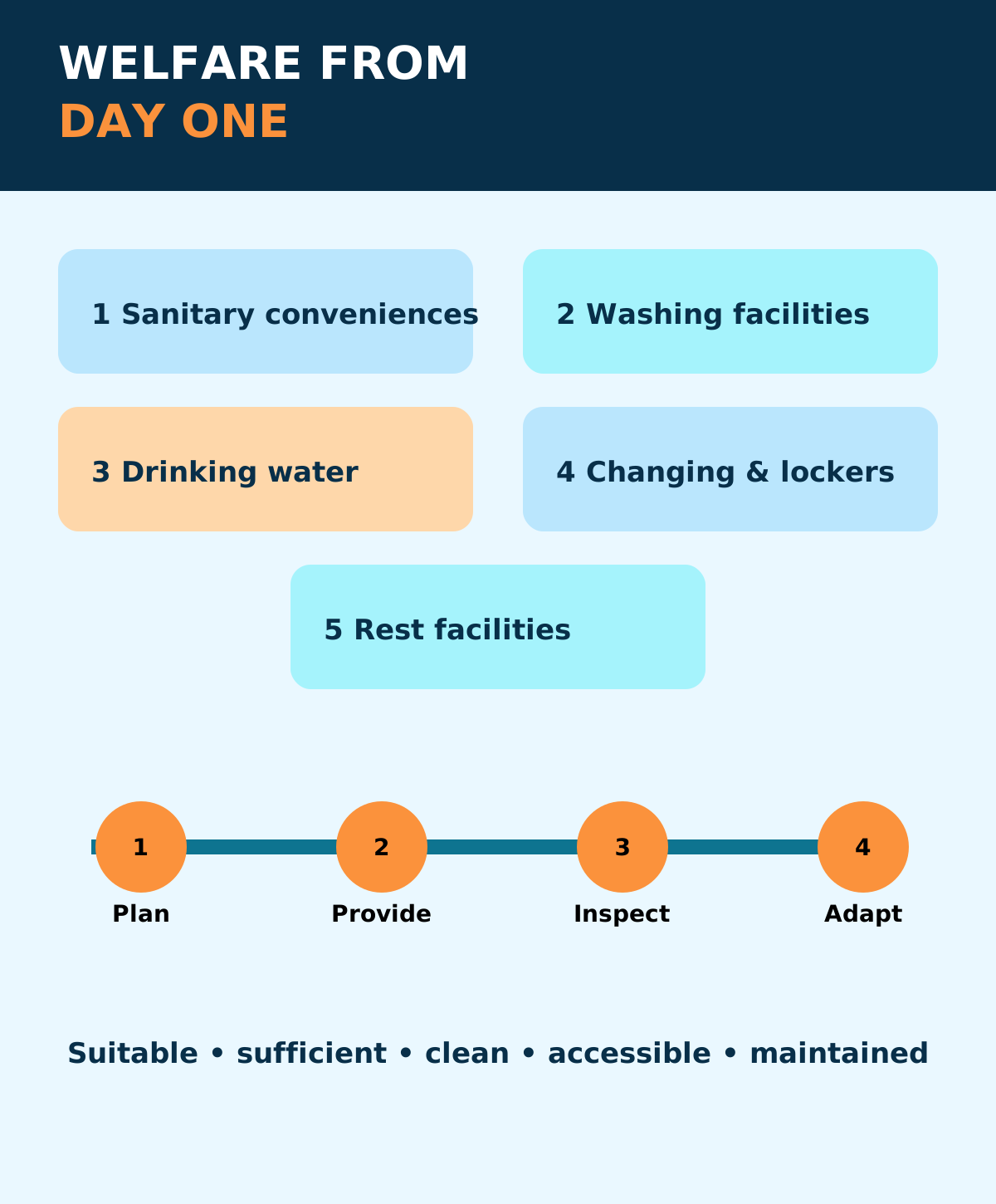
The Second Schedule covers sanitary conveniences, washing facilities, drinking water, changing rooms and lockers, and rest facilities. Read its detailed requirements when assessing suitability, sufficiency, access, ventilation, lighting, cleanliness, privacy and provision for men and women. The nature of the work can require showers. Drinking water should be identified, with suitable cups where it is not supplied through an upward jet.
Facilities should be available before construction starts and maintained until completion. An initial cabin inspection is insufficient. Define inspection ownership, frequency informed by use and risk, fault reporting, response times and temporary arrangements during repair. Check water, soap or other cleaning material, drying means, cleaning, lighting, ventilation, locks, drainage, seating and access conditions.
Provision should change with workforce numbers, shifts, gender, work location and project stage. Mobilisation can rapidly increase numbers; moved fencing can make the toilet route unsafe; a premises utility shutdown can interrupt water. The PCWC should liaise with other CWCs throughout construction. Do not assume client facilities are available without agreement, capacity, access and maintenance responsibilities.
Drinking, washing and rest facilities support health controls, but this article does not prescribe a health regime for each hazard. For specific substances or processes, check safety data sheets, health risk assessments and other applicable requirements. Do not place an eating area where dust or hazardous substances expose its users.
Fictional example MY-49-01: capacity before peak workforce
This is a fictional training example, not an actual incident or approved site plan. A commercial project expects a substantial workforce increase when structural and M&E work overlap. The PCWC readiness review finds facilities suitable for mobilisation, but washing, changing and rest capacity will not be sufficient for the planned peak phase.
The team records action MY-49-01. The PCWC and CWCs map forecast workers by phase and shift, the needs of men and women, dirty work, travel distance and planned utility interruptions. They add units before the peak team arrives, separate eating space from dust, and assign maintenance, cleaning and inspections proportionate to use.
The logistics plan and induction are updated so each group knows the safe route and allocated facilities. Water supply, drainage, ventilation, lighting, locks, soap, drying means and seating are tested before use. Temporary arrangements are defined if a unit fails or water is interrupted.
The welfare cabin is inspected before the shift. As workforce numbers increase, the team reviews sufficiency, cleaning, drinking water, washing and rest provision. A temporary welfare route is found to conflict with plant movement and is relocated before use. Actions close only after boundaries, access, communication and facilities are checked in the field. A later change reopens the assessment.
Infographic: five facility groups from day one
Evidence worth retaining
Structure evidence so a sample can be traced from entry authority to information received, permitted zones and follow-up. Sampling is more useful than merely counting cards or signatures. Check exceptions: who entered during a system failure, who was manually approved, and whether access was withdrawn. For welfare, connect inspections with complaints, repairs and field observations. Repeated defects can show unsuitable capacity, location or maintenance rather than only user carelessness. Records should allow the PCWC to establish the decision, its basis, who was informed and whether the outcome was verified.
- Scope and revision of induction material, date, presenter, participants and the method used to check understanding.
- Re-induction and change-briefing records showing the reason and affected group.
- Current boundary, entrance, zone, public or shared route and delivery plans.
- Authorisation, pass issue/return, visitor, escort, lost-pass and access-termination records, with personal data minimised.
- Inspections of fencing, gates, lighting, signs and routes, and correction evidence.
- Welfare assessment, inspection, cleaning, defect, complaint, repair and temporary-arrangement records.
- Reviews after changes to workforce, shift, layout, utilities or premises operations.
Set retention, access and disposal under applicable law and project requirements. This article does not invent one statutory retention period for every record.
Six common failures
- Using generic induction that omits current routes, site risks or emergency arrangements.
- Assuming an attendance signature proves understanding and competence.
- Controlling the main gate while side doors, temporary fencing or after-hours access remain weak.
- Leaving old cards active after workers or contractors leave the project.
- Providing welfare on mobilisation but failing to maintain or expand it when conditions change.
- Assuming client facilities are available without confirming agreement, access, sufficiency and maintenance responsibility.
PCWC checklist
- Is induction site-specific and at the current revision?
- Who is entering for the first time, changing task or affected by change, and what communication do they need?
- How is understanding, not merely attendance, checked?
- Are identity, authority, zone and access duration matched?
- Are all boundaries, side gates, shared routes and after-hours arrangements inspected?
- Do emergency access and escape routes remain functional?
- Are Second Schedule facilities suitable, sufficient, clean, accessible and maintained?
- Does provision reflect workforce size, shifts, gender, work nature and site changes?
- Do weaknesses have owners, risk-appropriate deadlines and closure evidence?
- Do CWCs, the client or premises operator receive and understand interface arrangements?
Primary JKKP/DOSH references
Occupational Safety and Health (Construction Work) (Design and Management) Regulations 2024, DOSH: Regulations 15(1), 15(2)(e), 17(1)(e)–(h) and the Second Schedule. Primary explanatory reference: DOSH Garis Panduan CDM Edisi 2026, paragraphs 120–124, printed pages 58–59.
This is general guidance, not legal advice or a site-security design. Check project-specific requirements and the complete Second Schedule. Contact RIMAYS to discuss training, induction and site-document coordination.
Related articles
Garis Panduan CDM Edisi 2026
CDM 2026 · 52 of 52
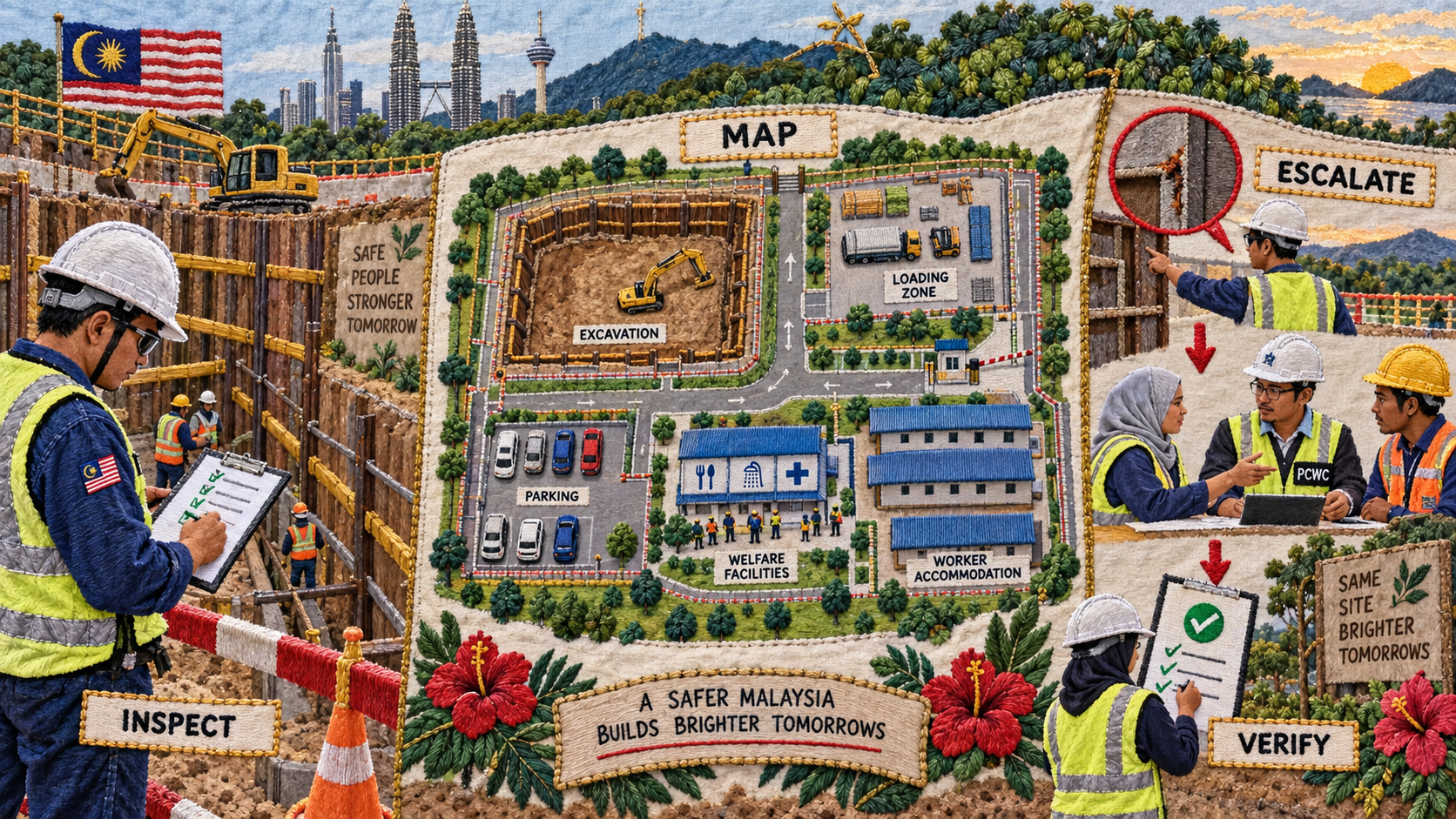
Practical Appendices: Excavation Inspection, Site Scope and Supervisor Guidance
Connect inspection reports, whole-workplace mapping and SSS supervision to action, escalation and verified closure.
Ir. Ts. Dr. Mohamad Syamir bin Senin.
Garis Panduan CDM Edisi 2026
CDM 2026 · 51 of 52
Duty-Holder Checklists and RAG: How to Use Them Without Fooling Yourself
Use Appendices 1 and 2 as evidence-led decision controls with owners and dates—not decorative status colours.
Ir. Ts. Dr. Mohamad Syamir bin Senin.
Garis Panduan CDM Edisi 2026
CDM 2026 · 50 of 52
Third and Fourth Schedules: Notification and Work Involving Particular Risks
Practical guidance for completing project notification and connecting work involving particular risks to the PCI and CPP.
Ir. Ts. Dr. Mohamad Syamir bin Senin.