
Garis Panduan CDM Edisi 2026
Energy Distribution: Temporary Boards, PBB/ELCB and Isolation
CDM 2026 · 35 of 52
Regulation 27 guidance for board positioning, cable protection, PBB/ELCB, inspection, isolation and utility controls.

SIX-SLIDE BRIEFING
Energy distribution at a glance
Slide 1 / 6
Plan
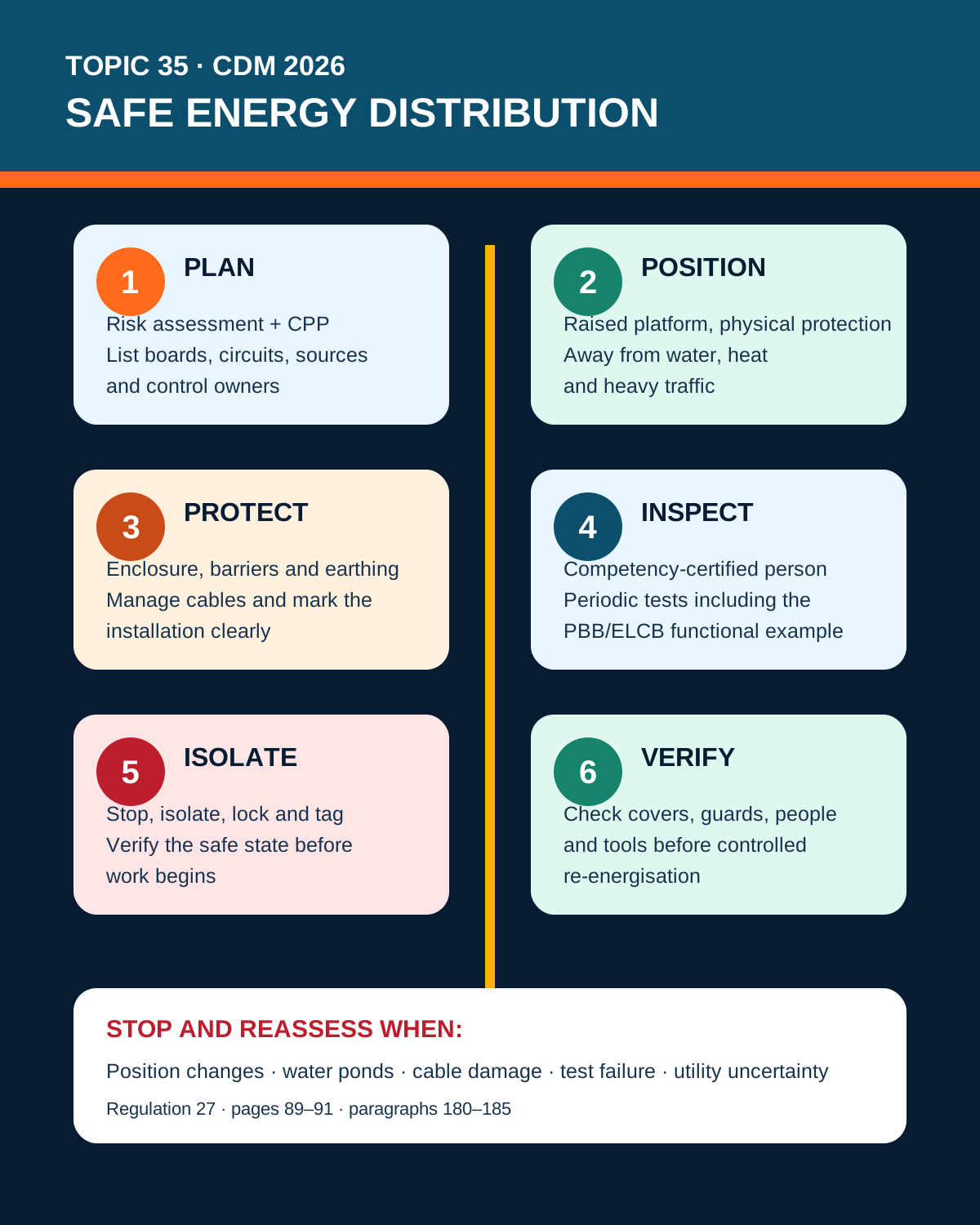
Risk assessment + CPP
Register boards, circuits, sources and control owners before installation.
A temporary energy distribution installation is a system, not merely a board fitted with sockets. Regulation 27 requires the construction work contractor (CWC) to manage the installation so it does not create danger: select a suitable location, inspect it periodically, mark it clearly, and control overhead electric power cables and underground services. The construction phase plan (CPP) and risk-assessment findings should determine the layout, protection, inspections and isolation method.
Position the board in a suitable location
Paragraphs 180–181 of the First Edition CDM Guidelines 2026 say that the CWC should take account of the risk assessment and CPP. Examples of suitable positioning include a raised platform, physical protection, no exposure to rain, heat or water, and a safe distance from the main route used by heavy vehicles. The actual decision must reflect site conditions and the installation design; these examples do not create universal dimensions.
On a Malaysian site that changes by phase, reassess the position when lorry routes, cranes, pumps or wash areas move. Provide stable support, suitable roofing or enclosure, impact protection and a work route that does not force cables across water or traffic paths. Panel doors should close and access should be controlled. Do not use the working space in front of a board for material storage.
Circuit protection and the PBB/ELCB terminology
Paragraph 182 gives the example of a functional test on a Pemutus Litar Bocor ke Bumi (PBB/ELCB) by pressing its test button. The series master plan uses the term RCD; this article preserves JKKP’s terminology. Mentioning PBB/ELCB is not permission to select a generic type, sensitivity or operating time. A person holding an electrical wireman competency certificate recognised by the Energy Commission should determine, install and inspect suitable protection in accordance with the design and applicable electrical legislation.
The test button is only one functional check identified by the guideline. It does not replace inspection of the board, earth continuity, polarity, cable condition, overcurrent protection or measurements required by the competent person. Records should identify the board or circuit tested, date, result, instrument where applicable, inspector and action taken after a failure.
Isolation, locking and re-energisation
Before opening a board, connecting a circuit or repairing a cable, identify the energy source, isolation point and possible backfeed. Stop equipment in a controlled manner, isolate the supply, apply a lock and identification tag under the site procedure, and verify the safe state using the test method set by the competent person. Control the keys and allow only authorised persons to alter the condition.
Regulation 27 does not state “lockout-tagout” as a separate requirement. Locking is presented here as a practical control for maintaining isolation. Before re-energisation, confirm that work is complete, covers and guards are installed, people and tools are clear, lock owners have completed the process and the responsible person verifies the condition. Do not re-energise merely because the shift has changed or production is urgent.
Overhead cables and underground services
Where an overhead electric power cable creates a risk, the CWC must route it away from the risk area or isolate and earth it from the construction work where necessary. If neither option is practicable, Regulation 27 requires a suitable warning notice together with barriers to exclude unnecessary plant, suspended protection where vehicles must pass below the cable, or a measure providing an equivalent level of safety.
For underground services, construction work likely to create a risk must not proceed unless suitable and sufficient steps have been taken, so far as practicable. Obtain utility plans, confirm the actual location before excavation, mark the route and, where necessary, disconnect the supply. An old drawing or surface marker alone is not confirmation. Coordinate the permit to dig, detection, trial holes and communication with the utility owner.
Fictional example MY-35-01
Fictional example — not a real incident, statistic or legal conclusion.
A building project in Johor changes its lorry route after prolonged rain. A temporary distribution board is now too close to the route and ponded water is approaching outgoing cables. The supervisor closes the area and stops use of the board; the electrical competent person isolates and locks the supply. The CWC reviews the risk assessment and CPP, then relocates the installation onto a raised, guarded and weather-protected platform. Cables receive mechanical protection. The competent person inspects the installation, performs the specified tests including the PBB/ELCB functional check, records the results and only then authorises re-energisation. This example sets no universal distance, PBB/ELCB rating or inspection frequency.
Compliance actions
- List every board, circuit, source and control owner.
- Coordinate the installation design with the risk assessment and CPP.
- Position the installation suitably, protect it and mark it clearly.
- Protect cables from water, heat, impact, traffic and mechanical damage.
- Use a person holding competency certification recognised by the Energy Commission.
- Define periodic inspections and immediate action for failed results.
- Apply controlled isolation, locking, verification and re-energisation.
- Control overhead cables and verify underground services before work.
Evidence to retain
Retain the single-line distribution plan and circuit schedule; risk assessment and relevant CPP section; board and cable location plan; competency certification; installation and commissioning records; board register; periodic inspection reports; test results and instrument details; PBB/ELCB records; earthing records; photographs of location and protection; defect and rectification register; permits to work; isolation and locking records; utility plans; detection results; utility-owner communications; and the re-energisation record.
Common failures
- Placing a board directly on the ground or in a ponding area.
- Leaving panel doors open, unlocked or unmarked.
- Treating the PBB/ELCB test button as the complete inspection.
- Allowing damaged cables or connections on a traffic route.
- Applying a tag without isolating and verifying the safe state.
- Removing another person’s lock without an approved procedure.
- Relying on an old utility plan without confirming the actual location.
- Assuming a goal post alone removes every overhead-line risk.
Supervisor checklist
- Is a current register of boards, circuits and sources available?
- Is each board’s position still suitable after site-phase changes?
- Is protection from weather, water, impact and traffic effective?
- Is the installation clearly marked and its access controlled?
- Are periodic inspections completed by a person with the relevant competency certification?
- Can test results, defects and rectification be traced?
- Is isolation locked, verified and released in a controlled manner?
- Are overhead cables and underground services identified and controlled?
Primary JKKP/DOSH references
Refer to Regulation 27, P.U. (A) 147/2024, the *First Edition CDM Guidelines 2026*, printed pages 89–91 and paragraphs 180–185, and the Guidelines for Occupational Safety and Health in the Construction Industry (Excavation Work) 2017. The competent person should also coordinate applicable electrical requirements with the Electricity Supply Act 1990 and current Energy Commission requirements.
Related articles
Garis Panduan CDM Edisi 2026
CDM 2026 · 52 of 52
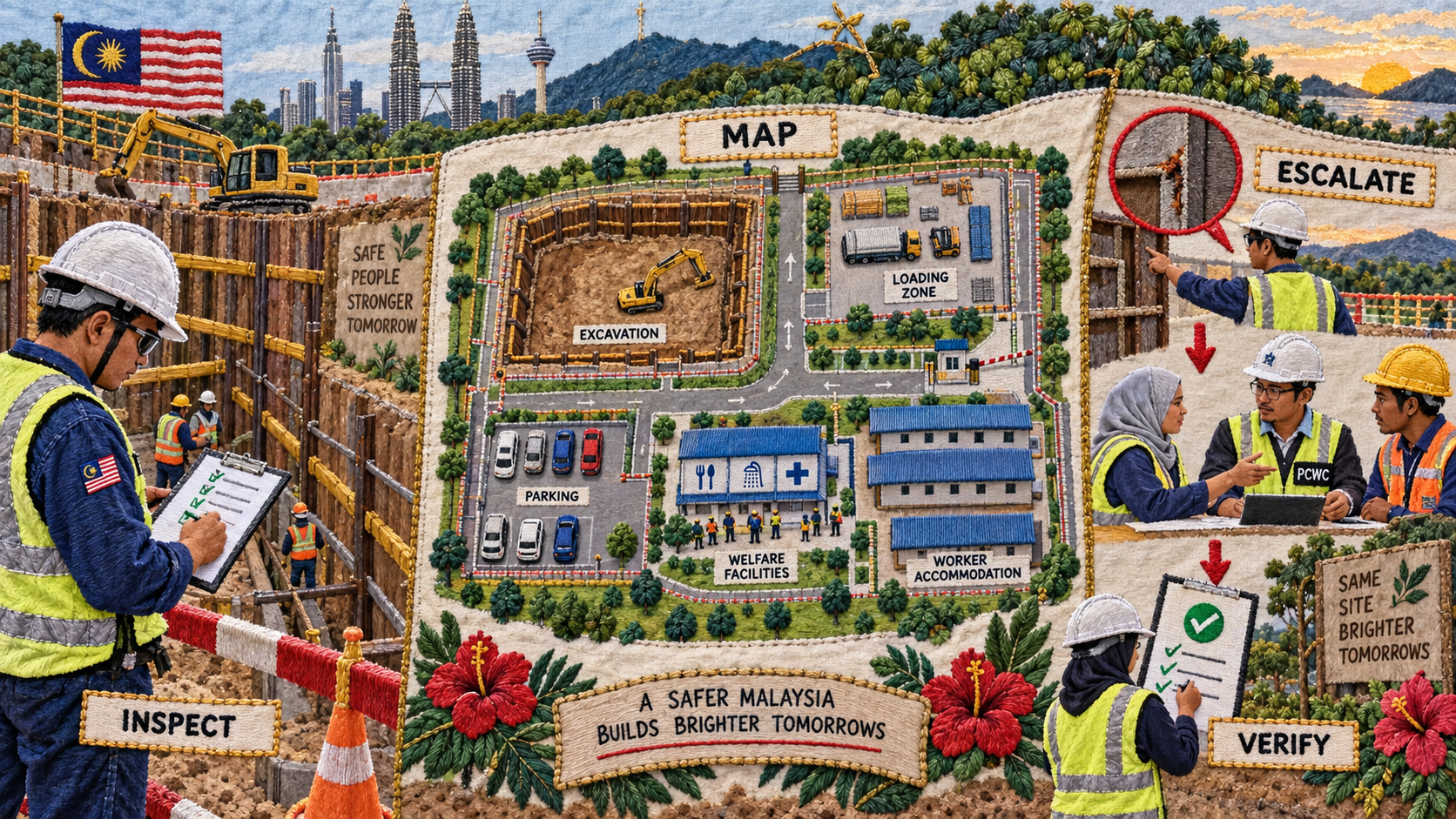
Practical Appendices: Excavation Inspection, Site Scope and Supervisor Guidance
Connect inspection reports, whole-workplace mapping and SSS supervision to action, escalation and verified closure.
Ir. Ts. Dr. Mohamad Syamir bin Senin.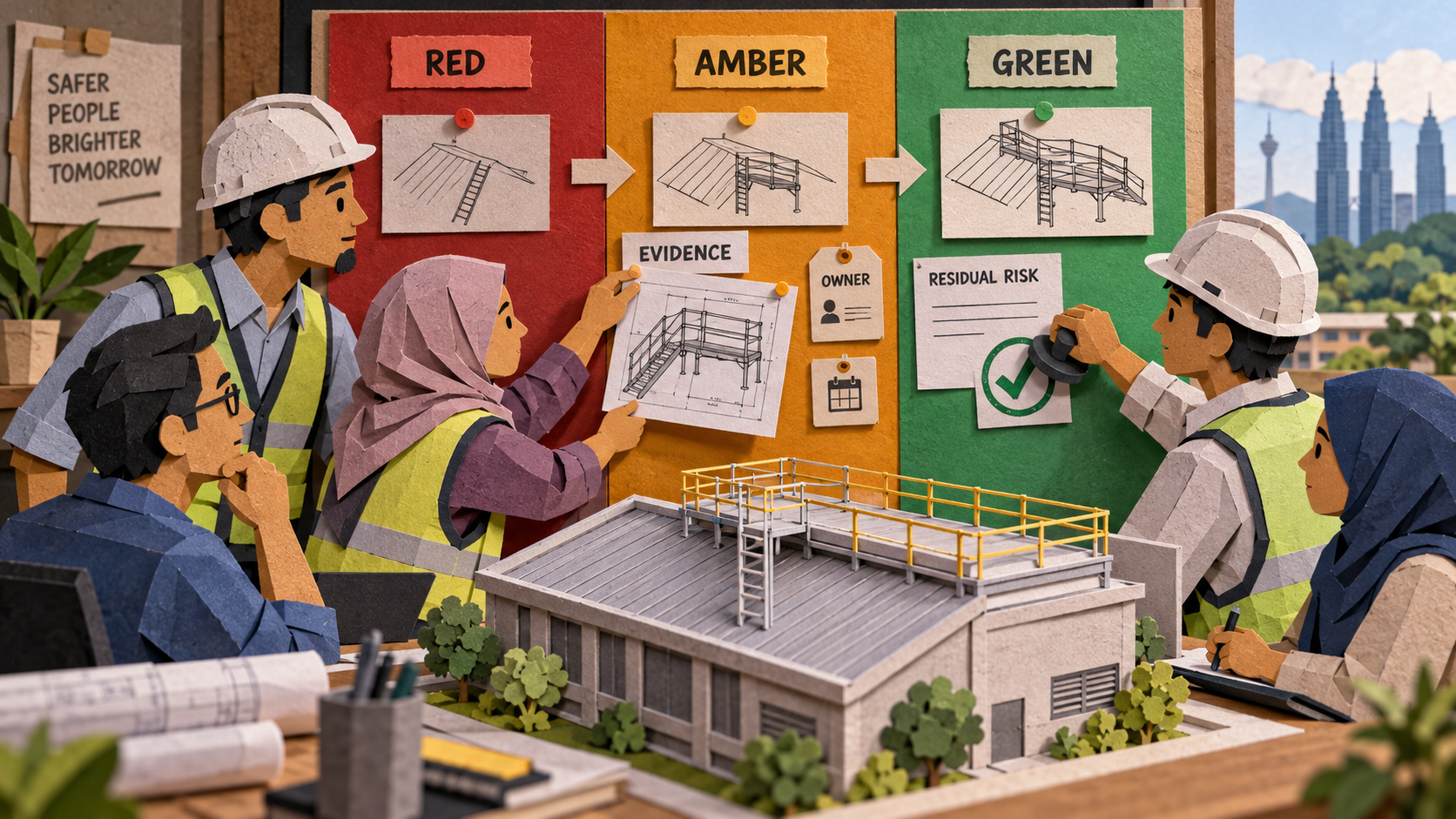
Garis Panduan CDM Edisi 2026
CDM 2026 · 51 of 52
Duty-Holder Checklists and RAG: How to Use Them Without Fooling Yourself
Use Appendices 1 and 2 as evidence-led decision controls with owners and dates—not decorative status colours.
Ir. Ts. Dr. Mohamad Syamir bin Senin.
Garis Panduan CDM Edisi 2026
CDM 2026 · 50 of 52
Third and Fourth Schedules: Notification and Work Involving Particular Risks
Practical guidance for completing project notification and connecting work involving particular risks to the PCI and CPP.
Ir. Ts. Dr. Mohamad Syamir bin Senin.