
Garis Panduan CDM Edisi 2026
Fire, Flooding and Asphyxiation: Planning for Major Scenarios
CDM 2026 · 39 of 52
Regulation 31 guidance on preventing risks from fire or explosion, flooding and substances likely to cause asphyxiation.
SIX-SLIDE BRIEFING
Major scenarios at a glance
Slide 1 / 6
Scenario
Three hazards, one method
Trace the trigger, people exposed, escalation and controls that must remain available.
Regulation 31 requires the construction work contractor (CWC) to take suitable and sufficient steps to prevent, so far as is reasonably practicable, the risk of injury to any person carrying out construction work arising from fire or explosion, flooding, or any substance likely to cause asphyxiation. These hazards should be assessed as scenarios that can escalate quickly, not as generic entries in a risk register.
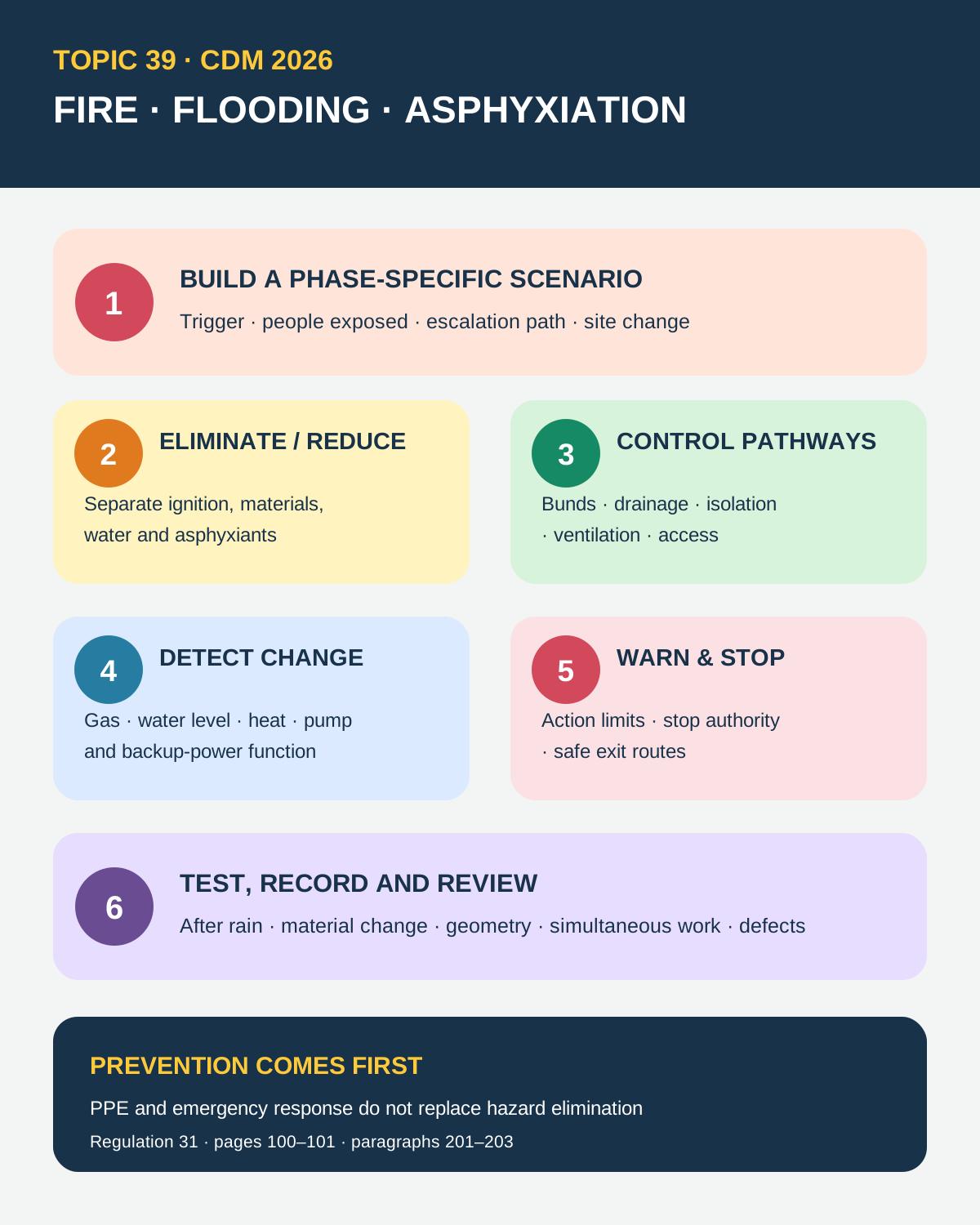
Build scenarios from actual project conditions
Use the risk assessment and construction phase plan (CPP) to map flammable materials, hot work, ignition sources, diesel tanks, gas cylinders, basements, deep excavations, surface-water flows, pumps, outlets, confined spaces and substances that can displace oxygen. Ask what can trigger the event, who may be exposed, how conditions can worsen, which controls must remain available and what changes demand a review.
Scenarios must be phase-specific. An open basement may have natural ventilation one week but become more enclosed after walls and doors are installed. A water route may change when a temporary drain is buried. Diesel storage may become exposed when hot work moves. Record review triggers such as changes to geometry, materials, weather, pumps, ventilation, temporary power or simultaneous work.
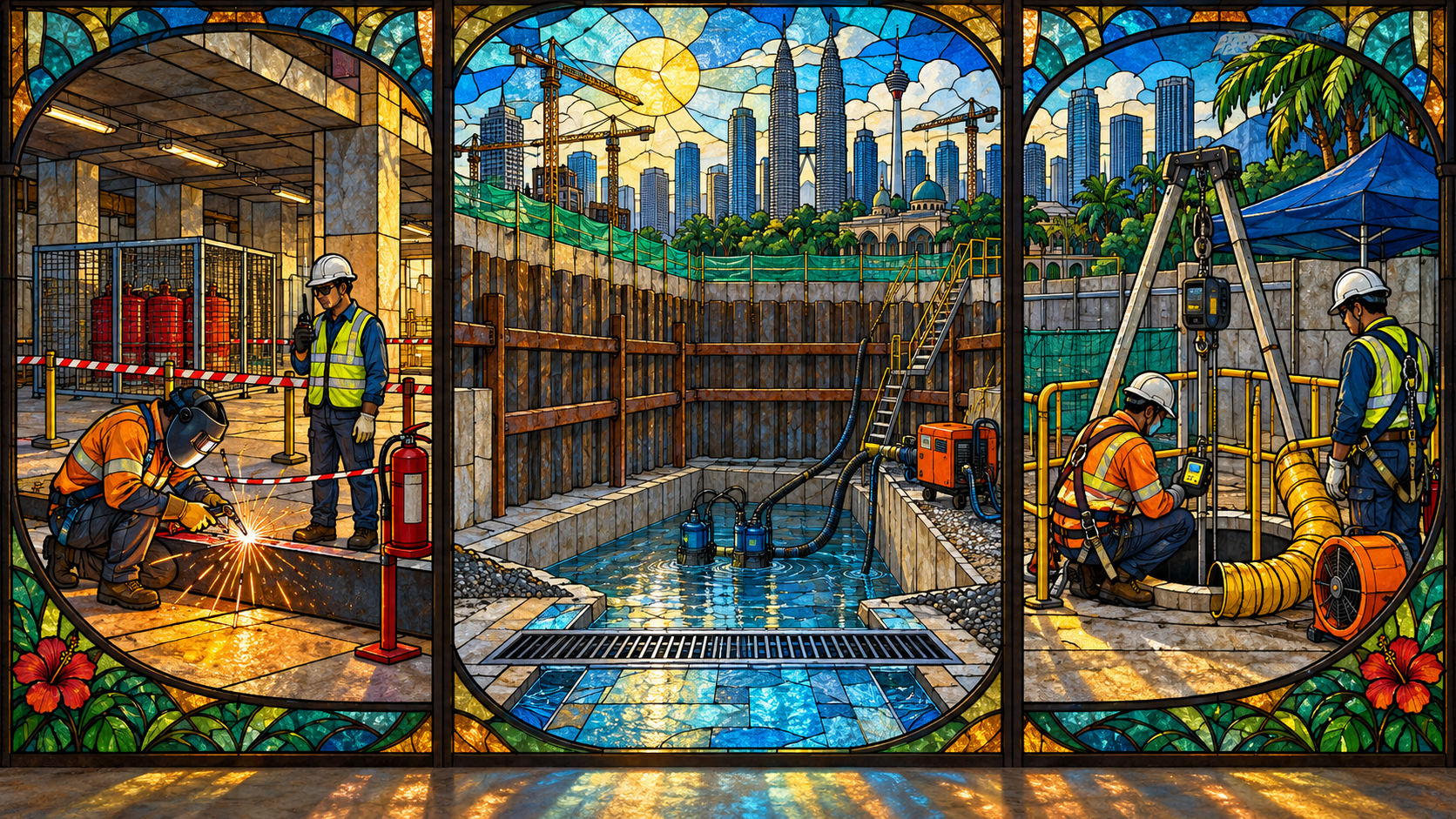
Fire or explosion
Paragraphs 201–202 use diesel storage as an example. Heat, ignition sources and leakage can create fire or explosion risks. Listed measures include a risk assessment, safe work procedure, fencing and restricted access, suitable fire extinguishers, a containment system (bund) to control leakage, and clear warning signs. The list is not exhaustive, and controls should be selected from the risk.
In practice, separate hot work from fuel and combustible material, control permits and the fire-watch period according to the assessment, manage cylinders correctly, keep exits clear and ensure suitable extinguishers are accessible. A bund must be compatible with the substance and maintained; it is not a storage place for rainwater or waste. Spillage, poor ventilation and simultaneous work should be assessed together because the combination can change the scenario.
Flooding
Site flooding can result from heavy rain, surface water, pump failure, a burst pipe, groundwater or discharge from adjoining land. Establish the water entry routes, low points, detectable rate of change, impact on access, temporary electricity, excavation stability and people working below ground.
Prioritise prevention through suitably designed drainage, bunding or diversion, maintained sumps, pumping capacity matched to the scenario and backup power where a power failure could defeat the control. Define water levels or conditions that trigger work stoppage and evacuation before routes are affected. A post-rain inspection must assess actual conditions; the presence of a pump alone does not prove that protection works.
Asphyxiation and confined spaces
A substance likely to cause asphyxiation can reduce or displace oxygen. Hazards may arise from inert gas, combustion, vapours, decomposition, tank work or spaces with restricted ventilation. Do not use smell as a detector and do not assume that a space is safe merely because its door is open.
Identify relevant spaces and activities, prevent substance entry, isolate lines or energy that could introduce a hazard, test the atmosphere with suitable equipment, provide ventilation and control access. Paragraph 203 states that where work takes place in a confined space, the CWC may refer to the *Industry Code of Practice for Safe Working in a Confined Space 2010*. Entry must follow the applicable specific arrangements, including people’s capability, monitoring and rescue; this article does not replace that code.
Detection, warning and response do not replace prevention
Gas monitors, water-level alarms and fire-watch observation help detect change. Define action limits, who receives the warning, how work stops and who can isolate energy. Test function, location, calibration or equipment condition according to the manufacturer’s instructions and site system. A single power or network failure should not disable every critical control.
Emergency and rescue plans should align with the scenario, but Regulation 31 focuses on preventing injury so far as is reasonably practicable. Do not use PPE or emergency response to justify a source that can be eliminated or reduced. Coordinate Topic 39 with emergency procedures under Regulation 32 without conflating the two duties.
Fictional example MY-39-01
Fictional example — not a real incident, statistic or legal conclusion.
A commercial basement project in Kuala Lumpur enters the coating and M&E installation phase. The assessment identifies rainfall entering down the ramp, loss of power to sump pumps and vapour from work materials in an increasingly enclosed space. The CWC rearranges material storage, provides water diversion and a standby pump on a separate power source, and defines a water level for stopping work. Before coating begins, the material is confirmed, ventilation installed and the atmosphere checked under the work arrangement. Nearby hot work is separated by time and location. The example does not prescribe universal pump capacity, gas readings or distances.
Compliance actions
- Identify fire or explosion, flooding and asphyxiation scenarios for each phase.
- Eliminate or reduce sources and exposure pathways so far as is reasonably practicable.
- Separate ignition sources, fuels and incompatible work.
- Design drainage, sumps, pumps and backup power for the site scenario.
- Control confined spaces, isolation, atmospheric testing, ventilation and access.
- Define detection, warnings, action limits and stop-work authority.
- Inspect and test controls and review after change or severe weather.
- Align prevention with applicable emergency and rescue plans.
Evidence to retain
Retain risk assessments and CPP reviews; material inventories and safety data sheets; storage, bunding, hot-work and isolation plans; relevant permits; extinguisher inspection records; drainage plans and the calculation or basis for pump selection; pump and backup-power test records; weather information used for site decisions; the confined-space register; atmospheric testing, calibration and ventilation records; entry authorisations; briefings; training records; stop-work triggers; and defect, correction and release records.
Common failures
- Using one generic assessment without phase-specific scenarios.
- Locating hot work near fuel or combustible materials.
- Allowing a bund to fill with water or material that reduces its containment capacity.
- Providing pumps without backup power where power loss is a credible scenario.
- Setting a flood warning only after the exit route is affected.
- Assuming yesterday's open space still has a safe atmosphere today.
- Relying on smell, PPE or a fan without isolation and verification.
- Failing to review risk after changes in materials, geometry, weather or simultaneous work.
Supervisor's checklist
- Have all three hazard groups been assessed for today's phase and location?
- Are materials, ignition sources and incompatible work separated?
- Are diesel storage, access, bunds, signs and extinguishers in good condition?
- Are drainage, sumps, pumps, backup power and stop-work triggers available?
- Are confined spaces identified and entry controlled?
- Are detectors, alarms and ventilation checked and reliable?
- Does everyone know the warning, exit route and who stops work?
- Are changes and defects closed out before work resumes?
Primary JKKP/DOSH references
Refer to Regulation 31, P.U. (A) 147/2024, the *First Edition 2026 CDM Guidelines*, printed pages 100–101, paragraphs 201–203, and the Industry Code of Practice for Safe Working in a Confined Space 2010 where confined-space activities are involved. The additional reference does not alter the precise scope of Regulation 31.
Related articles
Garis Panduan CDM Edisi 2026
CDM 2026 · 52 of 52
Practical Appendices: Excavation Inspection, Site Scope and Supervisor Guidance
Connect inspection reports, whole-workplace mapping and SSS supervision to action, escalation and verified closure.
Ir. Ts. Dr. Mohamad Syamir bin Senin.
Garis Panduan CDM Edisi 2026
CDM 2026 · 51 of 52
Duty-Holder Checklists and RAG: How to Use Them Without Fooling Yourself
Use Appendices 1 and 2 as evidence-led decision controls with owners and dates—not decorative status colours.
Ir. Ts. Dr. Mohamad Syamir bin Senin.
Garis Panduan CDM Edisi 2026
CDM 2026 · 50 of 52
Third and Fourth Schedules: Notification and Work Involving Particular Risks
Practical guidance for completing project notification and connecting work involving particular risks to the PCI and CPP.
Ir. Ts. Dr. Mohamad Syamir bin Senin.