
Garis Panduan CDM Edisi 2026
Fire Detection and Extinguishers: Match the Hazard
CDM 2026 · 42 of 52
Regulation 34 guidance for risk-based detection, alarms, extinguishers, user instruction and hot-work control.
SIX-SLIDE BRIEFING
Fire control at a glance
Slide 1 / 6
Basis
Regulation 34
Provide suitable and sufficient fire-fighting equipment and fire detection and alarm systems.
Regulation 34 of Malaysia's Occupational Safety and Health (Construction Work) (Design and Management) Regulations 2024 defines the outcome for a construction work contractor. Where necessary in the interests of safety and health, the site must have suitable and sufficient fire-fighting equipment and fire detection and alarm systems. The equipment and systems must be provided and located in suitable places, indicated by suitable signs, inspected, tested at suitable intervals and properly maintained.
Start with the actual hazard
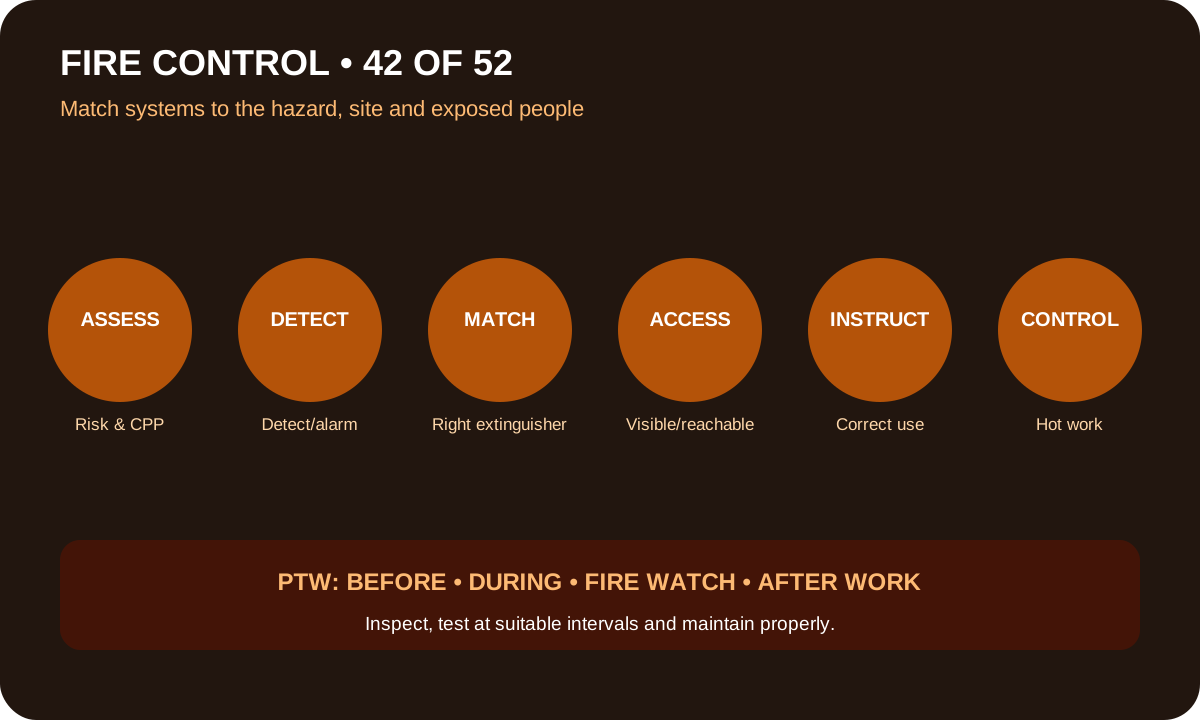
Selection should not start by asking, “How many extinguishers do we need?” Start with the risk assessment and construction phase plan (CPP). Identify combustible materials, gases, liquids, hot work, temporary electrical installations, machinery, storage, enclosed areas, building levels and the people likely to occupy each zone. Subregulation 34(2) requires the contractor to consider the matters in subregulation 32(2), including site use, equipment and dimensions and the maximum number of people likely to be present.
Hazards and layouts change with the phase. A bare concrete floor may have a different profile after temporary cables, finishes, packaging and gas cylinders arrive. Large sites such as dams, tunnels, airports or highways may need detection and alarm methods suited to different workplace conditions. A whistle, siren or other system is useful only if people in the actual zone can hear or understand it and it is integrated with the emergency procedure.
Match detection, alarm and extinguishing
Select detection according to how a credible fire could start and be detected. Consider dust, vapour, temporary work, possible loss of power and area coverage. Avoid detectors that repeatedly create false alarms because they are wrongly located; equally, do not disable detection without assessed alternative control. The alarm must reach exposed people, including remote workers, people wearing hearing protection, night workers and visitors.
Extinguisher type should be matched to the hazard through competent assessment and manufacturer or JBPM information. This article does not prescribe universal classes or numbers because the combination of materials, energy and environment differs from site to site. Labels, signs and manufacturer instructions must be clear. Manual extinguishers must be easily visible, readily accessible at all times and not blocked by pallets, hoarding, doors, materials or vehicles.
Installation is not completion. Maintain an asset register connecting a unique number, type, location, inspection date, test date, seal condition, access condition and corrective action. Inspection and test planning can take account of manufacturer recommendations or the Fire and Rescue Department of Malaysia. If a unit is removed for service, provide suitable temporary arrangements and record its return.
Hot work and permission to work
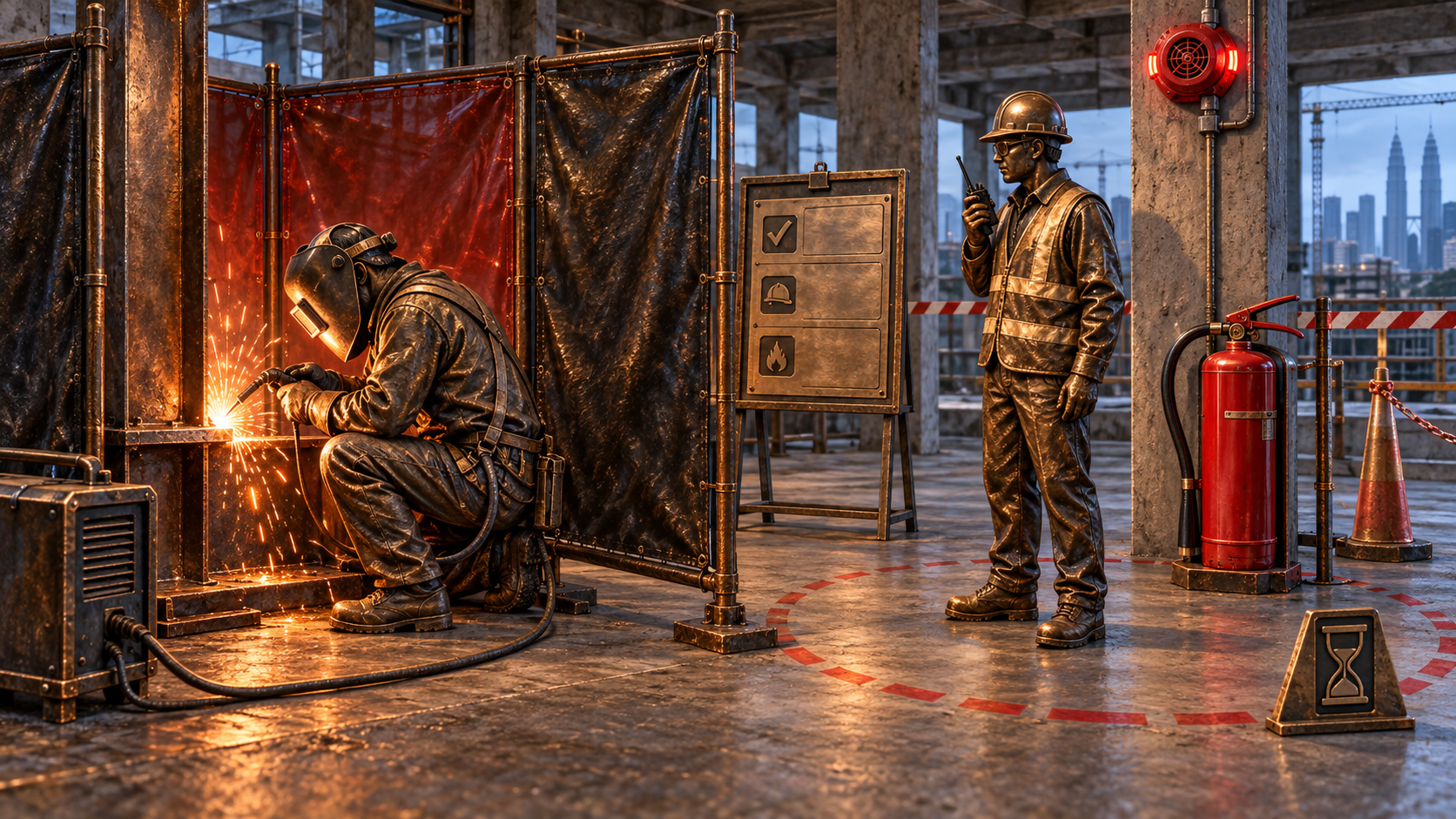
Hot work is an example of an activity that can create a particular fire risk. Subregulation 34(6) states that a person must not carry out such work or activity unless suitably instructed by the construction work contractor. A permit-to-work (PTW) system is one practical control, but the form alone is not the control.
The permit should identify scope, location, duration, combustible materials removed or protected, isolation, spark screens, ventilation condition, suitable extinguishing equipment, alarm method, appointed fire watch and post-work inspection. The post-work monitoring period must be determined by the risk assessment and project conditions; this article does not invent a universal interval. Stop the work if controls, extinguisher access or communication cannot be maintained.
Fictional example MY-42-01 — welding a steel support
This example is fictional and provided for learning; it is not a real incident. A commercial project needs to weld a steel support on level six. Packaging materials and a service opening to the floor below sit behind the proposed work zone. The supervisor does not issue the permit immediately. The team removes combustibles, contains sparks with suitable material, checks ventilation, confirms an extinguisher selected for the assessed hazard, tests the alarm method and keeps the exit route available.
An instructed fire watch is appointed and given no other task during the work. The permit records pre-start checks, controls during work and risk-assessed post-work monitoring. After welding, the adjacent area and floor below are inspected before the permit is closed. Decisions, the name of the person instructed and closure time are retained. The example does not claim that a PTW or fire watch is always sufficient; controls must match the actual hazard.
Compliance actions
- Use the risk assessment and CPP to map fire hazards by zone and phase.
- Determine suitable and sufficient fire detection and alarm systems.
- Match fire-fighting equipment to the hazard using competent input and valid information.
- Locate and sign equipment suitably; keep manual units readily accessible.
- Inspect, test at suitable intervals and maintain equipment properly.
- Instruct every person, so far as practicable, in the correct use of the equipment.
- Limit use to safe circumstances; instruction is not permission to fight a developing fire.
- Control hot work through suitable instruction, PTW where appropriate, fire watch and post-work monitoring.
- Review controls when materials, layout, work level, alarms or processes change.
Evidence to retain
Retain the risk assessment, CPP, equipment location plan, selection basis, asset register, manufacturer manuals, inspection, testing, servicing and defect records, access photographs, training or instruction records, alarm audibility tests, hot-work PTWs, fire-watch logs, post-work monitoring records and corrective-action closure evidence. Records should show who, what, when, location and result—not merely a generic signature.
Common failures
- Extinguishers are selected from habit without reference to current hazards.
- The alarm cannot be heard in noisy or remote zones.
- Manual units are hidden behind materials, doors or hoarding.
- A service tag is valid but routine access and damage checks are ignored.
- Workers are given equipment without instruction in its correct use.
- A PTW is signed after work starts or closed without post-work monitoring.
- The fire watch performs other duties and does not observe exposed areas.
- A phase change adds combustibles without a system review.
Supervisor's checklist
- [ ] Current fire hazards are mapped in the risk assessment and CPP.
- [ ] Detection and alarm suit the site and can reach exposed people.
- [ ] Extinguishers are matched to the hazard by an appropriate person.
- [ ] Locations are signed, visible and unobstructed.
- [ ] Inspection, testing and maintenance are current and recorded.
- [ ] People have been instructed in correct use.
- [ ] Hot work has suitable instruction and controls before starting.
- [ ] Fire watch and post-work monitoring are assigned where the assessment requires them.
- [ ] Every defect has an owner and closure evidence.
Primary references
The principal legal reference is Regulation 34, read with subregulation 32(2), P.U. (A) 147. Operational explanation uses paragraphs 209 to 213 of JKKP's 2026 CDM Guidelines. Manufacturer and JBPM information should be applied to the actual equipment and site conditions. This guide does not replace the legislation or site-specific competent assessment.
Related articles
Garis Panduan CDM Edisi 2026
CDM 2026 · 52 of 52
Practical Appendices: Excavation Inspection, Site Scope and Supervisor Guidance
Connect inspection reports, whole-workplace mapping and SSS supervision to action, escalation and verified closure.
Ir. Ts. Dr. Mohamad Syamir bin Senin.
Garis Panduan CDM Edisi 2026
CDM 2026 · 51 of 52
Duty-Holder Checklists and RAG: How to Use Them Without Fooling Yourself
Use Appendices 1 and 2 as evidence-led decision controls with owners and dates—not decorative status colours.
Ir. Ts. Dr. Mohamad Syamir bin Senin.
Garis Panduan CDM Edisi 2026
CDM 2026 · 50 of 52
Third and Fourth Schedules: Notification and Work Involving Particular Risks
Practical guidance for completing project notification and connecting work involving particular risks to the PCI and CPP.
Ir. Ts. Dr. Mohamad Syamir bin Senin.