
Garis Panduan CDM Edisi 2026
Fresh Air: Dust, Vapour, Gas and Oxygen Deficiency
CDM 2026 · 43 of 52
Regulation 35 guidance for fresh air, source control, ventilation, failure warnings, monitoring and RPE.
SIX-SLIDE BRIEFING
Fresh-air controls at a glance
Slide 1 / 6
Basis
Regulation 35
Take suitable and sufficient steps, so far as practicable, to provide fresh and clean air.
Regulation 35 of Malaysia's Occupational Safety and Health (Construction Work) (Design and Management) Regulations 2024 requires the construction work contractor to take suitable and sufficient steps, so far as practicable, to ensure that every construction site or nearby area has fresh and clean air. The intended outcome is a site or nearby area that is safe and without risk to safety or health. Where plant is used for that purpose, it must incorporate an effective visible or audible warning device for failure where necessary for safety or health.
Understand what can contaminate the air
The risk assessment and construction phase plan (CPP) should identify sources, exposure paths and people who may be affected. Common sources include concrete cutting or grinding, demolition, welding, paints and sealants, diesel-generator exhaust, process gases, decomposition and work in spaces with restricted airflow. Risk is not confined to the task location; contaminated air can travel to another floor, site office, public route or neighbouring premises.
Do not use the phrase “adequate ventilation” without recording its basis. Record the substance or process, location, duration, number of people, enclosure, openings, airflow direction, nearby discharge and phase changes. Decide whether monitoring is required to verify controls. For changing atmospheres or confined-space work, entry decisions, monitoring and rescue must be managed under the applicable system by competent people in accordance with relevant requirements.
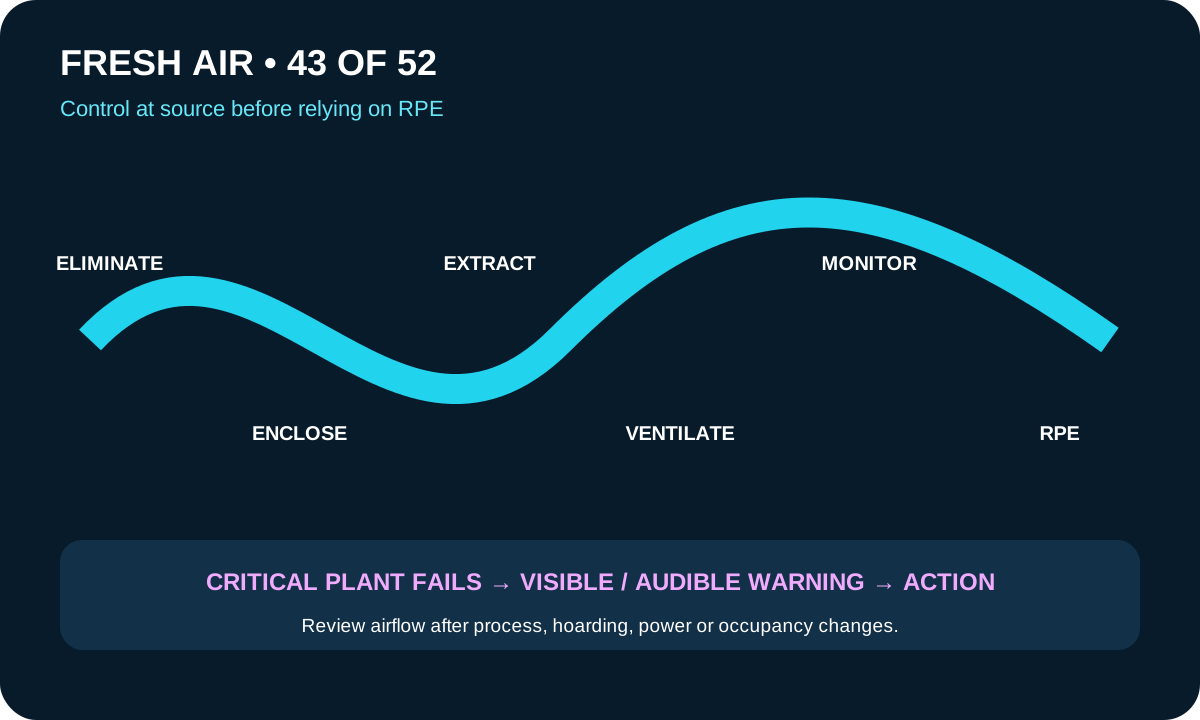
Prioritise control at source
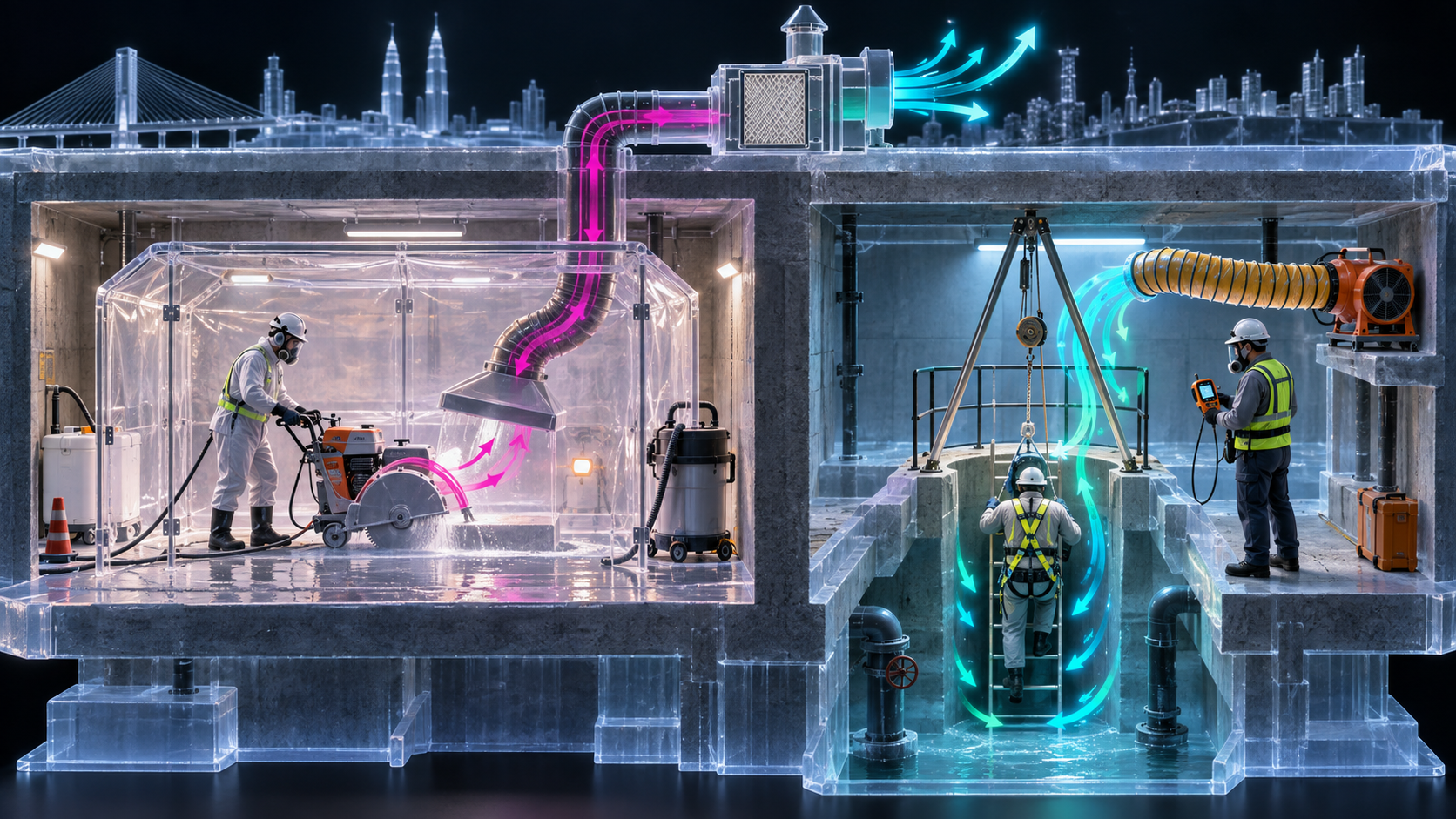
Begin with elimination or substitution where possible: use pre-cut components, wet methods, lower-volatility products or plant without combustion exhaust inside the space. Next enclose the process or use local exhaust ventilation (LEV) as close as practicable to the source. Extraction positioned too far from a blade or release point may simply draw contamination through the worker's breathing zone.
General ventilation or an air blower can supply fresh air and dilute or move contamination, but it does not necessarily replace source capture. Arrange supply and exhaust so there is no short-circuiting, stagnant zone or re-entry into occupied areas. Do not push contaminated air towards somebody else. Protect ducting from damage, inspect connections and provide a suitable power source.
Where safety or health depends on ventilation or extraction plant, assess the consequence of failure. Regulation 35(2) requires an effective visible or audible warning device where necessary. People at risk must be able to receive the warning under real conditions—including noise, hearing protection and distance—and the alarm must connect to action: stop the process, leave, isolate the source or start backup arrangements.
Monitoring and RPE
Monitoring does not remove a contaminant; it confirms conditions and triggers action. Define what is measured, where, the frequency or trigger conditions, action levels from valid sources, calibration, responsible person and response to unexpected readings. Do not take one convenient reading and treat an entire space as safe.
Respiratory protective equipment (RPE) is not an automatic substitute for engineering controls. Where residual risk requires it, use a complete programme: task- and substance-appropriate selection, suitability checks, fit testing for tight-fitting facepieces, training, pre-use checks, filter change, cleaning, storage and supervision. Facial hair, damage or incorrect use can undermine protection.
Fictional example MY-43-01 — enclosed concrete cutting
This example is fictional and provided for learning; it is not a real incident. A team needs to cut a chase in a concrete floor inside a service room with one doorway. The assessment identifies respirable dust and the possibility of contamination travelling into an occupied corridor. The contractor considers whether cutting can be avoided through a precast component; when it cannot, a wet method is selected and an LEV hood is positioned near the blade.
An air mover supplies fresh air from a clean location and the LEV discharge goes to a controlled place. The failure-warning device is checked before work. A functional test shows that the process stops if extraction airflow fails. The supervisor records checks, filter condition, duct arrangement and briefing. RPE selected for residual risk operates within a suitable programme rather than as the only control. After hoarding changes, airflow is reassessed before work resumes.
Compliance actions
- Identify contaminant sources, exposure paths and affected people in the risk assessment and CPP.
- Eliminate or substitute hazardous processes and materials so far as practicable.
- Enclose or capture contamination at source using suitable methods such as wet work or LEV.
- Provide general or replacement ventilation without transferring risk to others.
- Ensure critical plant has an effective visible or audible failure warning where needed.
- Define automatic action or clear instructions when the warning operates or control fails.
- Monitor conditions where necessary using suitable instruments, locations and methods.
- Use RPE only within a complete programme for residual risk.
- Review controls after changes to materials, process, enclosure, hoarding, power or occupancy.
Evidence to retain
Retain the risk assessment, CPP, substance inventory and SDS, airflow drawings, plant specifications and manuals, commissioning records, inspection, maintenance and alarm-test records, calibration and monitoring results, actions following readings or airflow failure, training, RPE selection and fit-testing records, filter schedules, layout photographs, briefings and defect-closure evidence. Records should show actual conditions and resulting decisions.
Common failures
- A fan circulates dust within the space without capturing or safely discharging it.
- The LEV hood is too far from the source or ducting leaks or collapses.
- Generator exhaust re-enters through an opening or is discharged towards other people.
- A failure alarm is installed but cannot be perceived or has no defined response.
- One reading is used to represent every floor and location.
- RPE becomes the only control without selection, fit testing or maintenance.
- A hoarding change creates a stagnant zone but controls are not reassessed.
Supervisor's checklist
- [ ] Sources, paths and recipients of contamination are identified.
- [ ] Elimination and substitution options have been assessed.
- [ ] Source controls are close enough and functioning.
- [ ] Fresh air enters and contaminated air discharges to a safe location.
- [ ] Plant, ducts, filters and power are checked.
- [ ] Failure warnings operate and the response is understood.
- [ ] Monitoring and instruments are valid where required.
- [ ] RPE is managed through a complete residual-risk programme.
- [ ] Phase or layout changes have triggered review.
Primary references
The principal legal reference is Regulation 35, P.U. (A) 147. Operational explanation uses paragraphs 214 to 216 of JKKP's 2026 CDM Guidelines. Other requirements concerning chemicals, confined spaces, monitoring and RPE must be assessed against the actual work; this article does not create additional legal conclusions.
Related articles
Garis Panduan CDM Edisi 2026
CDM 2026 · 52 of 52
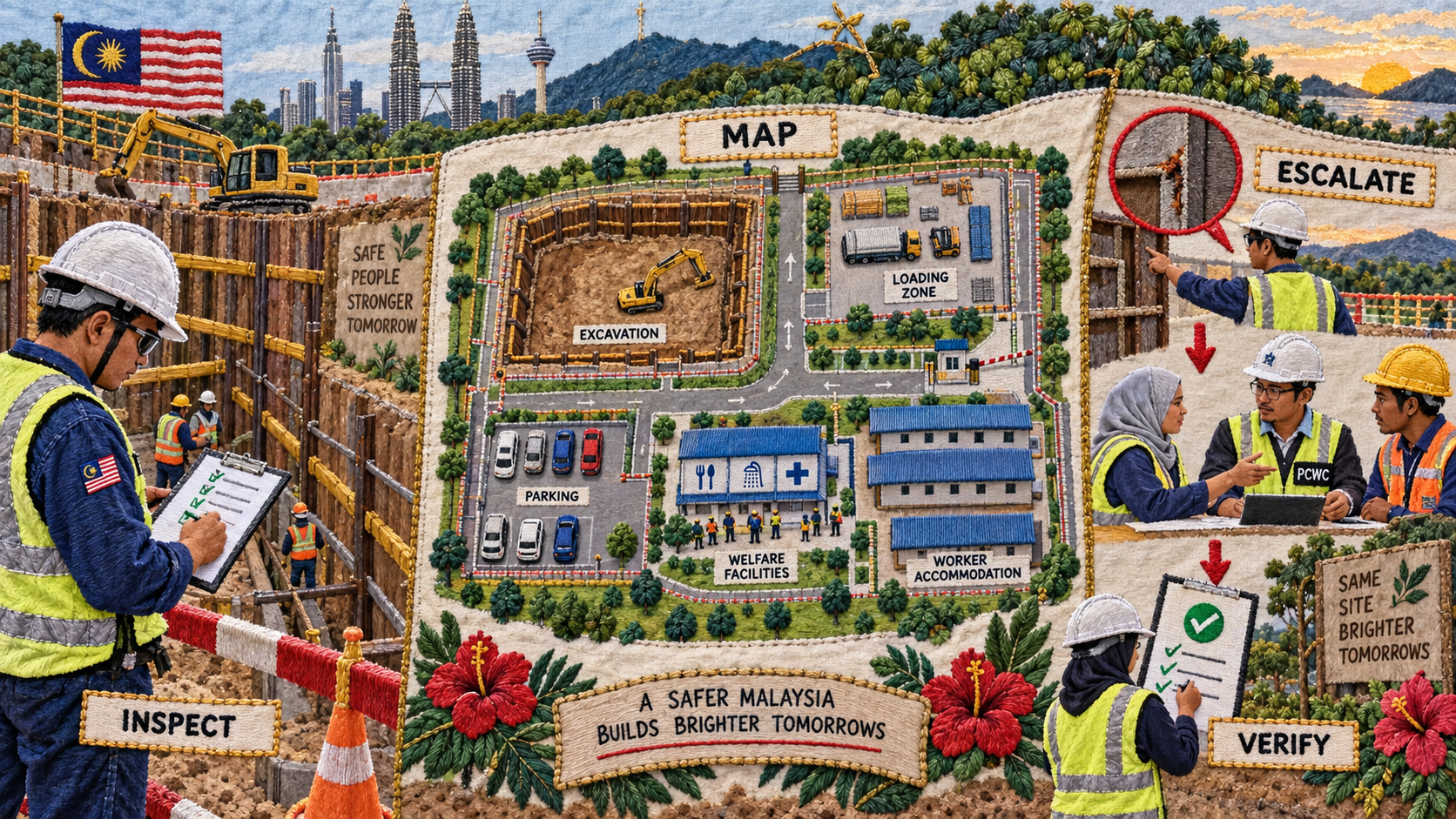
Practical Appendices: Excavation Inspection, Site Scope and Supervisor Guidance
Connect inspection reports, whole-workplace mapping and SSS supervision to action, escalation and verified closure.
Ir. Ts. Dr. Mohamad Syamir bin Senin.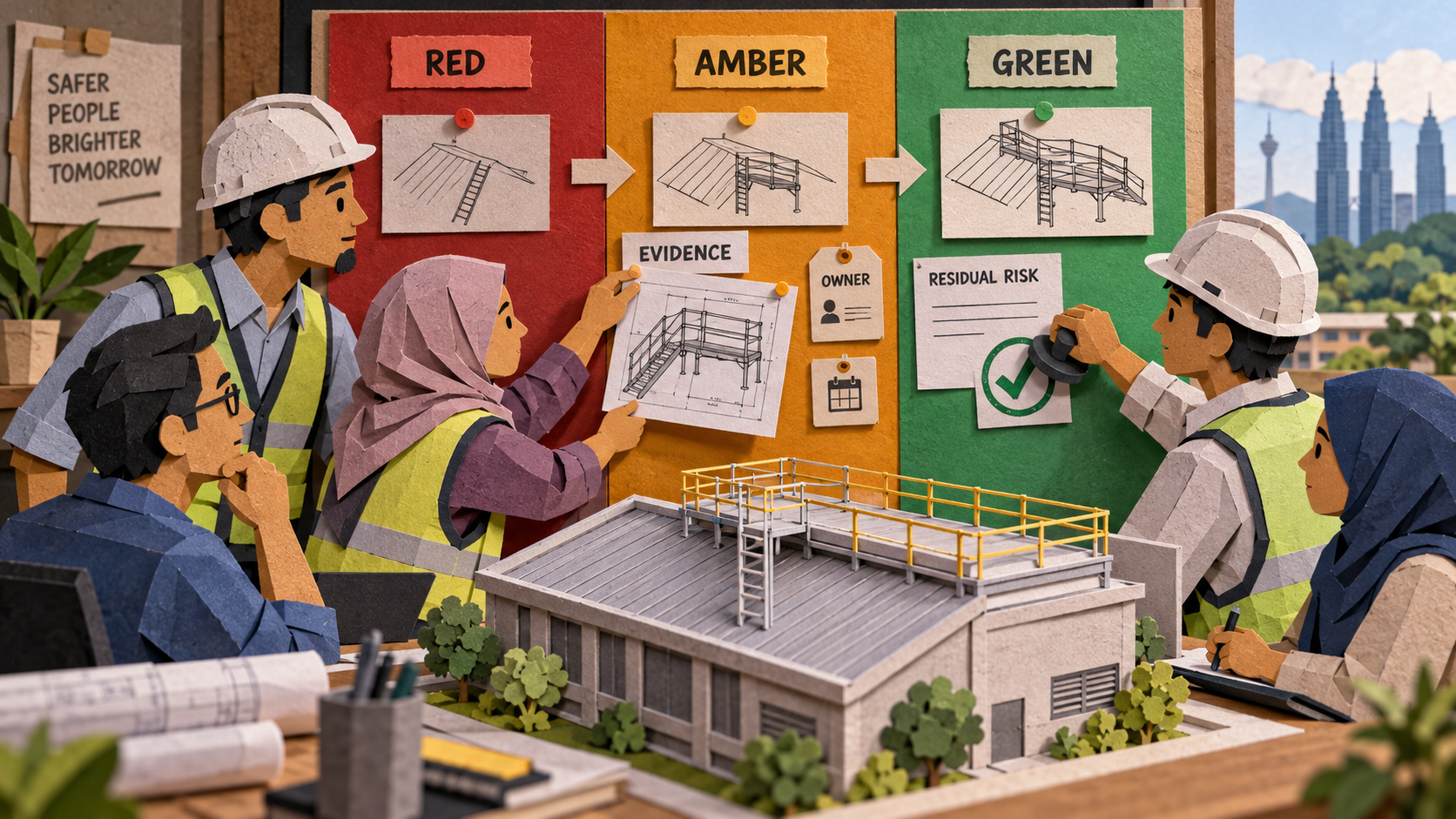
Garis Panduan CDM Edisi 2026
CDM 2026 · 51 of 52
Duty-Holder Checklists and RAG: How to Use Them Without Fooling Yourself
Use Appendices 1 and 2 as evidence-led decision controls with owners and dates—not decorative status colours.
Ir. Ts. Dr. Mohamad Syamir bin Senin.
Garis Panduan CDM Edisi 2026
CDM 2026 · 50 of 52
Third and Fourth Schedules: Notification and Work Involving Particular Risks
Practical guidance for completing project notification and connecting work involving particular risks to the PCI and CPP.
Ir. Ts. Dr. Mohamad Syamir bin Senin.