
Garis Panduan CDM Edisi 2026
Temperature and Weather: Heat, Rain, Wind and Stop-Work Criteria
CDM 2026 · 44 of 52
Regulation 36 guidance for reasonable temperatures, weather protection, monitoring, stop-work and verified restart.
SIX-SLIDE BRIEFING
Weather decisions at a glance
Slide 1 / 6
Basis
Regulation 36
Keep indoor temperatures reasonable and protect outdoor work from adverse weather.
Regulation 36 requires the construction work contractor to take suitable and sufficient steps, so far as practicable, to ensure that the temperature of an indoor construction workplace is reasonable for its use. Where necessary for the safety or health of people working outdoors, the site must also be arranged to protect them from adverse weather, considering the site's use and any protective clothing or plant provided. In Malaysia, this must become real work decisions for heat, heavy rain, lightning, wind and rapidly changing conditions - not merely a water station or a general instruction to “watch the weather”.
Legal scope and decision basis
The specific duty holder is the construction work contractor. Regulation 36(1) covers indoor construction workplaces, including conditions that may arise in cabins, office containers, tunnels or enclosed basement floors. Its legal test is a temperature that is reasonable having regard to the purpose for which the place is used. Regulation 36(2) covers people working outdoors where protection from adverse weather is necessary for safety or health.
Paragraphs 217 to 219 of DOSH's 2026 CDM Guidelines connect action to the risk assessment and construction phase plan (CPP). The guidance identifies excessively hot or cold temperatures, heavy rain, intense sunshine and storms; for outdoor work it also refers to extreme heat, lightning and heavy rain. Example measures include air circulation, drinking water, work rotation, periodic rest and temporary covered rest areas.
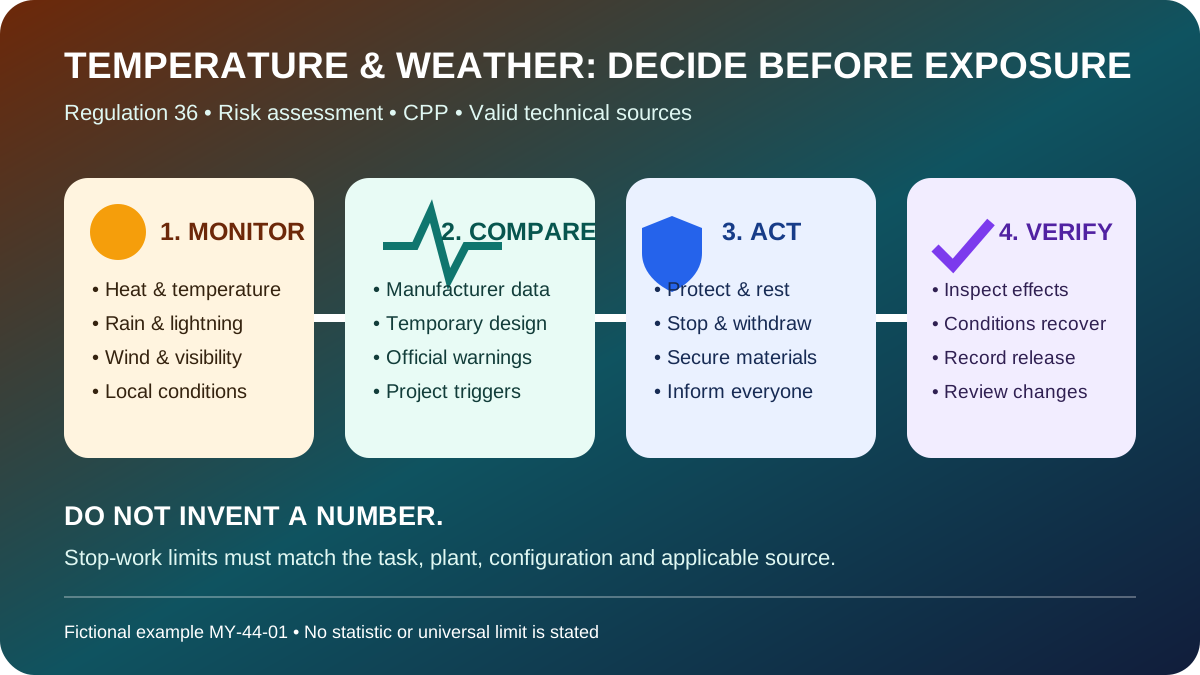
The Regulation does not set one universal number for every site. Stop-work criteria must come from the risk assessment, manufacturer instructions, temporary-works design, site procedure or another applicable technical source. A crane operation, for example, must stop at the manufacturer's wind limit applicable to its actual configuration - not at a number invented for the article or borrowed from another machine.
Compliance workflow
- Identify indoor workplaces, exposed tasks and people who may be more susceptible in the risk assessment and CPP.
- Identify task-specific weather hazards: heat, solar exposure, rain, slippery surfaces, flash flooding, lightning, wind, loss of visibility and loss of stability.
- Establish valid decision sources: official forecasts and warnings, suitable site instruments, manufacturer instructions, temporary-works design and local observation.
- Define action triggers before work starts. State who monitors, how often, where readings are taken, the action for each trigger and who can stop or restart work.
- Arrange work to reduce exposure by changing timing, rotating tasks, limiting duration and providing shade, drinking water and suitable rest.
- Control indoor temperatures with ventilation or another suitable method; do not assume that a fan alone makes the temperature reasonable.
- Protect outdoor work with a canopy or other practical protection without creating a new hazard such as unsecured sheeting in wind.
- Stop work when a trigger is met, control loads or loose materials, withdraw people from exposed areas and maintain communication.
- Before restart, verify recovery and inspect consequences such as ponded water, slippery surfaces, erosion, electrical damage, changed scaffolds or barriers.
- Review controls when the phase, plant configuration, workforce, work location or season changes.
Heat and indoor temperature
Heat management should consider workload, duration, clothing and PPE, ventilation, humidity, solar exposure and workers' acclimatisation. Make drinking water easy to reach and provide shade and periodic rest. Work arrangements should let people report symptoms without pressure to continue. Supervisors must understand the site's emergency response; this article does not prescribe a medical diagnosis or treatment.
In a container, cabin or enclosed space, assess conditions where people work and when heat load occurs. Failed air-conditioning, heat from plant or solar heating of a metal roof can change conditions quickly. Where ventilation is used, ensure it does not draw exhaust, dust or vapour from another source.
Rain, lightning and wind
Rain creates hazards beyond discomfort: slippery surfaces, reduced visibility, changed ground stability, water entering temporary electrics and wind-borne material. The procedure should distinguish tasks that can continue under protection from tasks that must stop. People must not shelter beneath suspended loads, cranes or temporary structures that have not been confirmed safe.
For lifting, scaffolds, platforms, formwork, canopies and sheet materials, use applicable manufacturer or design limits. Instrument readings must represent the risk location; a ground-level reading may not represent wind at crane height. Instruments should be suitable, maintained and used by people who understand their limitations.
Fictional example MY-44-01 - crane work and heat controls
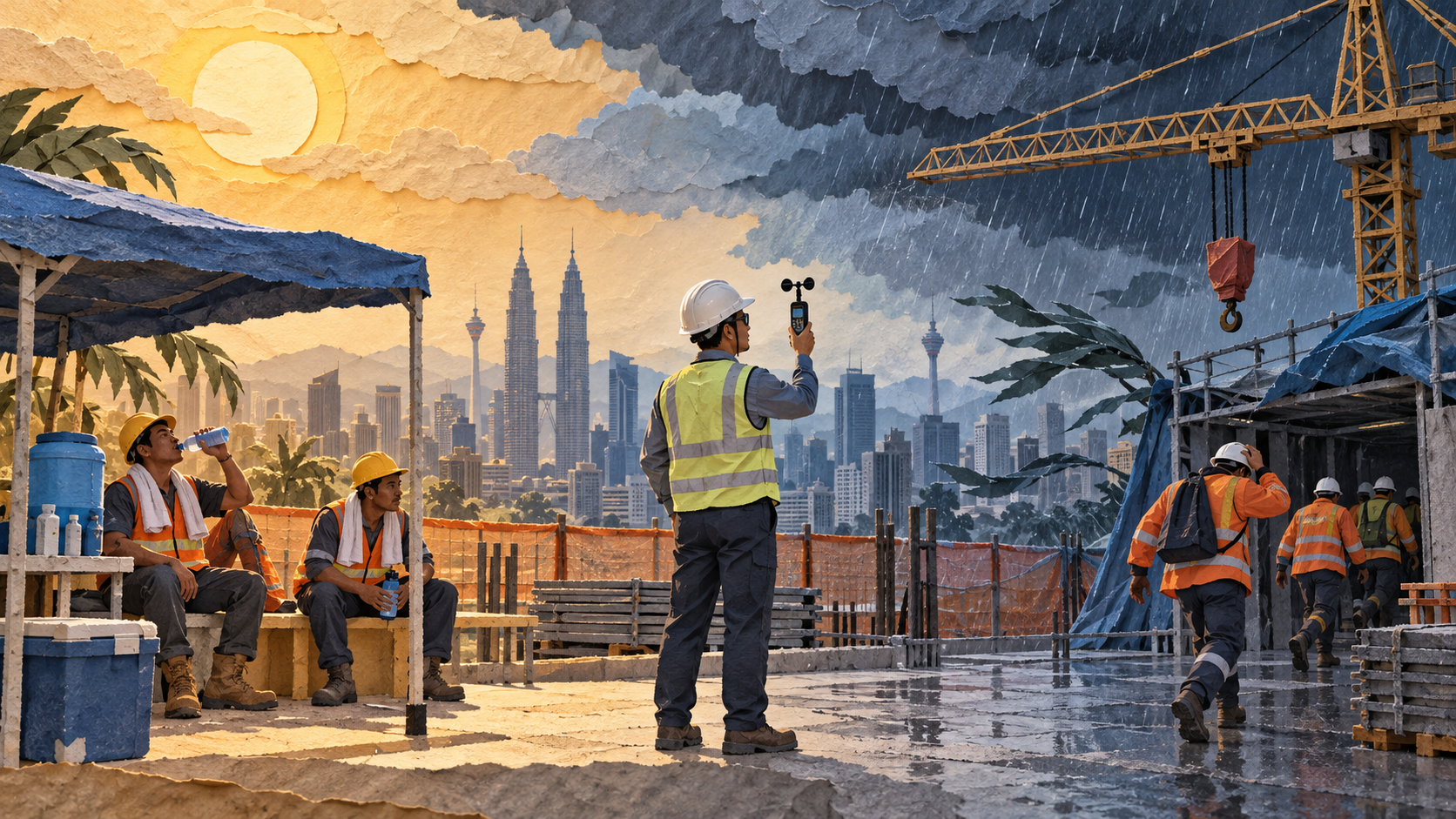
This example is fictional and is not a real incident. A multi-storey project plans panel lifting in the morning and reinforcement work at roof level at midday. The risk assessment records the manufacturer's wind limit for the crane's actual configuration, the monitoring location and the person authorised to stop operations. When the reading reaches the defined trigger, the lifting supervisor prevents new lifts, no load is left suspended, sheet materials are secured and the crew withdraws from the exposed zone.
At the same time, the reinforcement crew follows a work-rest schedule, uses a canopy designed for site conditions, has accessible drinking water and rotates tasks. When a storm warning is received, roof work stops under the procedure. After the rain, the supervisor does not immediately release work. Routes, barriers, temporary electrics, loose materials and canopy stability are inspected; current readings and instructions are recorded before restart. This example invents no wind or temperature limit - each project must use valid sources for its actual plant and task.
Evidence to retain
Retain the risk assessment and CPP; weather procedure and heat plan; warning and forecast sources; briefing records; manufacturer instructions; plant design and configuration; instrument location, specification, calibration or inspection; logs of conditions and decisions; work-rest and rotation arrangements; inspections of shade and water; stop-work, withdrawal and restart records; photographs; post-rain or post-storm inspections; defect reports and closure evidence. Records should show who decided, the information used and the resulting action.
Common failures
- The CPP says “adverse weather” but defines no trigger, decision owner or action.
- One wind limit is used for every crane, configuration, load and level without a valid source.
- A ground-level reading is treated as representative of conditions at a roof or crane boom.
- Water exists but is difficult to reach, rest is unplanned or shade is inadequate.
- Temporary canvas is installed without assessing wind load and becomes a new hazard.
- Work restarts as soon as rain stops without an inspection of consequential hazards.
- Records contain forecasts only, not actual site conditions and decisions.
Supervisor's checklist
- [ ] Task-specific temperature and weather hazards are identified in the risk assessment and CPP.
- [ ] Monitoring sources, reading locations and responsible people are defined.
- [ ] Stop-work triggers come from valid sources and match the actual configuration.
- [ ] Drinking water, shade, rest and task rotation are available and effective.
- [ ] Indoor workplaces have a reasonable temperature for their use.
- [ ] People understand warnings, withdrawal routes and stop-work authority.
- [ ] Materials, plant and temporary protection can be secured without exposing people.
- [ ] Post-weather inspections cover access, electricity, stability and loose materials.
- [ ] Restart authorisation is recorded and communicated.
Primary references
The primary legal reference is Regulation 36, P.U. (A) 147. Operational explanation uses paragraphs 217 to 219 of DOSH's 2026 CDM Guidelines. Meteorological sources, manufacturer instructions and other technical requirements must be selected for the actual project. This guide does not replace a project-specific risk assessment or legal advice.
Related articles
Garis Panduan CDM Edisi 2026
CDM 2026 · 52 of 52
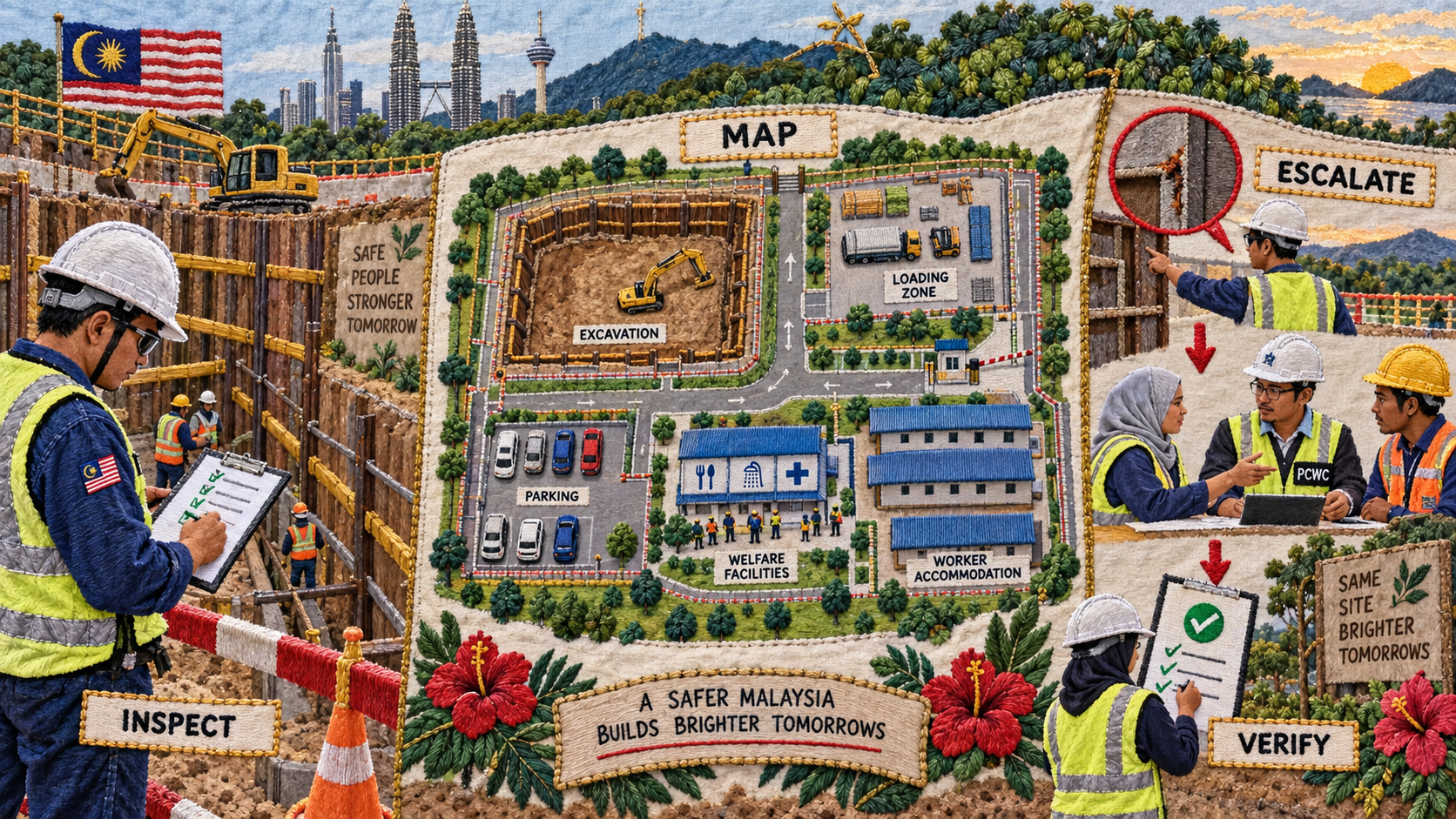
Practical Appendices: Excavation Inspection, Site Scope and Supervisor Guidance
Connect inspection reports, whole-workplace mapping and SSS supervision to action, escalation and verified closure.
Ir. Ts. Dr. Mohamad Syamir bin Senin.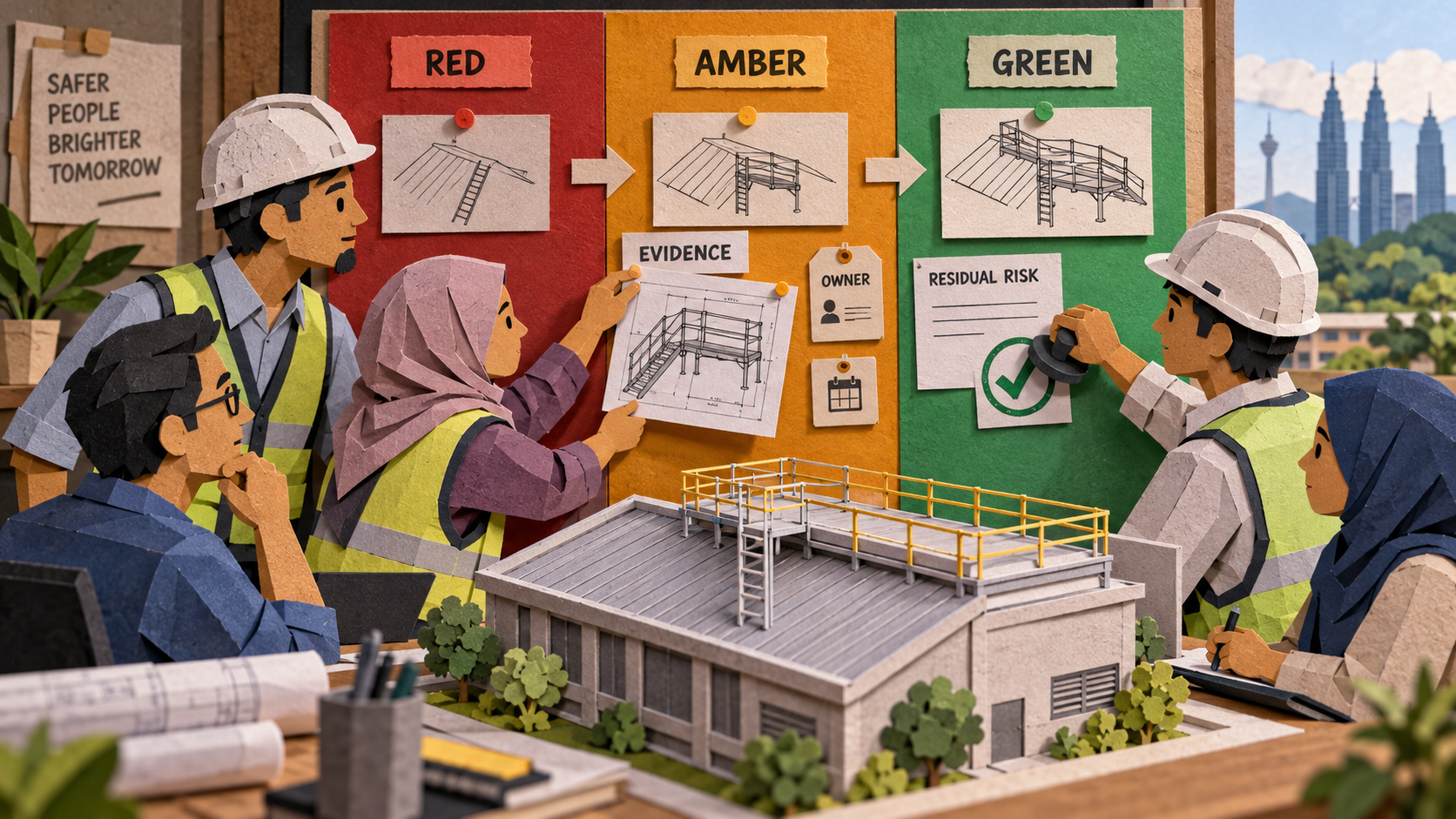
Garis Panduan CDM Edisi 2026
CDM 2026 · 51 of 52
Duty-Holder Checklists and RAG: How to Use Them Without Fooling Yourself
Use Appendices 1 and 2 as evidence-led decision controls with owners and dates—not decorative status colours.
Ir. Ts. Dr. Mohamad Syamir bin Senin.
Garis Panduan CDM Edisi 2026
CDM 2026 · 50 of 52
Third and Fourth Schedules: Notification and Work Involving Particular Risks
Practical guidance for completing project notification and connecting work involving particular risks to the PCI and CPP.
Ir. Ts. Dr. Mohamad Syamir bin Senin.