
Garis Panduan CDM Edisi 2026
Lighting: Night Work, Glare and Emergency Lighting
CDM 2026 · 45 of 52
Regulation 37 guidance for natural and artificial light, safety colours, glare control and secondary lighting.
SIX-SLIDE BRIEFING
Site lighting at a glance
Slide 1 / 6
Basis
Regulation 37
Provide suitable and sufficient natural lighting so far as practicable.
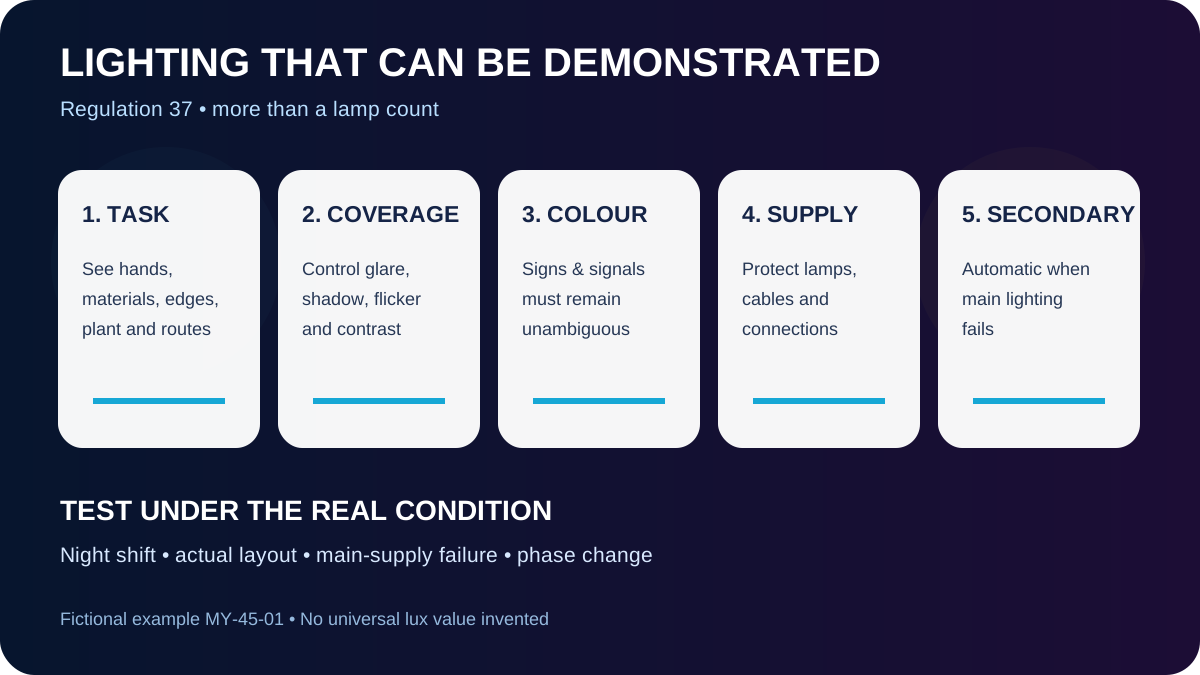
Regulation 37 requires the construction work contractor, so far as practicable, to provide suitable and sufficient natural lighting at every construction site, nearby surrounding area and traffic route to the site. Artificial-light colour must not be detrimental to, or alter perception of, a safety or health sign or signal. Suitable and sufficient secondary lighting is required wherever failure of the main artificial lighting could create a safety or health risk. Compliance is not simply a lamp count: lighting must suit the task, layout, movement, safety colours and credible failure condition.
Legal scope
Regulation 37(1) prioritises suitable and sufficient natural lighting, so far as practicable, not only at the workplace but also in nearby areas and traffic routes to the construction site. Regulation 37(2) protects the meaning of safety colours. Lighting that makes a red danger sign or green emergency-route sign look confusing defeats that control.
Regulation 37(3) requires suitable and sufficient secondary lighting wherever failure of the main artificial lighting might create a safety or health risk. Paragraph 223 of DOSH's 2026 CDM Guidelines explains backup or emergency lighting that operates automatically when power is interrupted, including at access routes, stairs, dark corridors and areas near dangerous machinery.
Regulation 37 does not prescribe one universal lighting value for every task. Level, uniformity and lamp characteristics must be determined from the risk assessment, CPP, work type, manufacturer information and applicable technical guidance. Do not invent a lux value or conclude that a single reading proves the entire area safe.
Why lighting design must be task-specific
Poor lighting can hide edges, openings, wet surfaces, cables, plant movement and work defects. Excessive or badly directed light can create glare, hard shadows and loss of contrast. A lamp behind an operator may cast a shadow over the exact task point; a floodlight facing a driver can impair vision. Flicker, connection failure and abrupt transitions between bright and dark zones also require assessment.
Colour and colour rendering matter for electrical work, conductor identification, pipework, signs and equipment status. Test under the real night-work condition, not only when daylight or office lighting still assists.
Compliance workflow
- Map workplaces, surrounding areas, traffic routes, stairs, access points, edges, openings, machinery and emergency routes.
- List visual tasks: general work, inspection, measurement, electrical termination, plant operation and movement of people.
- Use suitable and sufficient natural light so far as practicable; assess how it changes with time and phase.
- Design artificial lighting for coverage and uniformity, not lamp quantity alone. Control glare, shadow, reflection and contrast.
- Verify that artificial-light colour is not detrimental to, or does not alter perception of, safety signs and signals.
- Identify places that become dangerous if main lighting fails and provide suitable, sufficient secondary lighting that operates automatically on supply loss.
- Protect lamps, cables, connections and distribution equipment from impact, water, heat and traffic using a suitable temporary electrical system.
- Test lighting under actual work conditions, including a safely controlled simulation of main-supply failure.
- Inspect before the shift and after lamps, hoarding, scaffolds, plant or routes move.
- Record defects, control unsafe areas and verify rectification before work resumes.
Selection, placement and measurement
Position lamps so faces, hands, materials and hazards are visible without looking directly into a bright source. Several distributed sources commonly reduce shadow compared with one powerful floodlight. Portable lights should be stable, protected and clear of access routes. Cables must not create trip hazards or be exposed to water and mechanical damage.
Where measurement is used, record the instrument, calibration status, location, measurement plane, time, weather, lighting layout and task. Sample representative work areas and weak points rather than bright spots only. Measurement supports, but does not replace, observations of glare, shadow, colour, supply reliability and secondary-lighting usability.
Fictional example MY-45-01 - night concrete pour
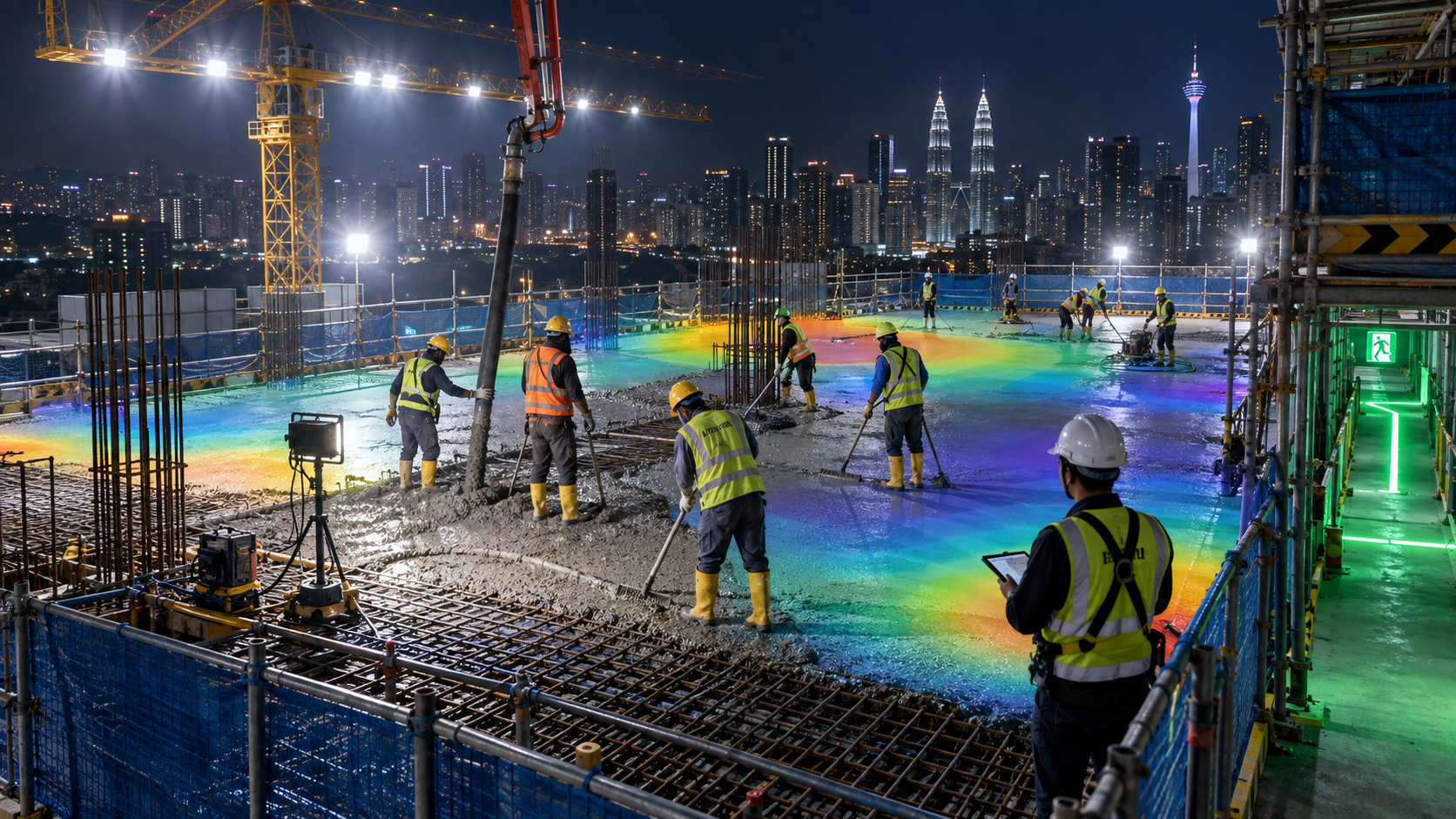
This example is fictional and is not a real incident. A Malaysian project plans a floor-slab concrete pour at night. Its lighting plan shows distributed perimeter lighting, protected low-voltage task lights near the pump and finishing areas, and an emergency route served by secondary lighting. Cables are routed away from workers and protected at crossing points.
Before the shift, the supervisor walks the delivery route, pump area, slab edges and stairs. The test identifies a floodlight that creates glare for an operator and a shadow at the finishing point. Its angle is changed and another task light is installed. Safety-sign colours are checked under artificial light. The main supply is then tested using a safe method; secondary lighting operates automatically and identifies the exit route without relying on phone torches.
During work, hoarding moves for hose access. The supervisor reassesses coverage and orders a lamp repositioned. Decisions, photographs, any required readings, secondary-lighting test and defect closure are recorded. This example states no universal lux value; the project must use valid technical criteria for its actual task.
Evidence to retain
Retain the risk assessment and CPP; lighting plans and calculations where used; lamp inventory and specifications; cable and supply layout; manufacturer information; inspection, maintenance and repair records; measurements and calibration records; glare, shadow and colour-rendering checks; main-supply failure and automatic secondary-lighting tests; briefings; photographs of actual conditions; defect logs and work-release evidence. Records should match the real phase and layout.
Common failures
- Many lamps are installed, but critical areas still have shadow or glare.
- Readings are taken only at the brightest points and treated as representative.
- Temporary lighting changes perception of sign or wiring colours.
- Emergency lights depend on the same supply or are never tested during failure.
- Cables cross wet routes or traffic areas without protection.
- Hoarding, scaffolds or plant move, but lighting is not reviewed.
- Workers use phone torches as a permanent control.
Supervisor's checklist
- [ ] Workplaces, surrounding areas and traffic routes have suitable and sufficient lighting.
- [ ] Natural light is used so far as practicable.
- [ ] Detailed tasks, edges, openings, stairs and plant movements are clearly visible.
- [ ] There is no hazardous glare, hard shadow, flicker or bright-dark transition.
- [ ] Safety-sign and signal colours remain clear and unambiguous.
- [ ] Lamps, cables and connections are protected from water, impact and traffic.
- [ ] Secondary lighting covers risk locations and operates automatically when main power fails.
- [ ] Tests, readings, defects and rectification are recorded.
- [ ] Phase or layout changes have triggered reassessment.
Primary references
The primary legal reference is Regulation 37, P.U. (A) 147. Operational explanation uses paragraphs 220 to 223 of DOSH's 2026 CDM Guidelines. Additional technical criteria must be selected for the actual task and system. This guide does not replace a project-specific risk assessment or legal advice.
Related articles
Garis Panduan CDM Edisi 2026
CDM 2026 · 52 of 52
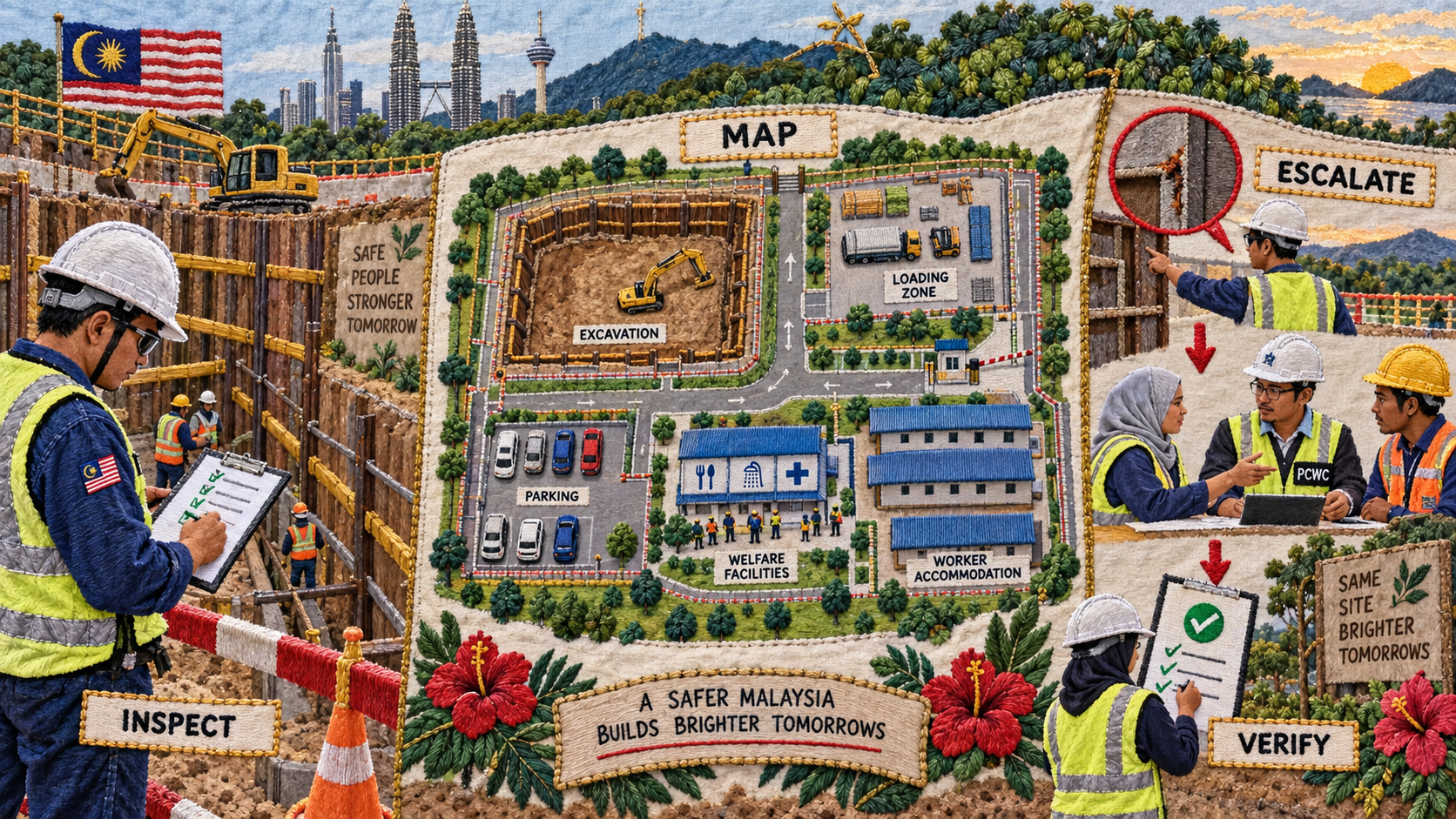
Practical Appendices: Excavation Inspection, Site Scope and Supervisor Guidance
Connect inspection reports, whole-workplace mapping and SSS supervision to action, escalation and verified closure.
Ir. Ts. Dr. Mohamad Syamir bin Senin.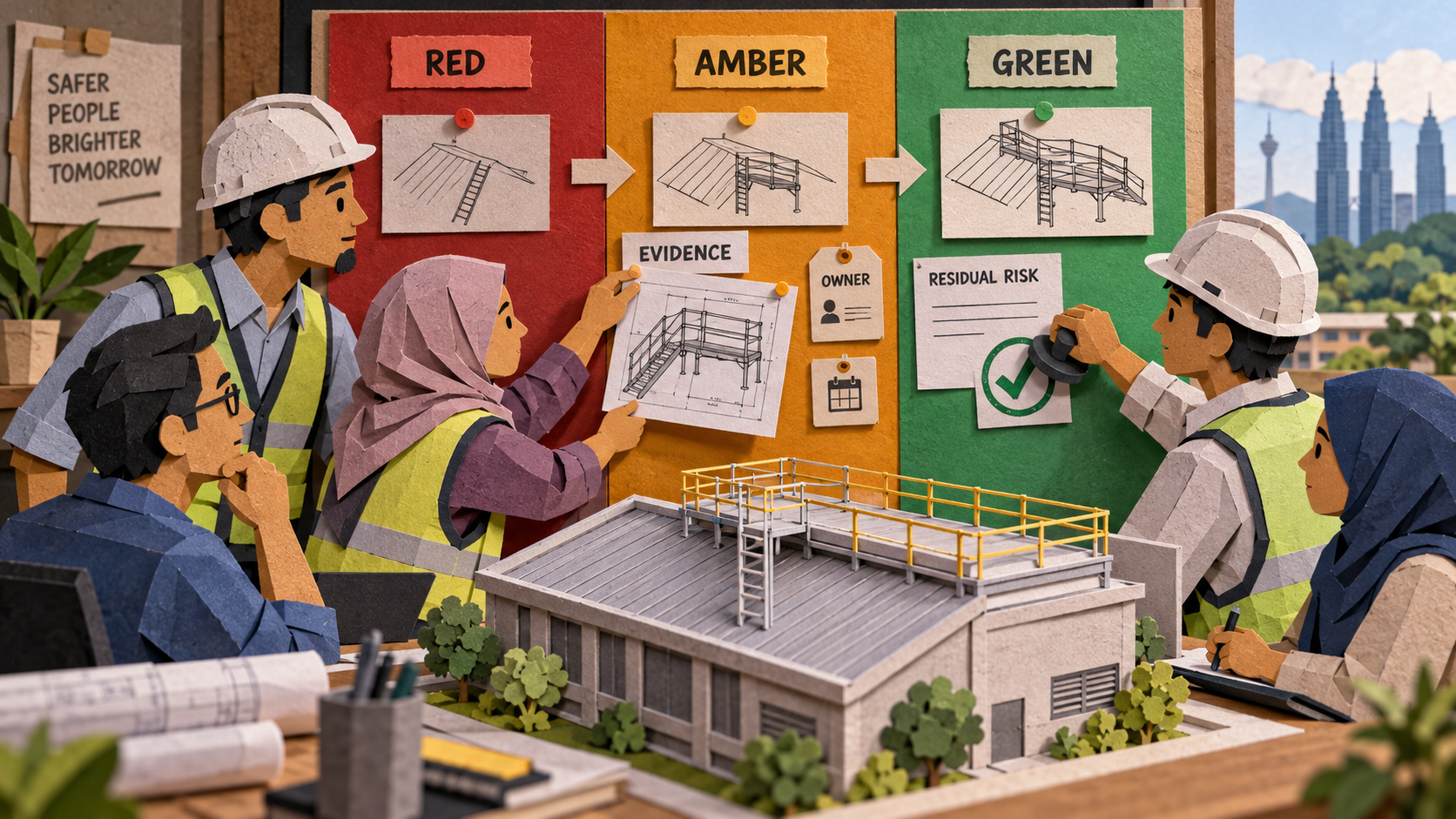
Garis Panduan CDM Edisi 2026
CDM 2026 · 51 of 52
Duty-Holder Checklists and RAG: How to Use Them Without Fooling Yourself
Use Appendices 1 and 2 as evidence-led decision controls with owners and dates—not decorative status colours.
Ir. Ts. Dr. Mohamad Syamir bin Senin.
Garis Panduan CDM Edisi 2026
CDM 2026 · 50 of 52
Third and Fourth Schedules: Notification and Work Involving Particular Risks
Practical guidance for completing project notification and connecting work involving particular risks to the PCI and CPP.
Ir. Ts. Dr. Mohamad Syamir bin Senin.