
Garis Panduan CDM Edisi 2026
Site Organisation and Security: Protecting Workers and the Public
CDM 2026 · 28 of 52
Regulation 20 guidance for good order, cleanliness, fencing, signs and public-interface control.
Six-slide briefing
The guideline at a glance
Slide 1 / 6
CDM 2026
Regulation 20
Keep the site in good order
Every site part needs good order and active work areas must remain reasonably clean.
- Material zones
- Waste bins
- Clear routes
Cleanliness is a control throughout the shift.
Use the buttons, dots or left/right arrow keys. This briefing summarises the guideline; the article and official source remain the detailed references.
Regulation 20 makes site organisation, cleanliness, boundaries and sharp objects everyday controls rather than temporary preparation for an inspection. An orderly site helps workers move and work without avoidable interference. An identifiable, fenced boundary helps prevent members of the public, school pupils, premises occupants and visitors from inadvertently entering hazardous areas.
Read Regulation 20 as four outcomes
Regulation 20(1) uses the statutory term construction site contractor and requires every part of a construction site, so far as is practicable, to be kept in good order. Parts where construction work is being carried out must be kept in a reasonably clean condition. This is a continuing requirement throughout shifts and project phases.
Regulation 20(2) requires, where necessary in the interests of safety and health and according to the level of risk, the perimeter and extent of the construction site to be identifiable by suitable signs and fenced, so far as is practicable. The decision should follow risk assessment, neighbourhood conditions, activities, working hours and foreseeable unauthorised access.
Regulation 20(3) prohibits a projecting nail or similar sharp object that may cause danger from being used or allowed to remain on timber or another object at the site. It calls for elimination of the condition, not merely marking it or reminding workers to be careful.
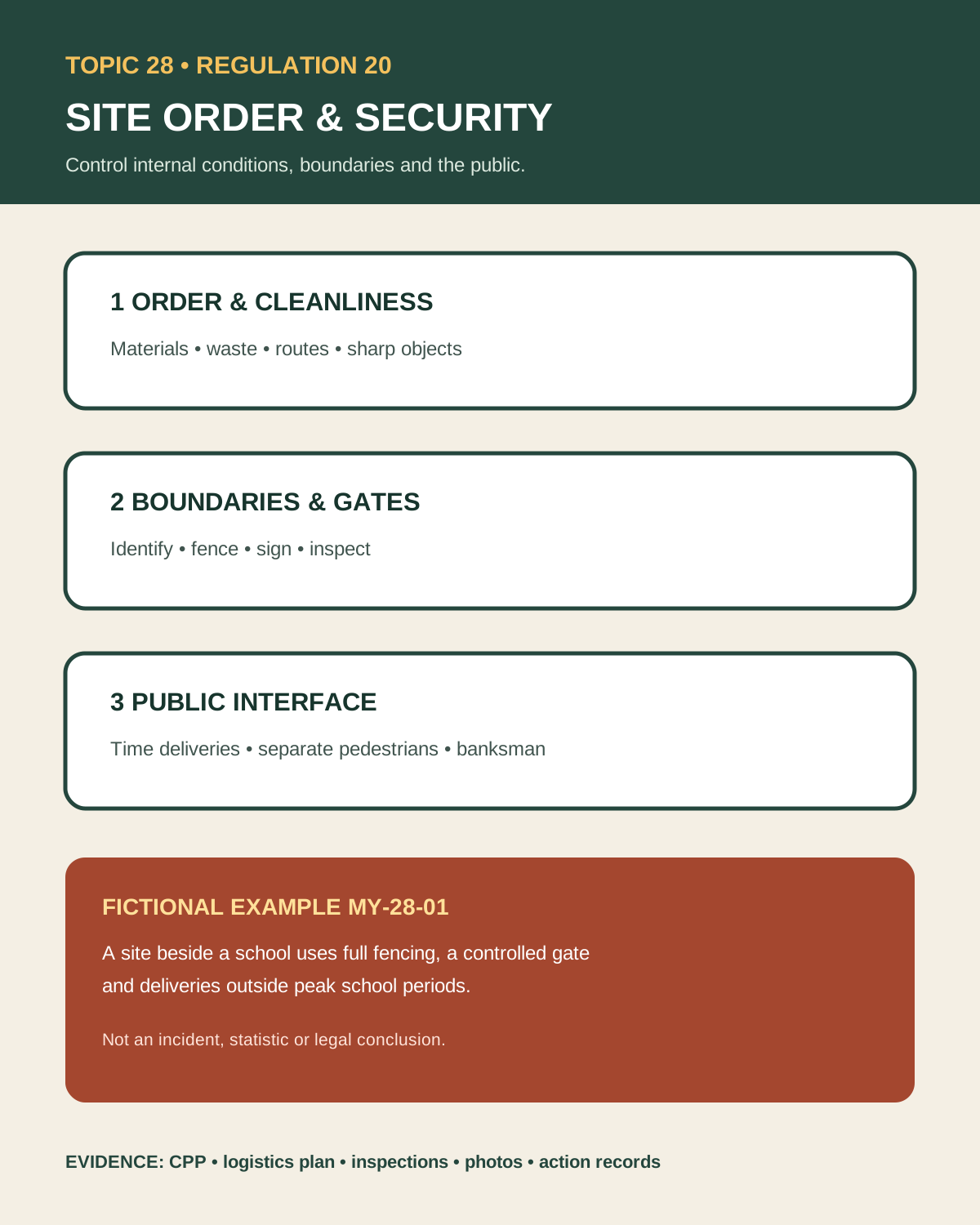
The four practical outcomes are: an orderly site; reasonably clean work areas; a clear and fenced boundary where risk requires it; and no projecting sharp object that may cause danger.
Site organisation starts before mobilisation
The construction phase plan (CPP) and logistics plan should show the boundary, entrances, guardhouse, pedestrian routes, vehicle routes, unloading zones, storage, waste, welfare facilities, restricted areas and emergency points. Map adjacent public areas such as schools, shops, bus routes, homes, client offices or shared access.
Review how the layout changes by phase. A fence adequate during earthworks may not suit crane, scaffold or night activity. A temporary delivery opening can create a direct route from a public road to the work area. Every change needs an owner, implementation date, inspection and communication.
Material arrangements should consider stack stability, handling access, separation of incompatible materials, weather protection and distance from routes. An unloading zone needs enough room for the vehicle, workers and lifting equipment without forcing people into vehicle paths or plant slewing areas.
Order and cleanliness are operational controls
Paragraph 160 of the DOSH Guidelines recommends systems for construction materials, temporary-structure materials, waste, bins, catch platforms and chutes. End-of-shift or end-of-day inspections help prevent deterioration. Cleaning frequency should reflect actual waste production and work; a single daily round may be insufficient for active cutting or unloading areas.
Assign responsibility by zone and activity. A contractor creating waste should move it to the designated place, while the party controlling the zone monitors overall condition. Use observable criteria: routes free from obstruction; waste in containers; materials clear of emergency equipment; spills controlled; and nails removed, bent or protected through a method that eliminates the danger.
Do not treat an early-shift clean photograph as evidence for the whole day. Records should connect the condition found, action, owner, closure time and verification. Where a defect presents immediate danger, restrict access or stop the affected activity until conditions are restored.
Design the boundary around risk and exposed people
Fencing should be continuous, stable and suited to duration and environment. The extent of the site must be identifiable. Inspect gaps below panels, damaged sections, blind corners, out-of-hours gates and places where people may climb or slip through. Cones, tape or Jersey barriers may suit particular functions, but their selection must match exposure and they are not an automatic substitute for perimeter fencing.
Beside a school or operating premises, separate public and construction movement. Schedule deliveries outside peak periods where practicable, use an instructed banksman, provide controlled vehicle holding space, and close the gate as soon as a vehicle completes its crossing. A banksman assists movement; that person does not replace a traffic plan, driver visibility or physical separation.
Signs and notices should be clear, placed at decision points and understood by recipients. A “no entry” sign is insufficient if the gate is open or the public route appears to continue into the site. Language and symbols should suit workers, visitors and the local community without relying on signs alone.
Fictional training example MY-28-01
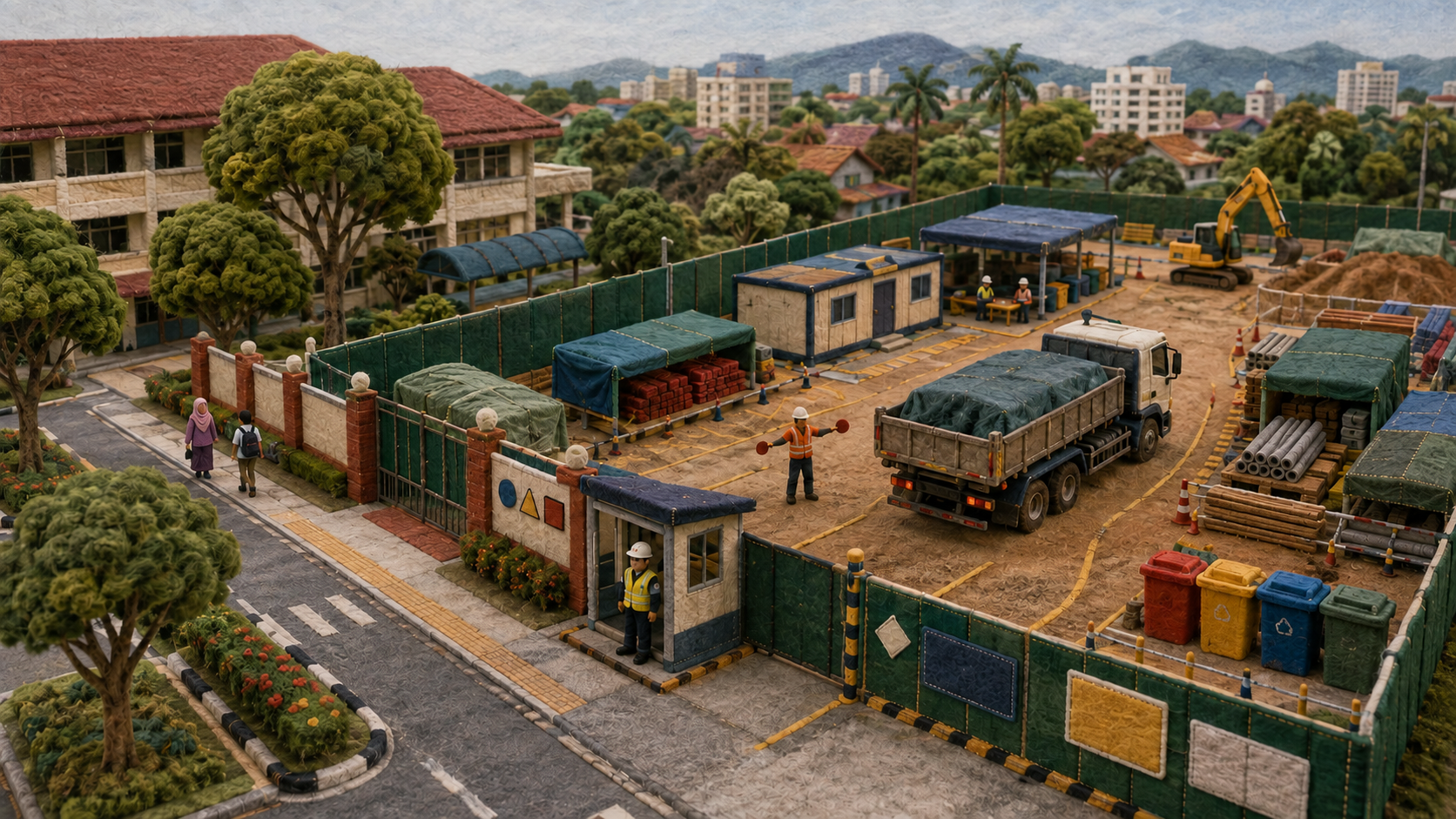
Fictional example — not a real incident, statistic or legal conclusion. A laboratory-block extension beside an operating secondary school in Selangor receives concrete and steel deliveries. The site gate is near the pupils’ route to a bus stop. The CWC and PCWC map school peak times, specify full fencing, one controlled gate and a public route that remains outside the lorry movement zone.
Deliveries are booked outside school arrival and departure times. A lorry waits at the agreed location and is called only when the unloading zone is clear. A banksman controls movement at the gate while physical barriers maintain pedestrian separation. After unloading, the gate closes and the route is checked. Packaging timber with projecting nails goes to a controlled area for nail removal before disposal.
During the afternoon review, the supervisor finds new material narrowing an internal route and one loose fence panel. Access is immediately restricted, materials relocated, the panel repaired and conditions verified before the next shift. The example shows organisation, cleanliness and security operating as one control loop.
Compliance actions
- Align the CPP, logistics plan and risk assessment with the boundary and neighbourhood conditions.
- Define storage, unloading, waste, pedestrian, vehicle and restricted zones.
- Select fencing and signs by risk level, not habit from a previous project.
- Control every gate, including temporary openings and out-of-hours access.
- Plan delivery timing, holding space and banksman arrangements for public interfaces.
- Set housekeeping inspections by shift, active area and after change.
- Eliminate projecting nails or similar sharp objects immediately.
- Restrict access when boundaries are damaged, routes obstructed or poor conditions create danger.
- Verify corrections at the location before closing actions.
Evidence to retain
Retain revision-controlled CPP and logistics plans; boundary and traffic risk assessments; fence and gate plans; perimeter inspections; visitor and access logs; delivery bookings; banksman instructions; driver briefings; public complaint registers; dated photographs; end-of-shift inspections; waste schedules; disposal tickets where relevant; sharp-object reports; repair records; and verified action-closure evidence.
Common failures
- Fencing is installed but a gate remains open and uncontrolled.
- Cones and tape form the main boundary despite high public exposure.
- Materials and waste obstruct routes between cleaning rounds.
- Deliveries coincide with school or operating-premises peak periods.
- A banksman is used without an unloading zone, movement plan or clear communication.
- Projecting nails are marked but left in place.
- An inspection records “good” without location, defect or correction evidence.
- A community complaint is received but not linked to a control change.
Supervisor checklist
- Is every part of the site in good order?
- Are active work areas reasonably clean?
- Are materials, waste and temporary-work items in designated zones?
- Are the site perimeter and extent identified and fenced according to risk?
- Is every gate and temporary opening controlled?
- Is public movement separated from construction traffic?
- Are today’s deliveries coordinated with adjacent operations?
- Have projecting nails and similar sharp objects been eliminated?
- Are changes and corrections inspected and recorded?
Primary JKKP/DOSH references
Refer to Regulation 20 of the Occupational Safety and Health (Construction Work) (Design and Management) Regulations 2024, P.U. (A) 147, together with the Guidelines for those Regulations, First Edition 2026, particularly paragraphs 160–162 and Figures 4 and 5. Review other provisions relevant to traffic, welfare and specific work. This article does not replace the legislation or project-specific assessment.
Related articles

Garis Panduan CDM Edisi 2026
CDM 2026 · 29 of 52
Kestabilan Struktur: Kerja Sementara, Penyangga dan Urutan
Panduan Peraturan 21 untuk reka bentuk kerja sementara, laluan beban, pemeriksaan dan penanggalan terkawal.
Ir. Ts. Dr. Mohamad Syamir bin Senin.
Garis Panduan CDM Edisi 2026
CDM 2026 · 27 of 52
Tempat Kerja Pembinaan Yang Selamat: Akses, Tepi dan Bukaan
Panduan Peraturan 19 untuk mengawal akses, jalan keluar, tepi, bukaan lantai dan ruang kerja mengikut keadaan sebenar tapak.
Ir. Ts. Dr. Mohamad Syamir bin Senin.
Garis Panduan CDM Edisi 2026
CDM 2026 · 26 of 52
Bahagian IV: Menentukan Siapa Mengawal Keperluan Tapak
Panduan memetakan kawalan sebenar, menyelaras tanggungjawab dan mengesahkan keperluan Bahagian IV di tapak pembinaan.
Ir. Ts. Dr. Hj. Mohd Fairuz Ab Rahman (PMP)Ir. Ts. Dr. Mohamad Syamir bin Senin.