
Garis Panduan CDM Edisi 2026
Drowning Prevention: Work Over or Near Water
CDM 2026 · 36 of 52
Regulation 28 guidance on fall prevention, buoyancy PPE, rescue equipment, drills and transport by water.
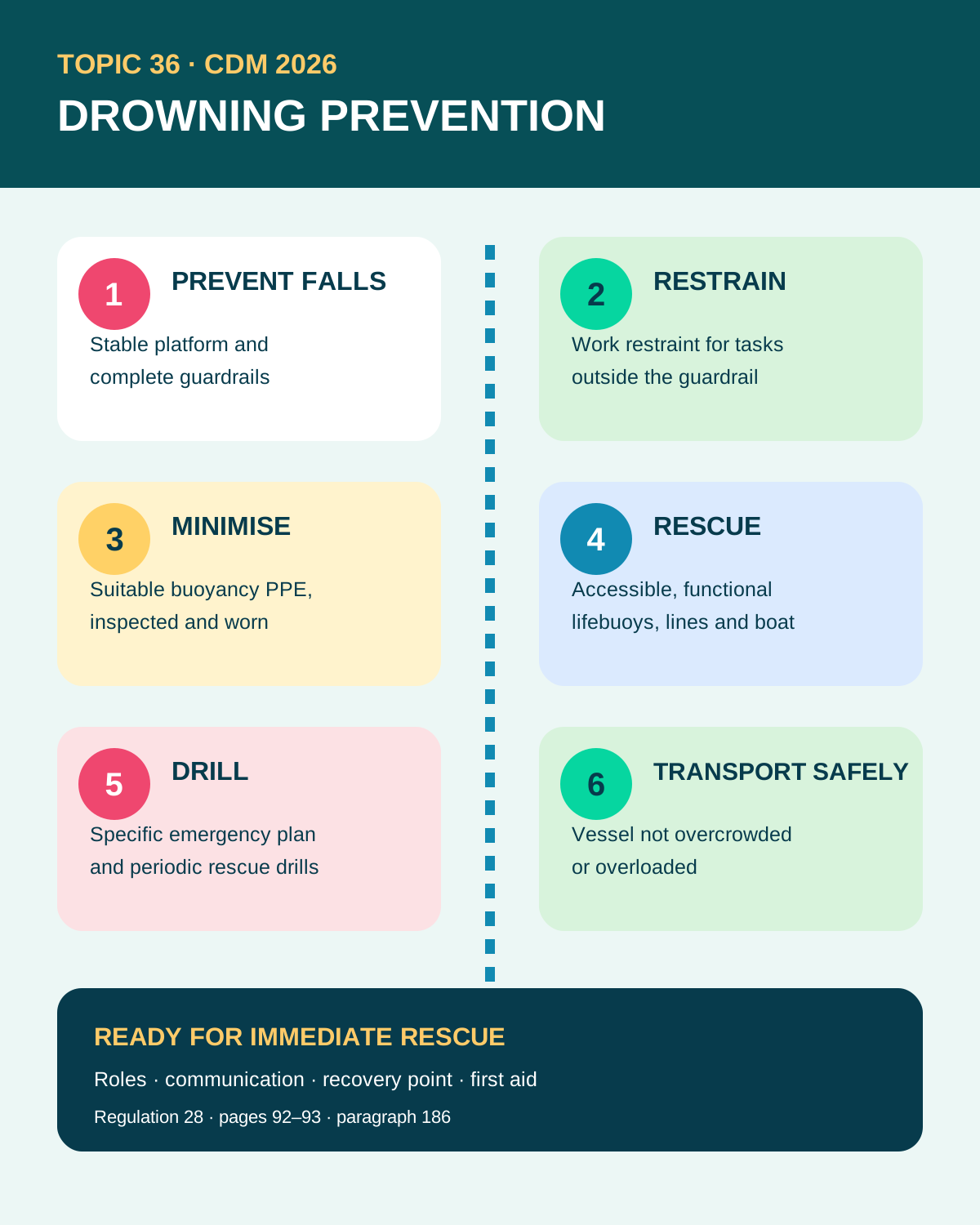
SIX-SLIDE BRIEFING
Drowning prevention at a glance
Slide 1 / 6
Prevent
Prevent a person from falling
Prioritise a stable platform and complete guardrail system.
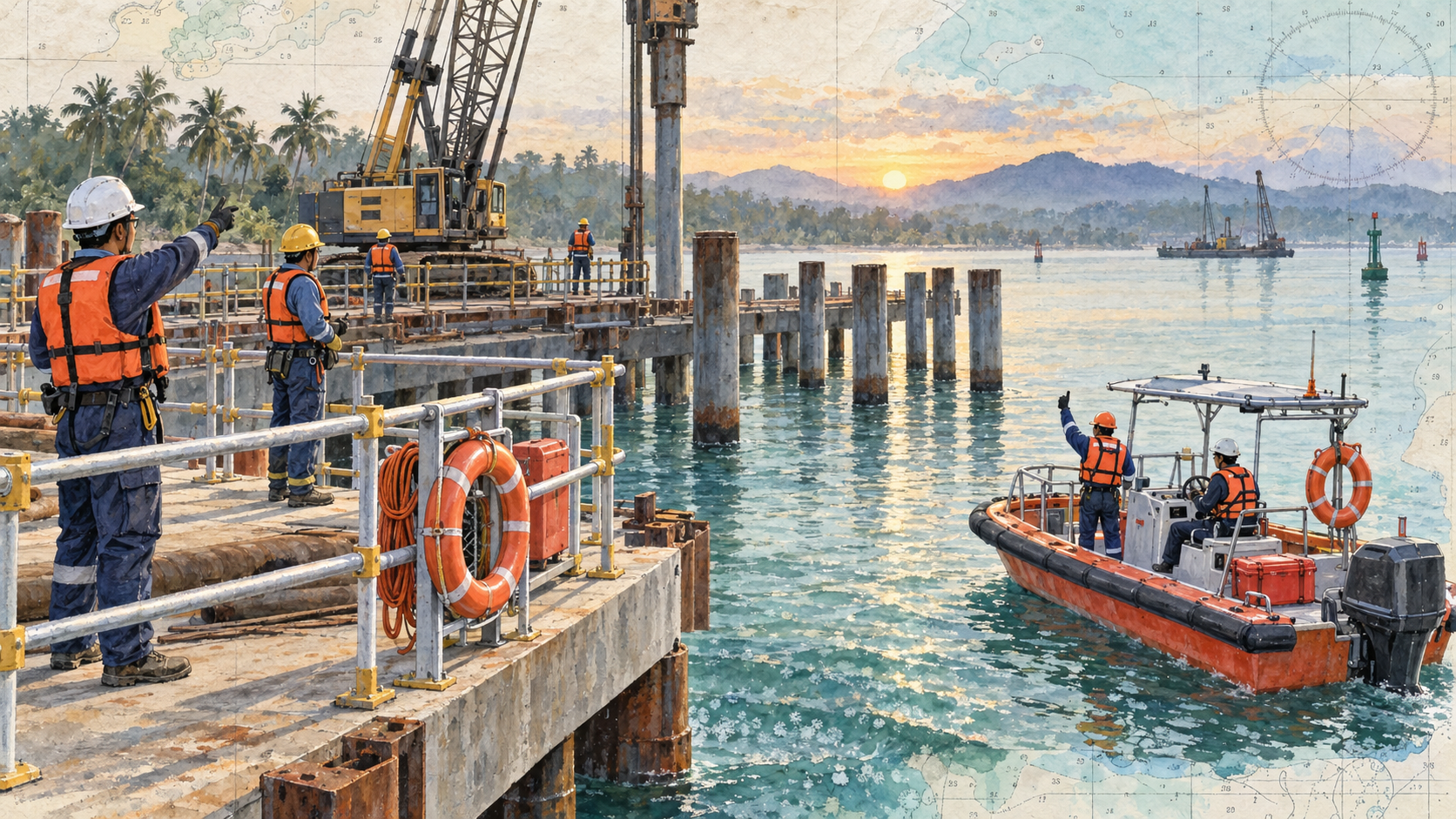
Work on jetties, bridges, embankments, floating platforms or shorelines presents two distinct but connected problems: a person may fall, then fail to be rescued promptly. Regulation 28 gives the construction work contractor (CWC) a clear control sequence: so far as practicable, prevent a person from falling; minimise the risk of drowning if a person falls; and ensure suitable rescue equipment is provided, maintained and used when necessary so that the person can be rescued immediately.
Begin by preventing the fall
The risk assessment and construction phase plan (CPP) should identify locations, activities and conditions in which a person could fall into water or another liquid with a risk of drowning. Consider water level, tides, current, weather, visibility, slippery surfaces, changing work edges, plant operations, night work and transfers between land, vessels and platforms.
Paragraph 186 prioritises risk elimination by reference to the First and Fourth Schedules. The Safe Work Procedure should prioritise a safe workplace, such as a stable work platform with a complete guardrail system. For areas outside the guardrail, the guideline identifies a work-restraint system. Actual selection must follow the design and risk assessment; a lifejacket does not replace a stable platform or guardrails.
Minimise drowning risk if a person falls
Where a fall risk remains, the CWC must take suitable and sufficient steps to minimise drowning risk. The guideline gives suitable personal protective equipment (PPE), such as a lifejacket for exposed workers, as an example. The type and suitability of buoyancy should be determined for the task, water conditions, clothing, carried equipment and rescue method; this article sets no universal buoyancy rating.
Ensure PPE is worn correctly, fits the user and does not interfere with work restraint or the task. Check fastenings, buoyancy material, stitching and any additional features in accordance with the manufacturer’s instructions. PPE stored in a cabin but not worn during exposure does not control the actual risk.
Rescue equipment and rescue team
Suitable rescue equipment may include lifebuoys and a rescue boat where needed. It should be maintained periodically and located for easy access so rescue can be immediate. The guideline identifies visual checks for physical damage and a functional engine test for a rescue boat as part of inspection and maintenance.
Equipment alone is insufficient. Decide who detects the fall, raises the alarm, throws the lifebuoy, operates the boat, provides first aid and calls external assistance. Confirm that communication works across the entire work zone and identify a casualty-recovery point usable in the current water conditions. The team should know when shore-based rescue is safer than launching a boat.
Emergency plan and rescue drills
A drowning-specific emergency response plan should be developed. Rescue drills should be conducted periodically so the response team acts efficiently. Define a credible scenario, stop operations that could interfere, and use a mannequin or training aid rather than putting a real person at risk.
Evaluate the drill through the action sequence, communication availability, time as internal operational information, equipment access, boat launch, simulated casualty recovery and handover to first aid. Do not publish drill time as a general performance statistic. Assign every finding to an owner and retain evidence of closure before the risk activity resumes.
Transporting workers by water
The CWC must take suitable and sufficient measures to ensure safe transport to or from the construction workplace. A vessel must not be overcrowded or overloaded. The guideline requires the load limit, by passenger number or maximum weight, to be identified and displayed clearly, with sufficient safety equipment for every passenger.
Before travel, check vessel condition, weather and water, operator competence, passenger manifest, load distribution, boarding points and communication. Do not weaken the decision because the trip is short or a shift is under pressure. Stop travel when conditions exceed operating limits determined by capable parties.
Fictional example MY-36-01
Fictional example — not a real incident, statistic or legal conclusion.
A jetty project in Sabah plans piling work from a temporary platform. Before work begins, the CWC provides a stable platform with complete guardrails and uses restraint for a controlled task beyond the barrier. Exposed workers wear task-selected lifejackets. Lifebuoys with lines are positioned at reachable points, the rescue boat is inspected and its engine tested, and the radio channel is confirmed. The team conducts a man-overboard drill using a mannequin. The exercise finds that a barge obstructs one casualty-recovery point; the plan is revised, an alternative point marked and a short drill repeated before work is released. This example sets no universal response time.
Compliance actions
- Identify every drowning-risk zone and task in the risk assessment and CPP.
- Prevent falls through workplace design, stable platforms and complete guardrails.
- Use work restraint for defined tasks outside the guardrail.
- Select, inspect and enforce suitable buoyancy PPE.
- Provide accessible, maintained rescue equipment.
- Define the team, communication, recovery points and first aid.
- Conduct periodic rescue drills and close findings before work.
- Control vessels, load limits, passengers and travel conditions.
Evidence to retain
Retain the risk assessment and relevant CPP section; water-zone and recovery-point plan; platform and guardrail design and inspection; Safe Work Procedure; PPE selection and register; lifebuoy, line and boat inspection records; engine-test records; operator competency evidence; emergency response plan; team list and communication channels; drill records, findings and corrective actions; weather or tide records used for decisions; passenger manifests; and displayed vessel load limits.
Common failures
- Relying on lifejackets while the work edge remains unguarded.
- Storing lifebuoys too far away or behind obstructions.
- Providing a boat without an operator, fuel or engine test.
- Using radios that do not cover the whole work zone.
- Conducting a drill without evaluating and closing findings.
- Treating a drill time as a guarantee for every condition.
- Allowing a vessel to become overcrowded or overloaded.
- Failing to reassess after changes in current, weather, access or layout.
Supervisor checklist
- Has the risk of falling into water or another liquid been identified for this shift?
- Are a stable platform and complete guardrails available?
- Is restraint suitable for defined work outside the barrier?
- Is buoyancy PPE suitable, inspected and worn correctly?
- Are lifebuoys, lines and the boat accessible and functional?
- Are rescue roles, communication and recovery points clear?
- Is the latest drill current and are all corrective actions closed?
- Are the vessel, load limits and passenger manifest controlled?
Primary JKKP/DOSH references
Refer to Regulation 28, P.U. (A) 147/2024, the *First Edition CDM Guidelines 2026*, printed pages 91–93, particularly Regulation 28 on page 92 and explanatory paragraph 186. Use the First and Fourth Schedules in the same Regulations when determining prevention and work involving particular risks.
Related articles
Garis Panduan CDM Edisi 2026
CDM 2026 · 52 of 52
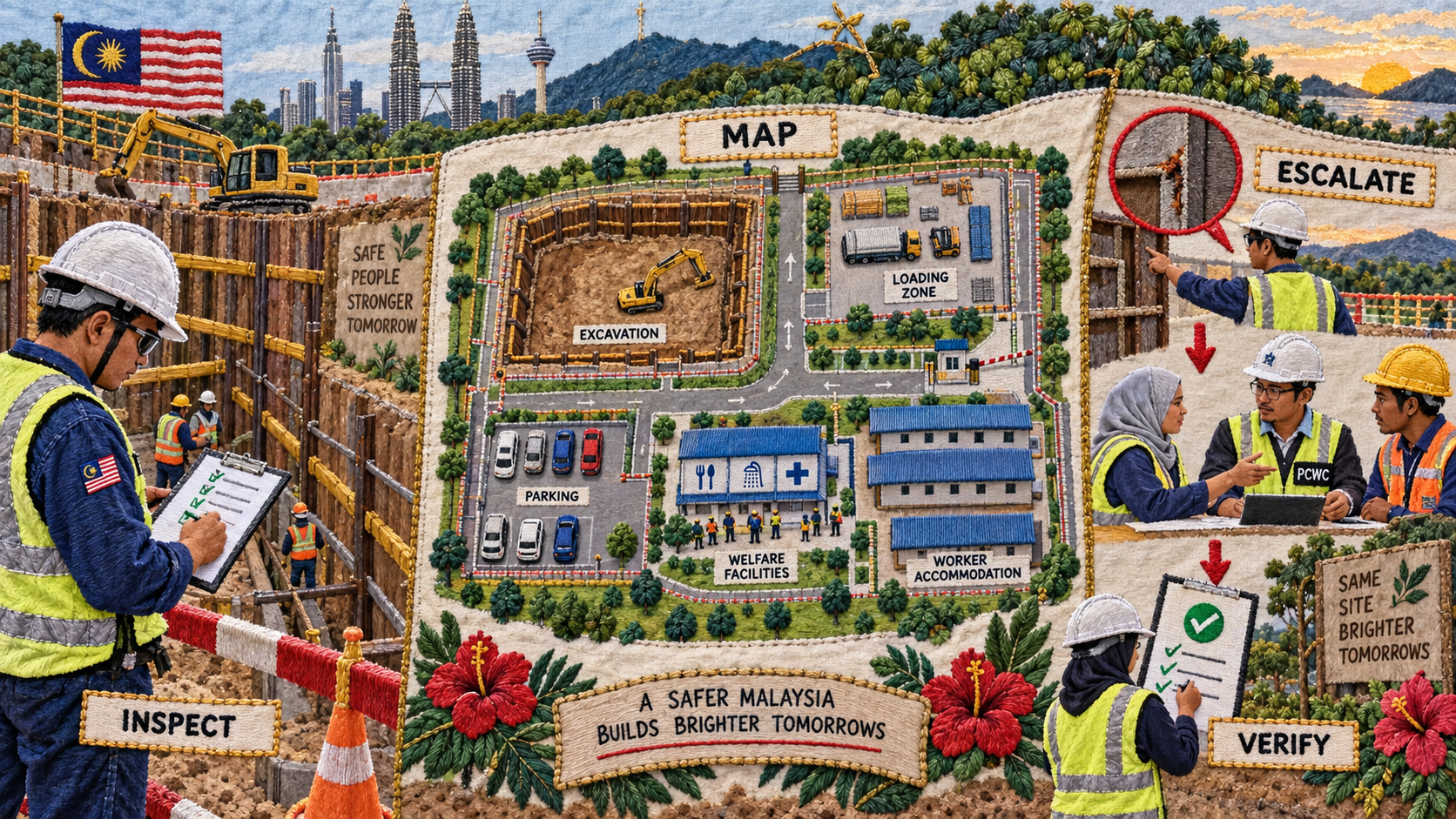
Practical Appendices: Excavation Inspection, Site Scope and Supervisor Guidance
Connect inspection reports, whole-workplace mapping and SSS supervision to action, escalation and verified closure.
Ir. Ts. Dr. Mohamad Syamir bin Senin.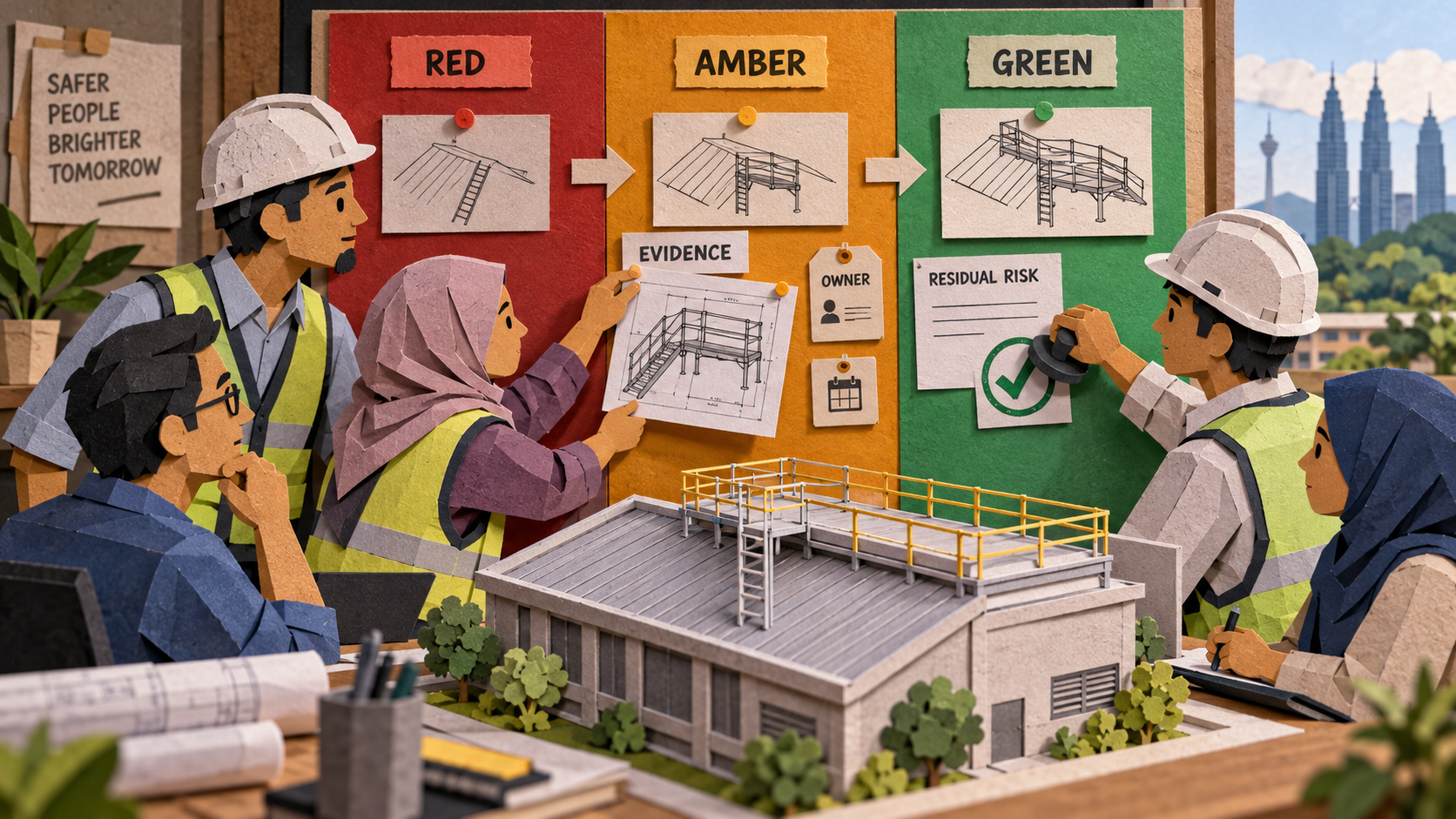
Garis Panduan CDM Edisi 2026
CDM 2026 · 51 of 52
Duty-Holder Checklists and RAG: How to Use Them Without Fooling Yourself
Use Appendices 1 and 2 as evidence-led decision controls with owners and dates—not decorative status colours.
Ir. Ts. Dr. Mohamad Syamir bin Senin.
Garis Panduan CDM Edisi 2026
CDM 2026 · 50 of 52
Third and Fourth Schedules: Notification and Work Involving Particular Risks
Practical guidance for completing project notification and connecting work involving particular risks to the PCI and CPP.
Ir. Ts. Dr. Mohamad Syamir bin Senin.