
Garis Panduan CDM Edisi 2026
Traffic Routes: Designing Safe Movement
CDM 2026 · 37 of 52
Regulation 29 guidance on route design, people-vehicle segregation, crossings, unloading and inspection.
SIX-SLIDE BRIEFING
Traffic routes at a glance
Slide 1 / 6
Plan
A phased traffic plan
Test routes with actual vehicles, turning radii and site changes.
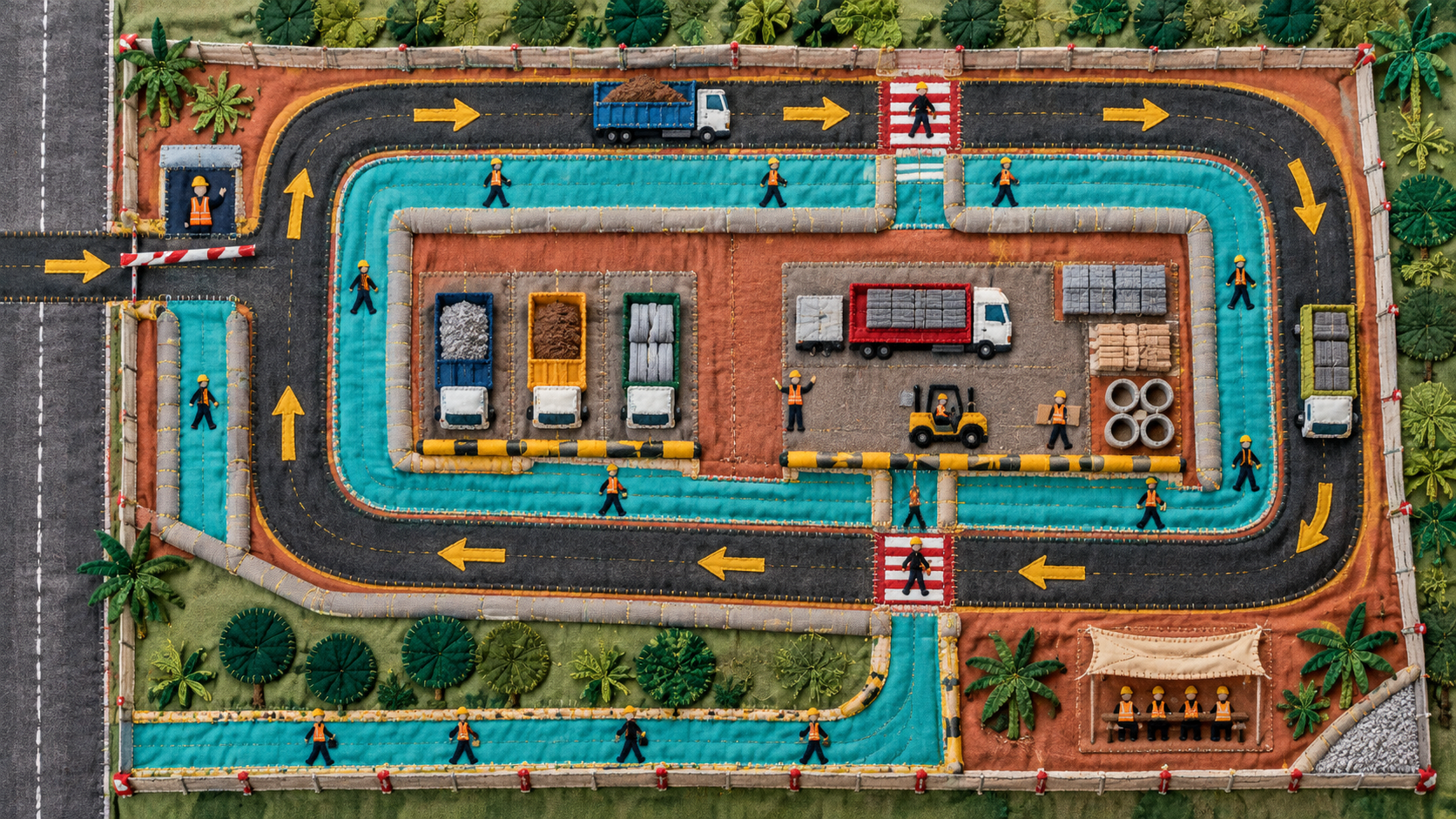
A site traffic route is not a line painted after mobilisation. Regulation 29 requires the construction work contractor (CWC) to organise the site properly and in an orderly manner, so far as practicable, so that people or vehicles can move without risk to safety or health. Routes must be suitable for use, sufficient in number and size, and located appropriately.
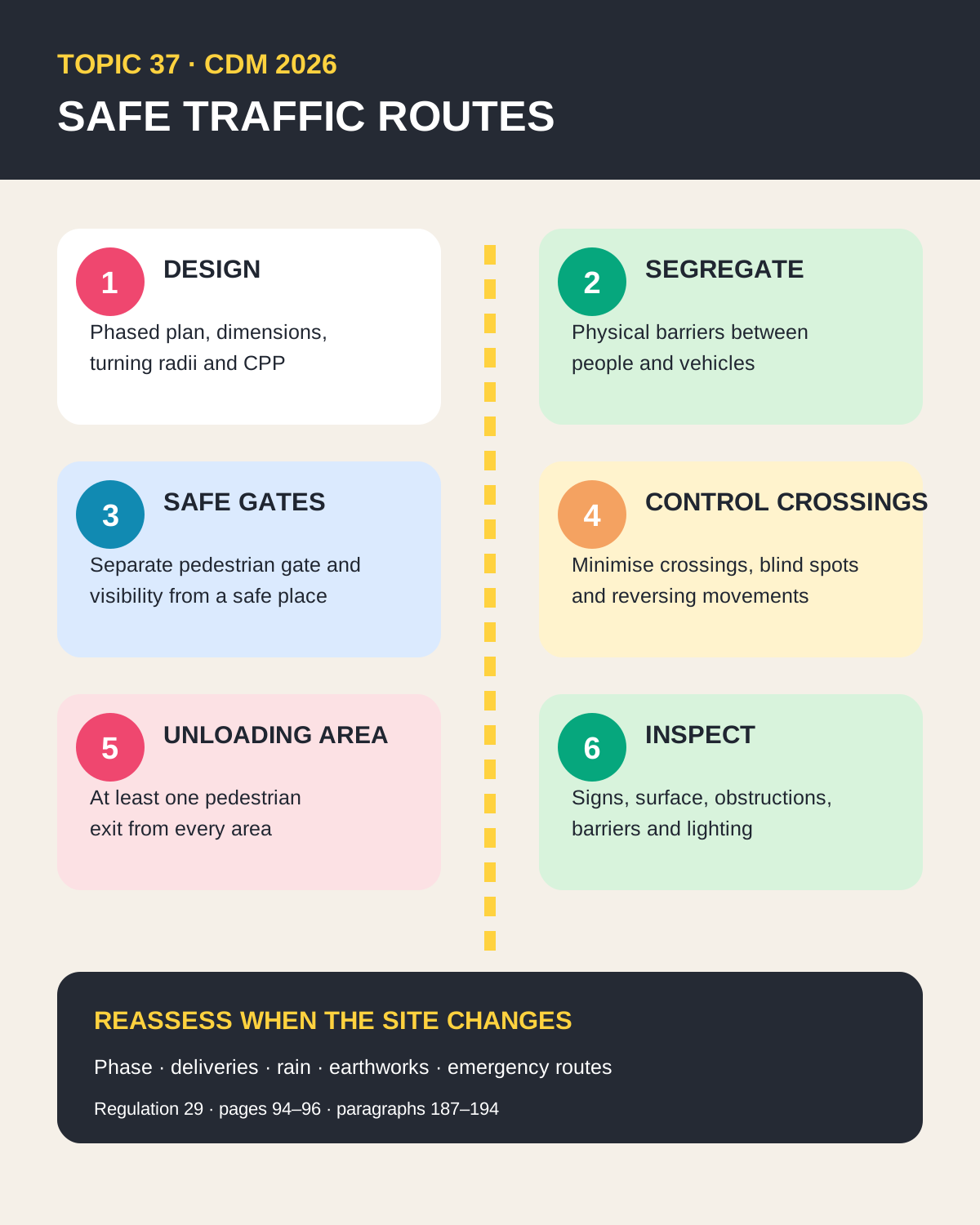
Design before mobilisation
Use the risk assessment and construction phase plan (CPP) to map entrances, delivery roads, holding areas, unloading areas, pedestrian routes, welfare facilities, parking, plant zones and emergency routes. Test the plan against actual vehicle dimensions, turning radii, gradients, surface capacity, headroom, blind spots and each phase change.
The main principle in paragraphs 188–189 is segregation of pedestrians from vehicles. A one-way system may be considered to reduce reversing, but it is not an automatic solution. Ensure the loop has suitable space, surface and gate controls. Delivery booking and a holding area outside the work zone can prevent unplanned queues or reversing.
Physical segregation and entrances
Provide sufficient separation distance between vehicles and pedestrians. Where this is not practicable, provide another means of protection and effective arrangements to warn people who may be crushed or trapped. Painted lines are easily lost in mud and do not restrain vehicles; use physical barriers suited to the risk.
A pedestrian door or gate leading to a traffic route should be sufficiently separated so people can see vehicles or plant from a safe place. Where the vehicle gate is unsafe for pedestrians, provide a nearby separate pedestrian gate, mark it clearly and keep it unobstructed. Do not allow canteen or prayer-room doors to open directly onto a lorry route.
Crossings, visibility and blind spots
Minimise crossings and position them where visibility is good. Use barriers to channel pedestrians to the controlled point, with a level surface, lighting and clear signs. Define priority and control deliveries outside normal operating hours.
Paragraph 193 calls for blind spots to be considered. Convex mirrors are strongly encouraged at sharp corners, but a mirror does not replace direct visibility or segregation. Where a person may be struck, crushed or trapped by a moving vehicle, provide a visible or audible warning system, or both. The guideline gives rotating beacons and reversing alarms as examples and recommends considering a trained signalman.
Unloading areas and deliveries
Regulation 29 defines an “unloading area” as a place or facility for loading or unloading construction items or waste. Every unloading area must have at least one pedestrian exit. Design it so workers cannot be trapped between the vehicle, stored material and a structure.
Before entry, confirm the booking, load, route, time, unloading area and coordinator. Keep pedestrians out during controlled movement. Remove packaging, pallets or waste that could narrow the route after unloading. Do not convert the unloading area into permanent storage.
Inspection and maintenance
Each traffic route should be marked with suitable signs where necessary, inspected periodically and maintained properly. A vehicle must not use the route unless, so far as practicable, it is free from obstruction and has sufficient clearance.
Paragraph 193 recommends a checklist confirming road-surface condition, sign clarity and absence of obstructions. Add barriers, gates, crossings, drainage, lighting and site changes. After rain, earthworks, a traffic change or barrier damage, reassess before normal flow resumes.
Fictional example MY-37-01
Fictional example — not a real incident, statistic or legal conclusion.
A housing project in Selangor finds that the workers’ lunch route crosses material lorries in front of an unloading area. The CWC reviews the CPP and redraws the logistics plan. A guarded pedestrian route runs behind the cabins, a dedicated gate is provided, and one controlled crossing is placed where visibility is good. Lorries use a one-way loop and holding area, while the unloading area has a pedestrian exit. A post-rain inspection finds settlement at a corner; the route is closed, repaired and inspected before reopening. This example sets no universal width, separation distance or speed limit.
Compliance actions
- Put a phased traffic plan in the CPP before mobilisation.
- Segregate pedestrians and vehicles using suitable barriers.
- Provide a separate pedestrian gate and a safe viewing position.
- Minimise crossings and control blind spots and reversing.
- Plan bookings, holding, unloading and pedestrian exits.
- Mark routes and ensure suitable clearance and surfaces.
- Inspect periodically and after changes or severe weather.
- Record defects, close routes where necessary and verify repairs.
Evidence to retain
Retain phased traffic plans and CPP revision records; risk assessments; vehicle dimensions and turning data; segregation, gate, crossing and unloading-area plans; delivery schedules; driver inductions; signalman training evidence; route inspection records; photographs of barriers and signs; lighting records; defect registers; closure instructions; repair evidence; change communications; and emergency-route plans.
Common failures
- Drawing a plan without testing actual vehicle movements.
- Using painted lines alone in a high-risk mixed zone.
- Opening pedestrian gates directly onto vehicle routes.
- Allowing material stacks to obstruct crossing visibility.
- Treating a convex mirror as elimination of a blind spot.
- Leaving pedestrians without an exit from an unloading area.
- Failing to reassess after a phase change or rain.
- Storing material, pallets or waste on an active route.
Supervisor checklist
- Does the current traffic plan match today’s site conditions?
- Are routes suitable, sufficient and appropriately located?
- Are people and vehicles physically segregated?
- Do pedestrian gates and crossings provide safe visibility?
- Are blind spots and reversing controlled?
- Does every unloading area have a pedestrian exit?
- Are signs, surfaces, drainage, lighting and barriers serviceable?
- Are defects closed and repairs verified before reopening?
Primary JKKP/DOSH references
Refer to Regulation 29, P.U. (A) 147/2024, the *First Edition CDM Guidelines 2026*, printed pages 94–96 and paragraphs 187–194, and JKKP’s Vehicle Safety on Construction Sites — a short guide.
Related articles
Garis Panduan CDM Edisi 2026
CDM 2026 · 52 of 52
Practical Appendices: Excavation Inspection, Site Scope and Supervisor Guidance
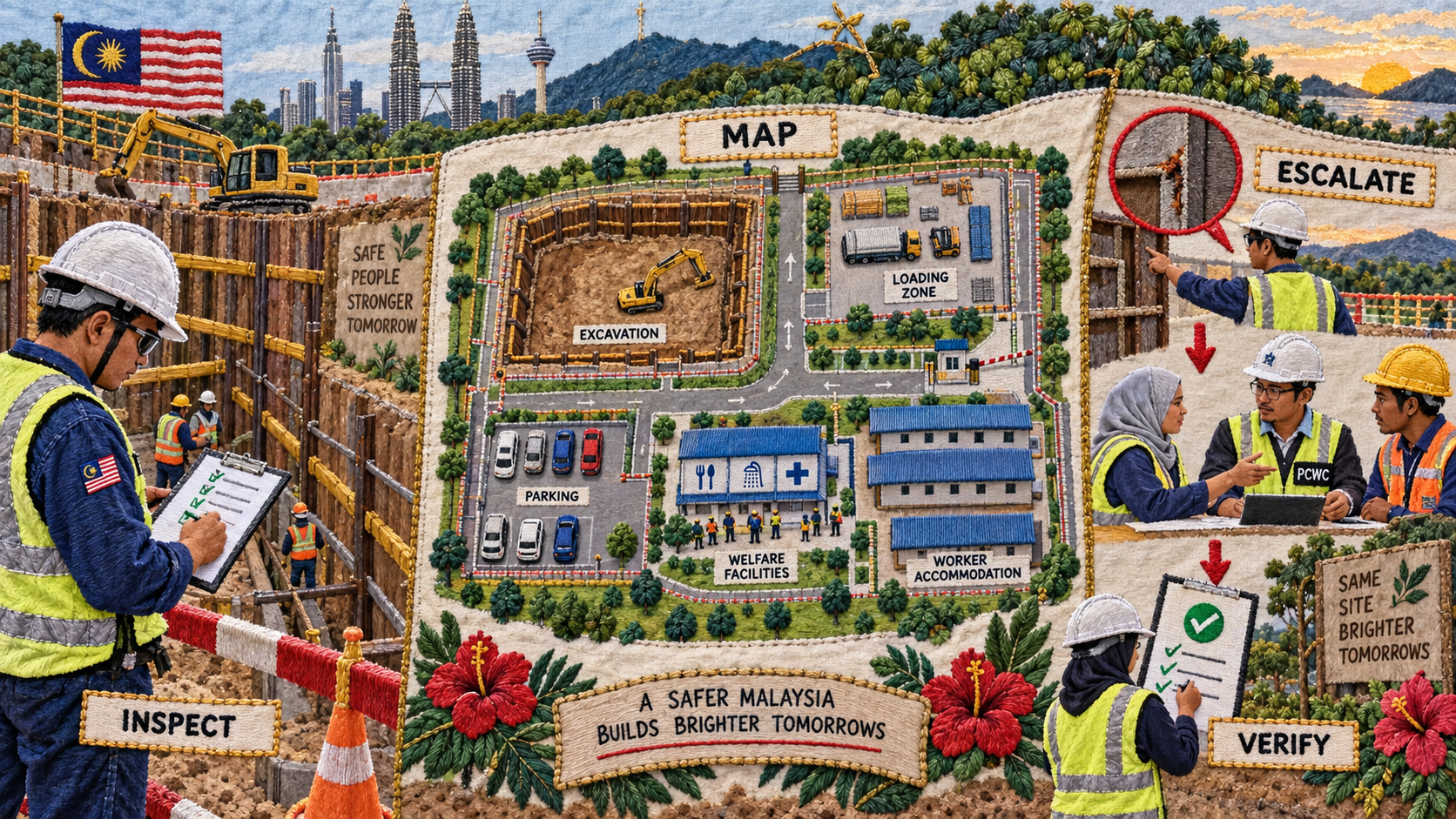
Connect inspection reports, whole-workplace mapping and SSS supervision to action, escalation and verified closure.
Ir. Ts. Dr. Mohamad Syamir bin Senin.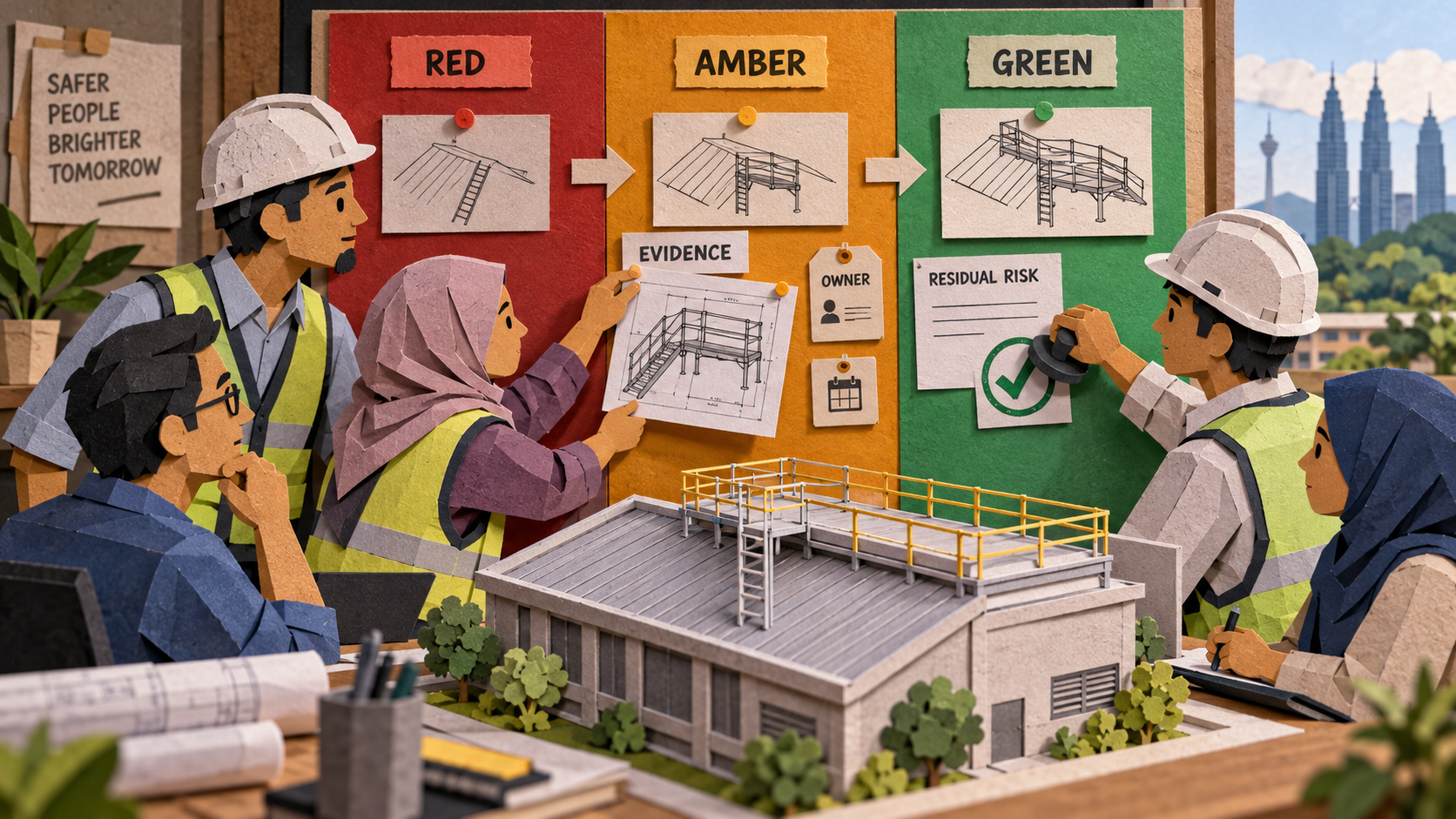
Garis Panduan CDM Edisi 2026
CDM 2026 · 51 of 52
Duty-Holder Checklists and RAG: How to Use Them Without Fooling Yourself
Use Appendices 1 and 2 as evidence-led decision controls with owners and dates—not decorative status colours.
Ir. Ts. Dr. Mohamad Syamir bin Senin.
Garis Panduan CDM Edisi 2026
CDM 2026 · 50 of 52
Third and Fourth Schedules: Notification and Work Involving Particular Risks
Practical guidance for completing project notification and connecting work involving particular risks to the PCI and CPP.
Ir. Ts. Dr. Mohamad Syamir bin Senin.