
Garis Panduan CDM Edisi 2026
Vehicles and Mobile Plant: Operators, Reversing and Parking
CDM 2026 · 38 of 52
Regulation 30 guidance on operators, inspection, blind spots, reversing, parking and edge controls.

SIX-SLIDE BRIEFING
Mobile plant at a glance
Slide 1 / 6
Plan
Actual plant and task
Assess the load, route, surface, blind spots, people and ground condition.
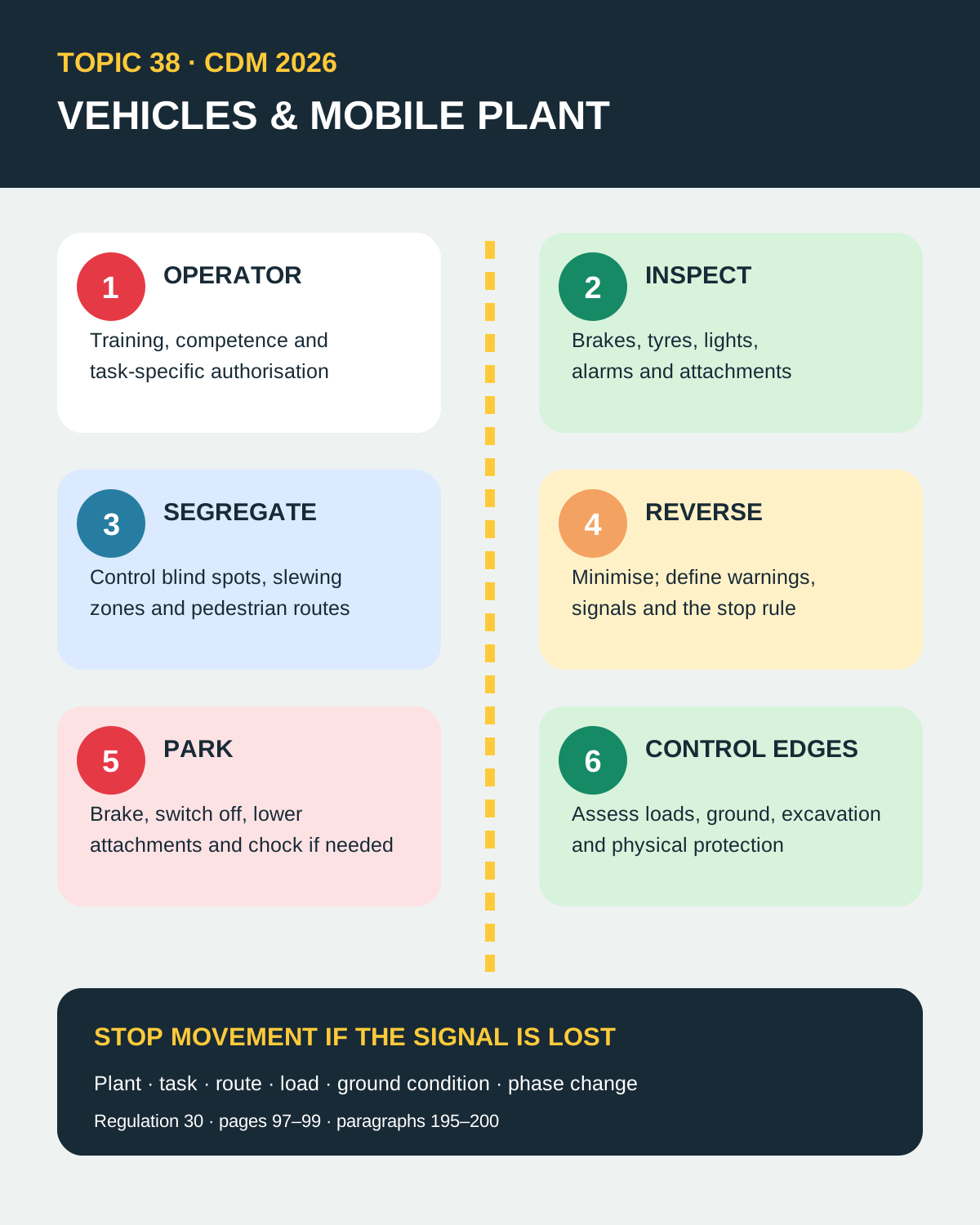
Regulation 30 requires the construction work contractor (CWC) to ensure that suitable and sufficient steps are taken to prevent or control the unintended movement of any vehicle. Control does not begin when the engine starts. It begins when plant is selected, routes and work areas are planned, the operator is verified, the vehicle condition is checked and other people are segregated from the movement zone.
Plan for the actual task and plant
Use the risk assessment and construction phase plan (CPP) to identify hazards arising from each vehicle on site. Record the plant type, task, load, route, surface, gradient, headroom, turning radius, blind spots, pedestrians, excavations, delivery method and parking arrangement. A generic plan is inadequate when telehandlers, excavators, tippers and forklifts have different operating characteristics.
Prioritise flows that reduce the need to reverse. Where reversing cannot be avoided, define the exclusion zone, safe viewing position, communication method and conditions requiring movement to stop. The driver or operator, or a person assisting them, must give suitable and sufficient warning to anyone at risk from the vehicle's movement. A reversing alarm or horn are examples in the guideline; selection must reflect the risk and site conditions.
Operators, authorisation and pre-use checks
A vehicle must be driven, operated, towed or loaded in a safe manner. The CWC should verify that the operator is trained for the relevant plant type and task and understands the machine limits, fitted attachment, site signals and movement plan. Site authorisation should have a clear scope; a card or certificate alone does not demonstrate that a person understands the project's conditions that day.
Use a pre-use checklist for critical components such as brakes, tyres, lights and alarms, as recommended in paragraph 197. Add steering, mirrors or cameras, seat belt, guards, hydraulic connections, forks or attachments and leaks as required by the manufacturer's instructions and task risk. A safety-critical defect should be reported, the vehicle taken out of use and release recorded after repair. A checklist does not replace maintenance or any applicable statutory examination.
Segregation, blind spots and banksmen
Physically segregate plant and pedestrians so far as is reasonably practicable. Define the plant work area, entry gate, controlled crossings and worker waiting points. Do not rely on eye contact alone: the operator may lose sight when the boom, load or structure obstructs visibility.
Where the risk assessment requires a banksman or signaller, appoint a trained person, use one identified signaller and agree signals before movement starts. The signaller must remain where the operator can see them without entering the vehicle path. If visual contact or communication is lost, the operator stops. A banksman is a task-specific control, not a substitute for route design, segregation or good visibility.
Loads, passengers and unloading loose material
Do not exceed permitted load, stability or configuration limits. The load should be stable and must not obstruct visibility to the point that operation becomes unsafe. No person may ride on a vehicle except in a place provided for that purpose. Workers must therefore not ride in an excavator bucket, on forks or on a deck not designed for passengers.
A person must also not be required or permitted to remain on a vehicle while loose material is loaded or unloaded unless the operation is carried out at a place provided and maintained for that purpose. Plan a level, stable and controlled area and keep people away from positions where they could be buried, trapped or struck by material.
Parking and unintended movement
When a vehicle is parked, apply the brake securely and switch off the engine. Use wheel chocks where necessary, such as on a gradient, and follow the manufacturer's instructions for lowering attachments, isolating energy and controlling keys. Provide a stable designated parking area that does not obstruct emergency or pedestrian routes. Before leaving plant, the operator should ensure that the boom, bucket or forks are in a safe state and do not create a new hazard.
Excavation edges, holes, water and earthworks
The CWC must take suitable and sufficient steps to prevent a vehicle falling into an excavation or hole, falling into water, or running over the edge of an embankment or earthwork. Determine a safe stand-off from the vehicle type, axle load, ground condition and stability, excavation geometry and relevant design advice—not a universal number copied from another project. Visual markings can support the control, while robust physical measures such as stop blocks or earth bunds should be selected according to risk.
Fictional example MY-38-01
Fictional example — not a real incident, statistic or legal conclusion.
A commercial building project in Johor uses a telehandler to deliver block pallets to a reception area. A task review finds that structural columns restrict the view as the vehicle turns and other workers use a nearby route. The CWC changes the route to allow forward entry, barriers the work zone and establishes one controlled crossing. An authorised operator completes the pre-use check. A trained banksman stands in a protected position and movement stops if the signal is lost. After the task, the forks are lowered, engine switched off, brake applied and telehandler parked in a stable bay. The example does not prescribe universal distances, speeds or qualifications.
Compliance actions
- List every vehicle and task in the risk assessment and CPP.
- Verify operator training, competence and authorisation for the plant and task.
- Complete pre-use checks and isolate plant with a safety defect.
- Segregate people from movement zones and minimise reversing.
- Define warnings, communication and the stop rule when visibility or signals are lost.
- Control loads, passengers and the unloading of loose material.
- Brake, switch off and secure parked vehicles against unintended movement.
- Protect excavation, hole, water, embankment and earthwork edges through a specific assessment.
Evidence to retain
Retain the vehicle register; risk assessment and relevant CPP sections; movement and exclusion-zone plans; operator training, assessment and authorisation evidence; signal briefings; pre-use records; defect, quarantine, repair and release records; maintenance records; manufacturer instructions; load plans; photographs of edge controls; surface and parking inspections; and reviews following a change of plant, route, ground or work phase.
Common failures
- Treating an operator licence or card as sufficient without site-specific authorisation.
- Allowing people to walk through blind spots or plant slewing zones.
- Using a banksman without agreed signals or a protected standing position.
- Continuing movement after the operator loses sight of the banksman.
- Ignoring brake, tyre, light or alarm defects recorded during a check.
- Carrying passengers on parts of a vehicle not designed for them.
- Leaving an engine running, attachment raised or vehicle unchocked where chocks are needed.
- Applying a generic edge distance without assessing ground stability and load.
Supervisor's checklist
- Is the plant suitable for the actual task, load, surface and space?
- Is the operator trained, authorised and briefed on today's plan?
- Is the pre-use check complete and are defects closed out?
- Are people segregated from routes, blind spots and slewing zones?
- Are warnings and the lost-communication stop rule understood?
- Is the load stable and are passengers only in designed positions?
- Is parking stable, with brake applied, engine off and attachment lowered?
- Do edge controls reflect the vehicle, load and ground stability?
Primary JKKP/DOSH references
Refer to Regulation 30, P.U. (A) 147/2024 and the *First Edition 2026 CDM Guidelines*, printed pages 97–99, paragraphs 195–200. Measures such as pre-use checklists, reversing alarms, horns, designated parking areas, wheel chocks and stop blocks are described as examples or good practice selected according to risk; this article does not present them as separate universal statutory duties.
Related articles
Garis Panduan CDM Edisi 2026
CDM 2026 · 52 of 52
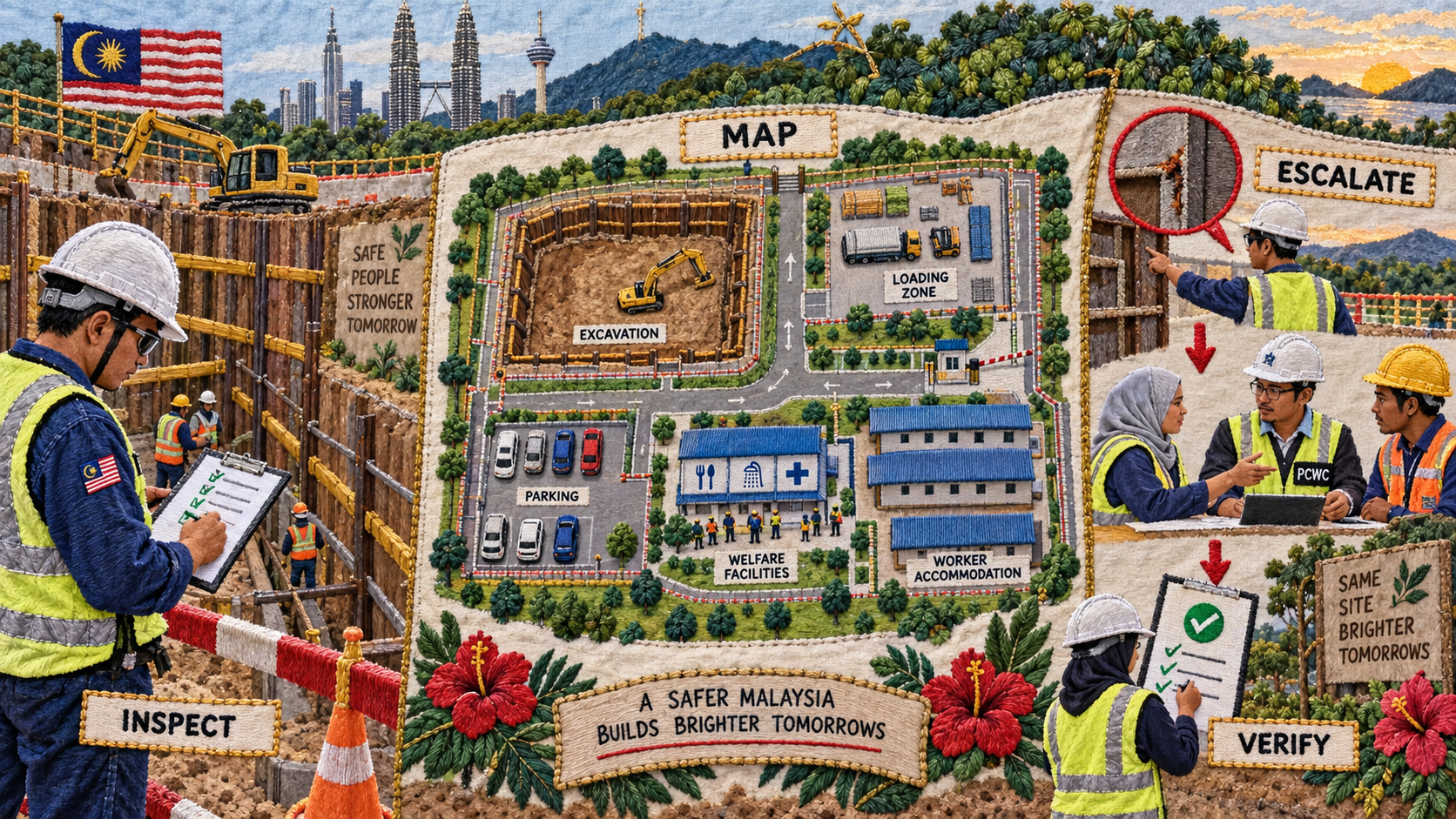
Practical Appendices: Excavation Inspection, Site Scope and Supervisor Guidance
Connect inspection reports, whole-workplace mapping and SSS supervision to action, escalation and verified closure.
Ir. Ts. Dr. Mohamad Syamir bin Senin.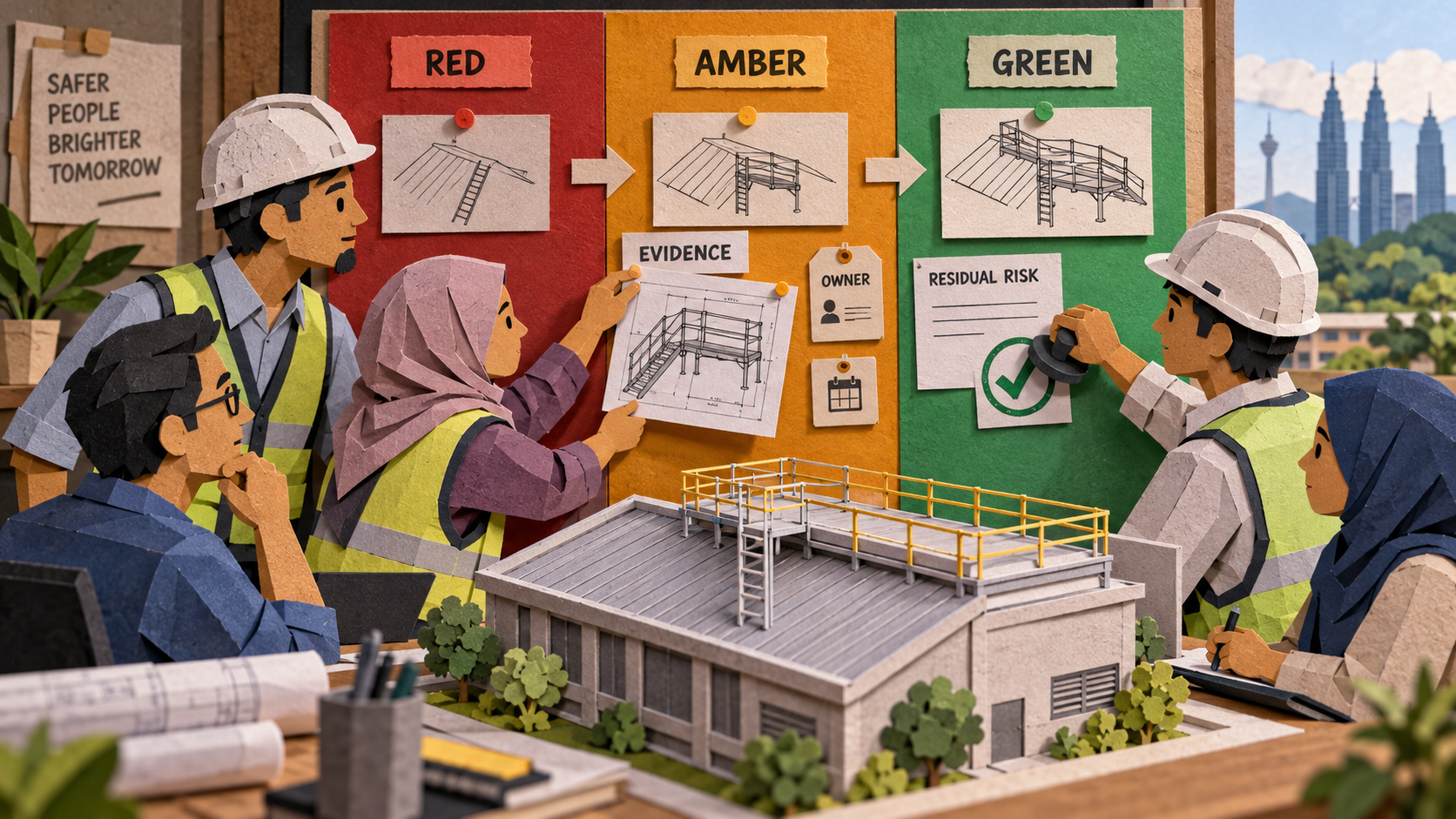
Garis Panduan CDM Edisi 2026
CDM 2026 · 51 of 52
Duty-Holder Checklists and RAG: How to Use Them Without Fooling Yourself
Use Appendices 1 and 2 as evidence-led decision controls with owners and dates—not decorative status colours.
Ir. Ts. Dr. Mohamad Syamir bin Senin.
Garis Panduan CDM Edisi 2026
CDM 2026 · 50 of 52
Third and Fourth Schedules: Notification and Work Involving Particular Risks
Practical guidance for completing project notification and connecting work involving particular risks to the PCI and CPP.
Ir. Ts. Dr. Mohamad Syamir bin Senin.