
Garis Panduan CDM Edisi 2026
Emergency Procedures: A Plan That Actually Works
CDM 2026 · 40 of 52
Regulation 32 guidance on scenarios, roles, warnings, evacuation, head counts, emergency teams and drills.
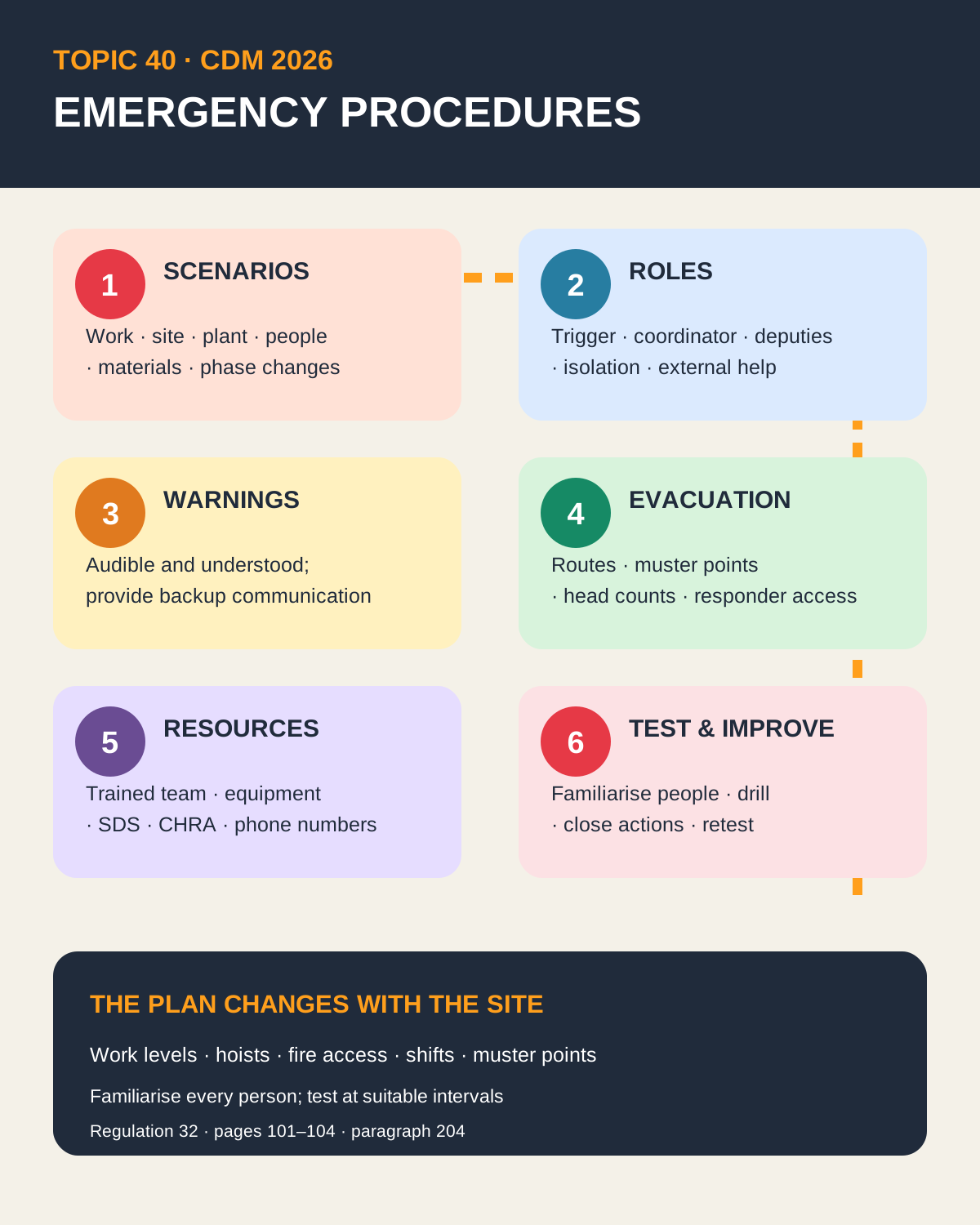
SIX-SLIDE BRIEFING
Emergency procedures at a glance
Slide 1 / 6
Foresee
Scenarios change with the phase
Assess the work, site, plant, people and materials actually present.
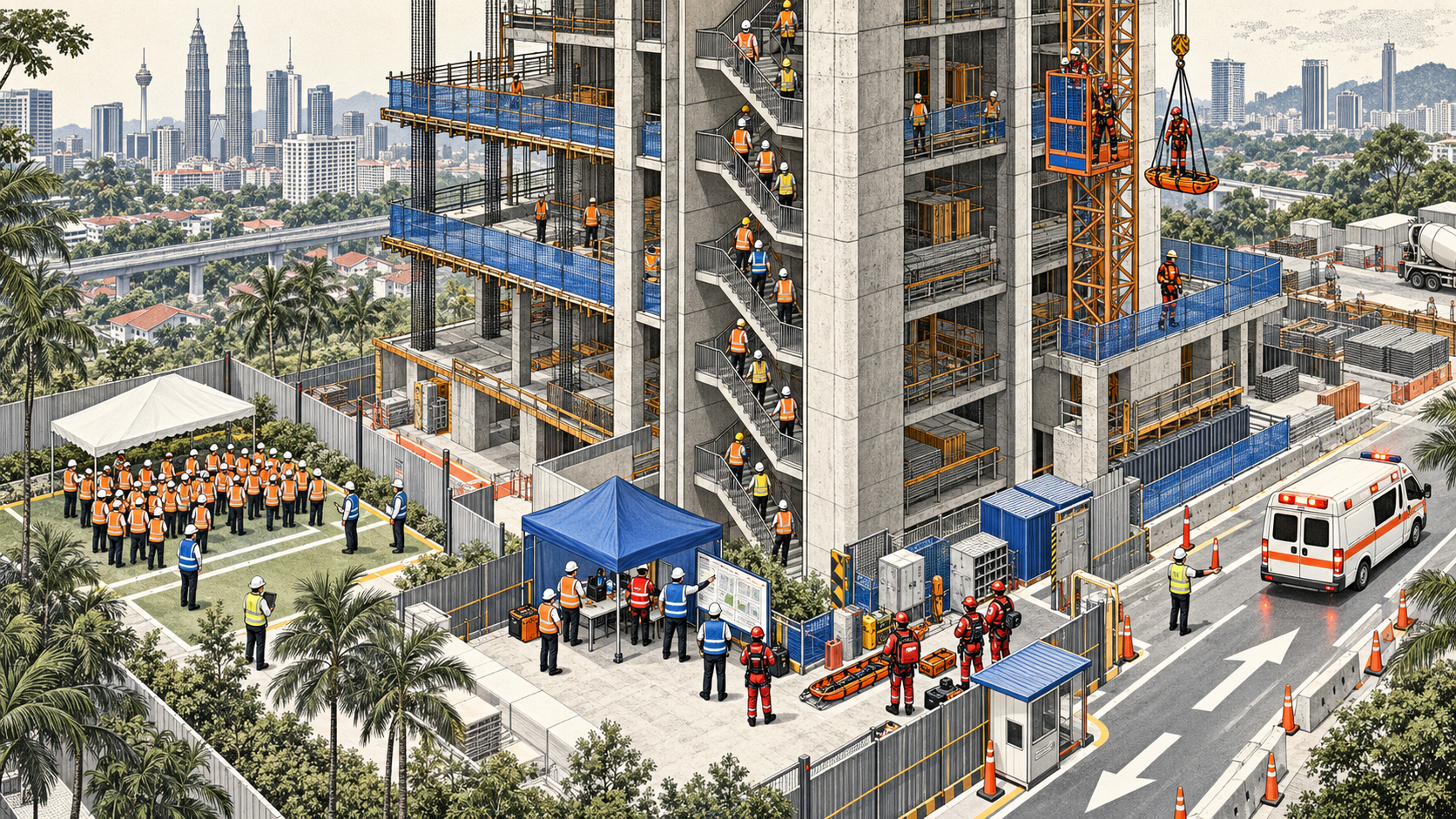
Regulation 32 requires the construction work contractor (CWC), where necessary in the interests of people’s safety or health on site, to prepare, maintain and implement suitable and sufficient arrangements for dealing with any foreseeable emergency. The arrangements must include procedures for any necessary evacuation of the site or part of it. A plan that remains in a file does not meet this operational purpose.
Start with foreseeable emergencies
Use the risk assessment and construction phase plan (CPP). Consider the type of work; site characteristics and size; the number and location of construction workplaces; plant used; the number of people likely to be present; and the physical and chemical properties of substances or objects on site. Demolition, excavation, work at height and confined spaces may require different specific arrangements.
Sites beside highways, slopes or swampy ground have distinct constraints. Long linear projects such as railways, pipelines or tunnels cannot rely on one muster point or a single central team. Scenarios must change with the phase, building height, fire-service access, hoist locations, phased occupation and shift work.
Define triggers, roles and communication
For each scenario, state who detects the condition, sounds the alarm, stops work and isolates energy, calls external assistance, leads evacuation, conducts the head count and coordinates rescue. Nominate deputies for critical roles. Instructions must be understood by workers, visitors, drivers and subcontractors present.
Warnings must suit noise, distance, shifts and people who may not see or hear one method. Provide a backup where power, telephone networks or the normal system could fail. Display emergency telephone numbers clearly at practical locations such as the site office, entrance and canteen, as paragraph 204 explains.
Exits, muster points and head counts
Map exits from actual workplaces, including upper floors, basements, excavations, platforms and remote areas. Ensure routes are protected from the initiating hazard, unobstructed, illuminated and lead to a safe muster point. Do not place a muster point on a plant route or emergency-vehicle access.
Record workers and other people present so that a head count is meaningful. Decide how visitors, delivery drivers, mobile workers and night shifts are tracked. Establish a process for reporting a missing person without directing untrained workers back into the hazard area.
Teams, equipment and external assistance
The CWC should establish an emergency response team suited to the scenarios. The guideline says members may include trained firefighting personnel, trained first-aiders and other relevant persons. Assess team capability, equipment, access and the availability of external help realistically.
Consider particular plant such as scaffolds, passenger hoists, tower cranes and gondolas. Rescue from height or a confined space needs specific arrangements; do not rely on public responders without confirming access, communication and interfaces. List materials and review relevant Safety Data Sheets (SDS) and Chemical Health Risk Assessments (CHRA) when developing emergency action.
Familiarise everyone and test at suitable intervals
Where arrangements are required, the CWC must ensure that every person to whom they extend is familiar with them and that the arrangements are tested by being put into effect at suitable intervals. Induction, phase briefings, noticeboards and practical drills should reinforce each other. The guideline identifies firefighting and evacuation drills as examples, not the only forms of testing.
A drill should test real decisions: can the alarm be heard, do doors open, are routes clear, does the team arrive with equipment, is the head count accurate and does external assistance receive the correct location? Record observations without inventing performance statistics. Close actions, name owners and retest after a material change.
Fictional example MY-40-01
Fictional example — not a real incident, statistic or legal conclusion.
A tower project in Penang reviews its rescue plan whenever work levels and access change. In the early phase, the muster point is near the main gate. When the ambulance route moves and the hoist reaches a new level, the CWC changes evacuation routes, equipment locations and team deployment. A drill finds that evening-shift subcontractors are missing from the current head-count list; the sign-in process is corrected and the drill repeated. The example does not prescribe a universal drill frequency or response time.
Compliance actions
- Identify foreseeable emergencies from the risk assessment and CPP.
- Consider the work, site, plant, number of people and material properties.
- Define triggers, roles, deputies, warnings and backup communication.
- Provide exits, muster points, responder access and head-count arrangements.
- Establish a trained team and provide scenario-specific equipment.
- Familiarise every person covered by the arrangements.
- Test arrangements at suitable intervals and record findings.
- Close actions and review the plan when the site or phase changes.
Evidence to retain
Retain risk assessments and CPP reviews; scenario matrices; emergency action plans; route and muster maps; role and deputy lists; attendance registers and head-count records; equipment inventories; team competence evidence; relevant SDS and CHRA; emergency numbers; induction and briefing records; drill schedules and reports; observations, corrective actions, owners and close-out evidence; and phase-change reviews.
Common failures
- Using a generic plan that does not reflect current work or layout.
- Having no deputy when the emergency coordinator is absent.
- Providing warnings that cannot be heard or understood across zones and shifts.
- Allowing exits or muster points to conflict with ambulance and plant access.
- Excluding visitors, drivers or shift workers from the head count.
- Assuming external responders will provide every specialist rescue capability.
- Conducting drills without closing identified actions.
- Failing to update the plan as the building rises or access changes.
Supervisor’s checklist
- Do today’s scenarios match the actual work and phase?
- Are roles, deputies and activation authority clear?
- Do alarms and backup communications work?
- Are exits, muster points and emergency access clear?
- Does the attendance register support a reliable head count?
- Are the team and equipment suitable and available?
- Has everyone been familiarised with their actions?
- Are previous drill actions closed and the plan reviewed?
Primary JKKP/DOSH references
Refer to Regulation 32, P.U. (A) 147/2024 and the *First Edition 2026 CDM Guidelines*, printed pages 101–104, paragraph 204. Drill frequency, team structure and equipment should follow suitable and sufficient arrangements for the foreseeable emergencies; this article does not invent a universal interval.
Related articles
Garis Panduan CDM Edisi 2026
CDM 2026 · 52 of 52
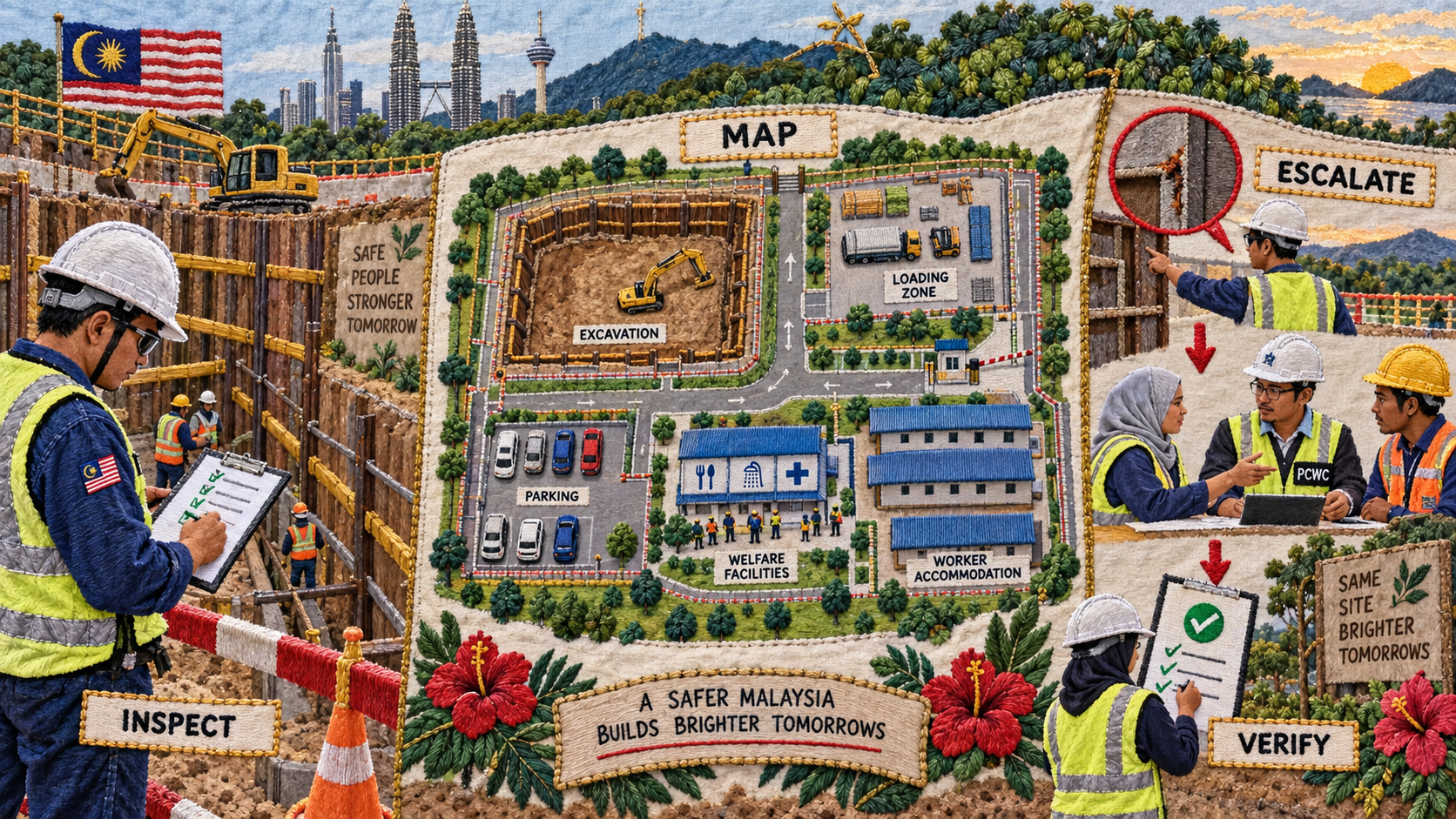
Practical Appendices: Excavation Inspection, Site Scope and Supervisor Guidance
Connect inspection reports, whole-workplace mapping and SSS supervision to action, escalation and verified closure.
Ir. Ts. Dr. Mohamad Syamir bin Senin.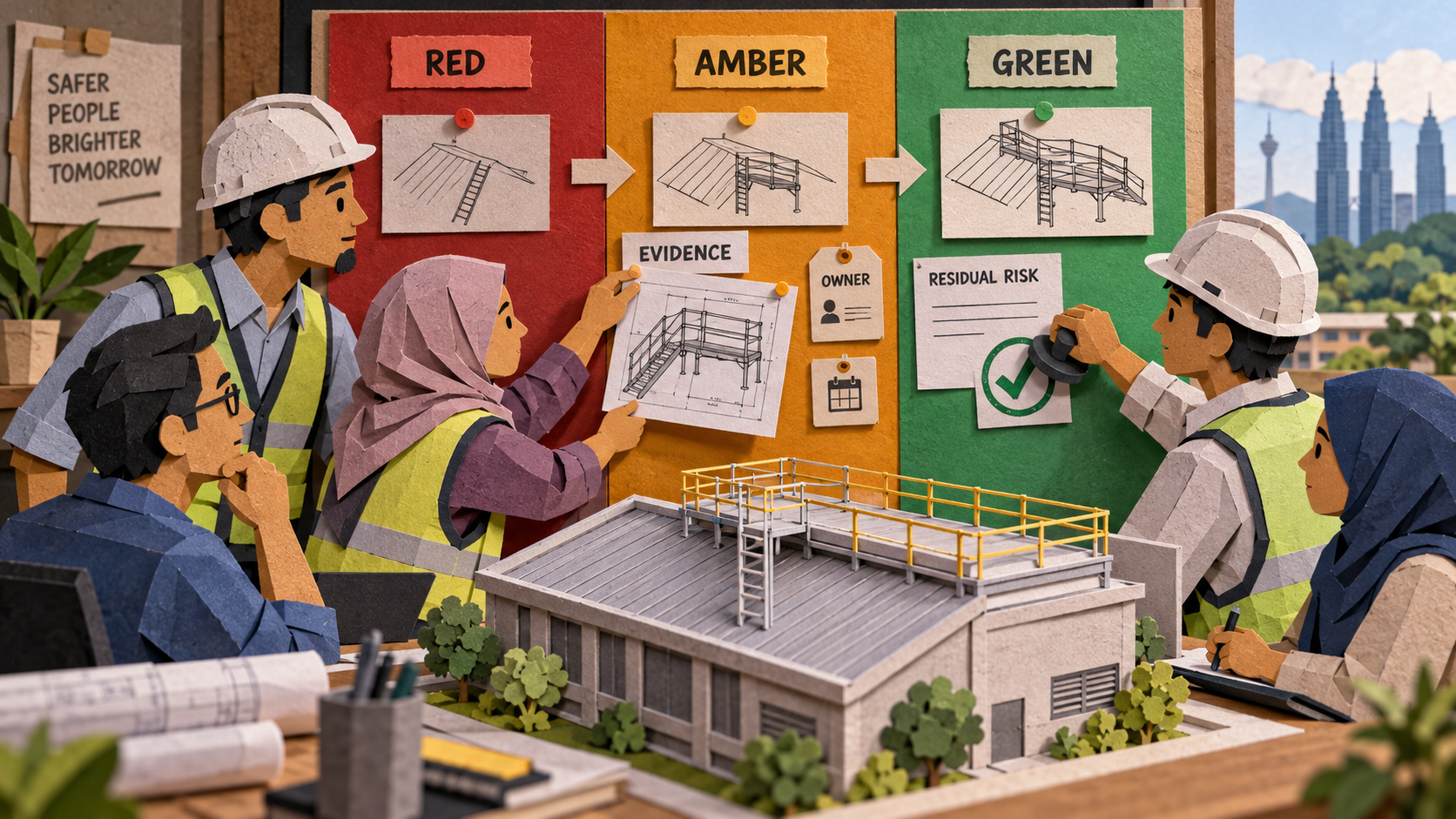
Garis Panduan CDM Edisi 2026
CDM 2026 · 51 of 52
Duty-Holder Checklists and RAG: How to Use Them Without Fooling Yourself
Use Appendices 1 and 2 as evidence-led decision controls with owners and dates—not decorative status colours.
Ir. Ts. Dr. Mohamad Syamir bin Senin.
Garis Panduan CDM Edisi 2026
CDM 2026 · 50 of 52
Third and Fourth Schedules: Notification and Work Involving Particular Risks
Practical guidance for completing project notification and connecting work involving particular risks to the PCI and CPP.
Ir. Ts. Dr. Mohamad Syamir bin Senin.