
Garis Panduan CDM Edisi 2026
Safety and Health Assistance: When a Duty Holder Needs Help
CDM 2026 · 46 of 52
Regulation 38 guidance for identifying gaps, verifying assistants, providing time and means, and arranging cooperation.

SIX-SLIDE BRIEFING
Assistance at a glance
Slide 1 / 6
Basis
Regulation 38
Assistance may be appointed, but the duty and decisions remain with the duty holder.
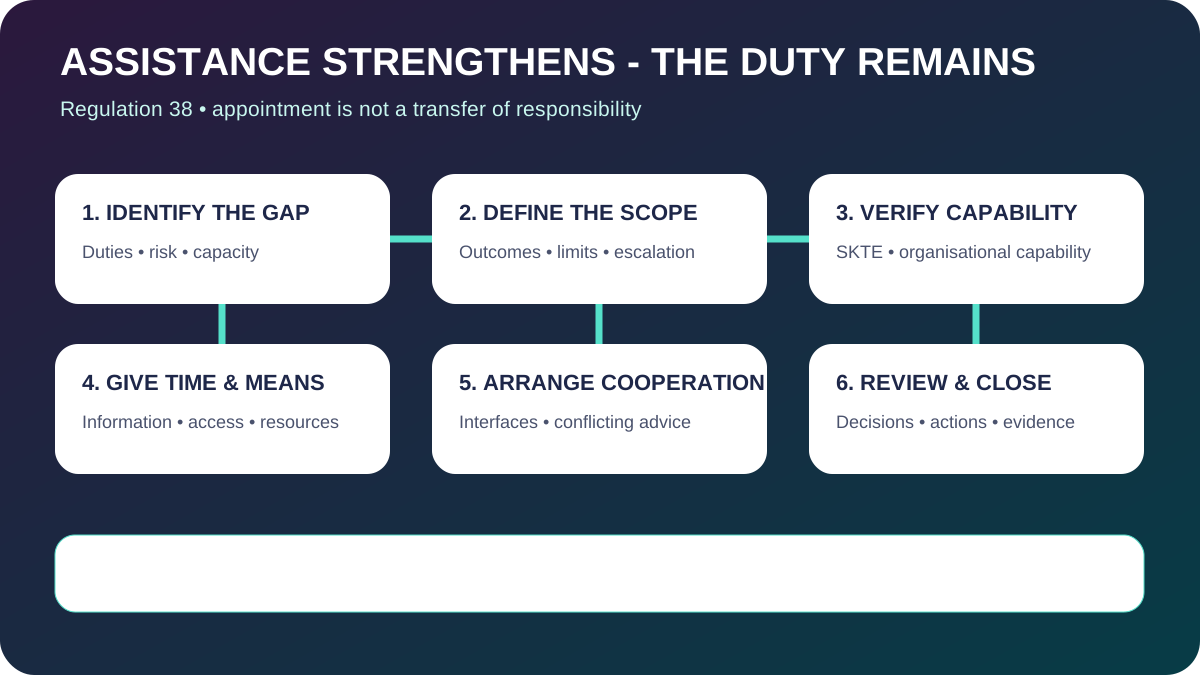
Regulation 38 permits any person holding a duty under the CDM Regulations to appoint another person to assist in undertaking the measures needed for compliance. Assistance is not a transfer of the duty. The appointee must have the necessary skills, knowledge, training and experience; where an organisation is appointed, its organisational capability must also be suitable. The appointing person must take steps to satisfy themselves that those conditions are met, ensure sufficient cooperation between multiple assistants, and provide adequate time and means. The duty holder must still understand decisions, provide information and act on relevant advice.
What Regulation 38 actually permits
Regulation 38(1) permits assistance with measures needed to comply with CDM requirements. Regulation 38(2) prevents a person from accepting a project appointment unless they have the necessary skills, knowledge, training and experience; for an organisation, organisational capability is also tested. Regulation 38(3) requires the appointing person to take steps to satisfy themselves that the appointee meets those conditions.
Where more than one person is appointed, Regulation 38(4) requires arrangements for sufficient cooperation to the extent necessary for the duty holder to meet the duty. Regulation 38(5) requires adequate time and means, considering the size of the undertaking, risks to workers and their distribution throughout the undertaking. Regulation 38(6) connects this appointment with Regulations 10(5) and (6).
Paragraphs 224 to 230 of DOSH's 2026 CDM Guidelines reinforce the duty holder's responsibility, the information and support to be provided, verification that prevention principles can be applied, priority for suitable internal capability, and the possible combination of internal competence with external support. A course or qualification may be part of the evidence but does not alone prove suitability for a particular project scope.
When assistance may be needed
Start with an honest assessment of the work, not with a consultant's name. An infrequent client may need help preparing the brief, pre-construction information (PCI), assessing management arrangements or reviewing proposed appointees' capability. A designer may need specialist structural, fire, geotechnical or maintenance-access expertise. A contractor may need support for particular-risk work, design-construction coordination or evidence systems.
A gap may also concern capacity rather than knowledge. An internal team may be capable but lack time, geographical coverage or resources during a peak phase. Add assistance before the gap affects decisions; it is not a mechanism for obtaining a signature after the work is complete.
Compliance workflow
- List the duties, decisions and outcomes required for the project and relevant phase.
- Assess internal capability: skills, knowledge, training, experience, time, staffing, systems and access to decision-makers.
- Record gaps clearly, including limitations requiring external support or a combined team.
- Prepare an assistance scope stating outcomes, boundaries, interfaces, programme, information access, reporting format and escalation route.
- Verify candidates using relevant evidence: comparable task experience, sample outputs, references, team resources, methods and treatment of limitations.
- Take steps to satisfy yourself that the individual or organisation meets Regulation 38(2); do not rely only on a title or brochure.
- Provide adequate information, including the brief, PCI, design, CPP, programme, changes and risk records.
- Provide adequate time and means, including site access, meetings, specialists, documents and access to decision authority.
- Where several parties assist, define coordination, treatment of overlaps and gaps, and escalation of conflicting advice.
- Review assistance outputs, record the duty holder's decisions and monitor actions to closure.
Assessing individuals and organisations
Assessment should be proportionate to size, complexity and risk. For an individual, examine the relationship between actual experience and the assigned task. Ask what they have produced, which limitations they identified and how they communicated an issue the project team resisted. For an organisation, assess more than a director's CV: review the team that will perform the work, supervision, continuity, quality controls and access to additional expertise.
Capability must remain adequate throughout the appointment. Personnel replacement, scope growth, programme change or new risk may require reassessment. If the assistant lacks time or information, the output cannot be treated as adequate merely because the appointment letter remains valid.
Fictional example MY-46-01 - an infrequent client
This example is fictional and is not a real incident. A Malaysian manufacturer plans a factory extension, but its property team rarely manages construction projects. The client maps its duties and identifies gaps in the safety brief, PCI, capability review of appointees and coordination with live factory operations. An experienced internal employee becomes decision owner while an external organisation is appointed for specific CDM assistance.
The external scope identifies deliverables including a brief workshop, PCI register, candidate-capability matrix and interface-issue log. The client reviews the actual personnel, comparable work, resources, escalation method and limitations. The organisation receives utility plans, process information, operational access and time for site visits. The internal process engineer and external assistant meet under an agreed schedule so operational and design risks do not fall between scopes.
When the assistant recommends additional segregation, the client records its decision and instructs the design team to update the documents. The internal owner verifies closure. Assistance strengthens the client's capability without taking over the client's duty or decision authority.
Evidence to retain
Retain duty mapping and gap assessment; scope and appointment letter; selection criteria; relevant CVs, training and experience; reference or sample-work checks; organisational-capability assessment; named delivery team and supervision; declared limitations or conflicts; time and resource records; information supplied; coordination minutes; advice, decision and action registers; escalation records; performance reviews; scope or personnel changes; and closure evidence. Evidence should demonstrate judgement rather than certificate collection.
Common failures
- Assuming that appointing a consultant transfers the legal duty.
- Selecting a title or certificate without testing suitability for the actual task.
- Using a vague scope such as “manage all CDM” without outcomes, boundaries or escalation.
- Supplying documents late or withholding important operational information.
- Appointing several advisers without cooperation arrangements, creating overlaps or gaps.
- Providing a budget but insufficient time, access or authority to obtain information.
- Accepting a report without decisions, action owners or closure evidence.
Duty holder's checklist
- [ ] Duties and internal capability gaps are mapped.
- [ ] Priority for suitable internal assistance has been considered.
- [ ] Assistance scope, outcomes, boundaries and interfaces are clear.
- [ ] Skills, knowledge, training, experience and organisational capability are verified.
- [ ] Actual personnel, time, means and resources are adequate.
- [ ] Required project information is provided and kept current.
- [ ] Cooperation between all assistants has explicit arrangements.
- [ ] Advice, decisions and actions are recorded and tracked to closure.
- [ ] Changes to scope, personnel or risk trigger reassessment.
Primary references
The primary legal reference is Regulation 38, P.U. (A) 147, including its link to Regulations 10(5) and (6). Operational explanation uses paragraphs 224 to 230 of DOSH's 2026 CDM Guidelines. This guide is not certification of any party's competence or project-specific legal advice.
Related articles

Garis Panduan CDM Edisi 2026
CDM 2026 · 52 of 52
Practical Appendices: Excavation Inspection, Site Scope and Supervisor Guidance
Connect inspection reports, whole-workplace mapping and SSS supervision to action, escalation and verified closure.
Ir. Ts. Dr. Mohamad Syamir bin Senin.
Garis Panduan CDM Edisi 2026
CDM 2026 · 51 of 52
Duty-Holder Checklists and RAG: How to Use Them Without Fooling Yourself
Use Appendices 1 and 2 as evidence-led decision controls with owners and dates—not decorative status colours.
Ir. Ts. Dr. Mohamad Syamir bin Senin.
Garis Panduan CDM Edisi 2026
CDM 2026 · 50 of 52
Third and Fourth Schedules: Notification and Work Involving Particular Risks
Practical guidance for completing project notification and connecting work involving particular risks to the PCI and CPP.
Ir. Ts. Dr. Mohamad Syamir bin Senin.