
Garis Panduan CDM Edisi 2026
Site Safety Supervisor: Function, Authority and Reporting
CDM 2026 · 47 of 52
Regulation 39 guidance for SSS appointment, presence, inspection, escalation, defect closure and trend analysis.

SIX-SLIDE BRIEFING
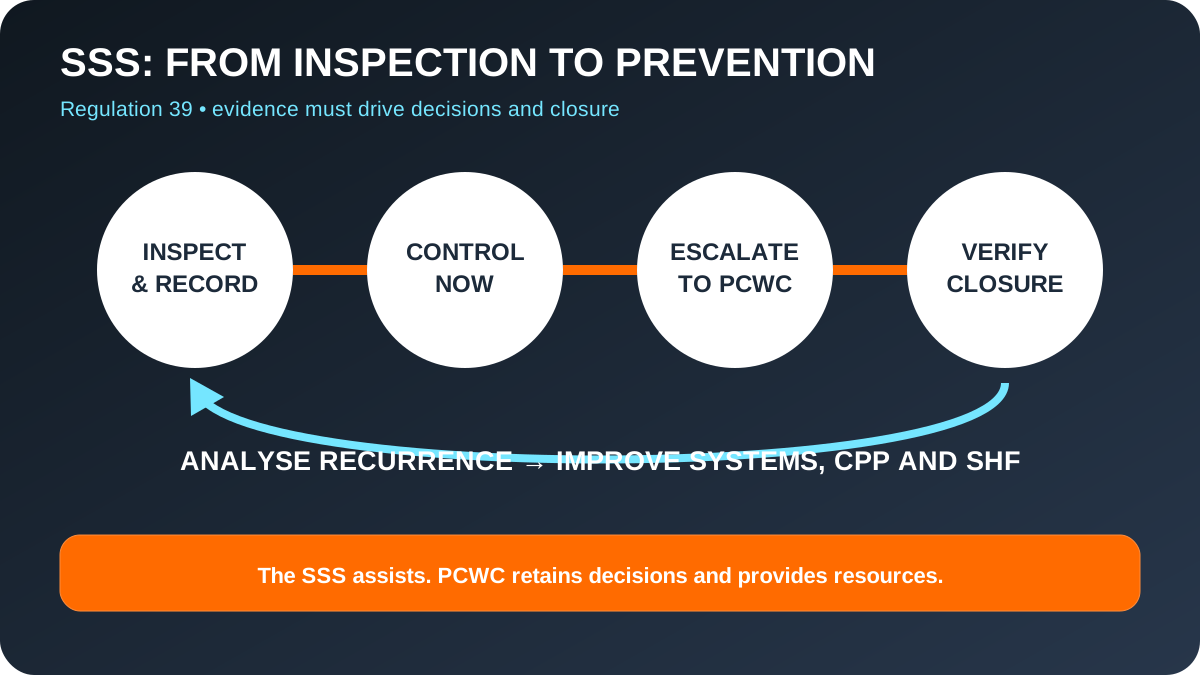
SSS work cycle at a glance
Slide 1 / 6
Basis
Regulation 39
PCWC appoints a competent person who is an SSS to assist with compliance.
Regulation 39 requires the principal construction work contractor (PCWC) to appoint a competent person who is a site safety supervisor (SSS) to assist with compliance with CDM duties. Appendix 5 of DOSH's 2026 CDM Guidelines explains that the PCWC appoints at least one SSS full-time for a project, in writing, with clearly stated duties and responsibilities. The SSS assists the PCWC; the SSS does not replace PCWC management's ownership of decisions, resources or accountability. Reporting must move defects into action and verified closure, not merely generate photographs or inspection counts.
Appointment and presence
Regulation 39(1) uses the term “competent person who is a site safety supervisor”. Appendix 5 states that the appointed SSS must be registered with the Director General of DOSH Malaysia as a competent person under section 31C of the Act and continue to hold a valid certificate of qualification. The PCWC should make a written appointment defining duties and responsibilities.
Under Appendix 5, an SSS may perform SSS duties and responsibilities at only one construction site at a time and performs the role full-time. Coverage planning must be realistic for site area, shifts, phases and risks. Where a site works nights or has several active zones, the PCWC must ensure assistance is genuinely adequate; a name on an organisation chart is not the same as effective presence and access.
Other parties such as the client, PCWD, CWD or CWC may also appoint an SSS where needed, considering complexity, activity risk or the skills, knowledge and experience of supervised workers, with reference to Regulation 38. An additional appointment does not remove the PCWC's Regulation 39 requirement.
Main SSS functions
Appendix 5 describes broad functions: assisting compliance of construction activities; coordinating duty-holder cooperation; helping develop the CPP; planning, managing, monitoring and coordinating safety and health during the construction phase; contributing to the General Principles of Prevention; supervising CPP implementation; and helping update the safety and health file (SHF).
Physical inspections may cover site layout and housekeeping, emergency routes, temporary structures, plant, particular-risk work, markings, electricity, traffic routes, work permits and PPE. The SSS also assists briefings, training, documentation, emergency management, investigations, communication and cooperation. A contract may add detail but should not shrink the function until the SSS becomes only a photographer of defects.
Authority, access and escalation
The written appointment should define access to workplaces, records, coordination meetings and decision-makers. It should also establish the route for an unsafe condition or non-compliance: immediate area control, notification, response time, escalation level and who verifies release. This article does not invent a universal statutory stop-work power for the SSS; the PCWC must define clear operational authority consistent with law and the project system.
The SSS should be able to report directly to PCWC management without findings being filtered by the party inspected. A report alone is insufficient. The PCWC must provide people, time, material and decision authority for corrective action and review recurrence trends.
Compliance workflow
- Verify the appointment requirement, competent-person registration and valid certificate of qualification.
- Appoint in writing, stating site, duration, functions, reporting relationship, access, presence and shift arrangements.
- Match coverage to the programme, active zones, contractors, particular-risk work and phase changes.
- Give the SSS the brief, PCI, CPP, SWPs, method statements, designs, programme, plant registers and relevant records.
- Define a risk-based inspection schedule plus additional triggers after change, weather, an event or a complaint.
- Use records stating location, condition, risk, immediate control, action owner, target date and closure evidence.
- Escalate critical or recurring defects to the PCWC through the defined route.
- Verify rectification physically; do not close an item from a message or photograph that does not represent actual conditions.
- Analyse patterns across areas and contractors to improve design, resources, supervision or the CPP.
- Review SSS effectiveness, coverage and management support when the site changes.
Reporting that drives action
A report should distinguish observation, immediate action, recommendation and the PCWC's decision. Photographs should retain location and time context without unnecessarily exposing personal data. Categories or priorities need consistent project definitions; red-green colours without criteria can mislead.
Trends matter more than inspection totals. Repeated edge-protection defects on three floors may indicate a weak sequence, connection design or installation responsibility. The SSS should raise the pattern to management, while the PCWC decides the systemic correction and provides resources.
Fictional example MY-47-01 - recurring edge protection
This example is fictional and is not a real incident. On a Malaysian multi-storey project, the SSS identifies edge-protection components repeatedly removed for material transfer. The affected area is controlled under the project procedure and the work supervisor is informed. The SSS records the floor, location, activity, relevant party, contextual photographs and immediate action.
Instead of sending three isolated reports only, the SSS compares records and identifies a pattern after deliveries. The issue is escalated to PCWC management. A review with the CWC and design team finds that the transfer point was not coordinated with the guardrail system. The PCWC approves a controlled transfer zone with a designed removable component, reinstatement method and inspection before release.
The SSS verifies installation and monitors the following delivery cycle. Closure evidence includes the PCWC decision, method change, briefing, photographs and follow-up inspection. The example claims no real incident or liability conclusion.
Evidence to retain
Retain the appointment letter and scope; registration and valid-certificate checks; presence and coverage schedule; reporting chart; brief, PCI and CPP supplied; inspection plans and logs; daily or periodic reports; contextual photographs; defect register with immediate action, owner and target date; escalation records; rectification and release evidence; briefings and training; coordination minutes with the SHO and management; CPP and SHF inputs; trend analyses; and performance reviews. Records should show the PCWC response, not SSS activity alone.
Common failures
- Appointing a registered name without checking the certificate, site or actual presence.
- Splitting one SSS between several sites at the same time.
- Treating the SSS as a substitute for contractor supervision or PCWC accountability.
- Measuring performance by photograph count rather than risk and closure.
- Closing defects by message without physical verification.
- Filing reports without an action owner, target date or escalation.
- Repeating local repairs without addressing a systemic cause.
PCWC checklist
- [ ] The SSS is registered as a competent person and holds a valid certificate of qualification.
- [ ] The written appointment states functions, responsibilities, access and reporting.
- [ ] Full-time presence and one site at a time are satisfied.
- [ ] Coverage matches shifts, zones, programme and project risk.
- [ ] The SSS receives the information, time, access and support required.
- [ ] Defect records include immediate control, owner, date and closure evidence.
- [ ] Escalation to PCWC management works.
- [ ] Trends improve systems, the CPP and SHF.
- [ ] PCWC decisions and action resources are recorded.
Primary references
The primary legal reference is Regulation 39, P.U. (A) 147. Operational explanation uses paragraphs 231 to 232 and Appendix 5 of DOSH's 2026 CDM Guidelines, including its reference to section 31C of the Act. Registration and certificate requirements should be verified directly with DOSH for the actual circumstances. This guide is not project-specific legal advice.
Related articles
Garis Panduan CDM Edisi 2026
CDM 2026 · 52 of 52
Practical Appendices: Excavation Inspection, Site Scope and Supervisor Guidance
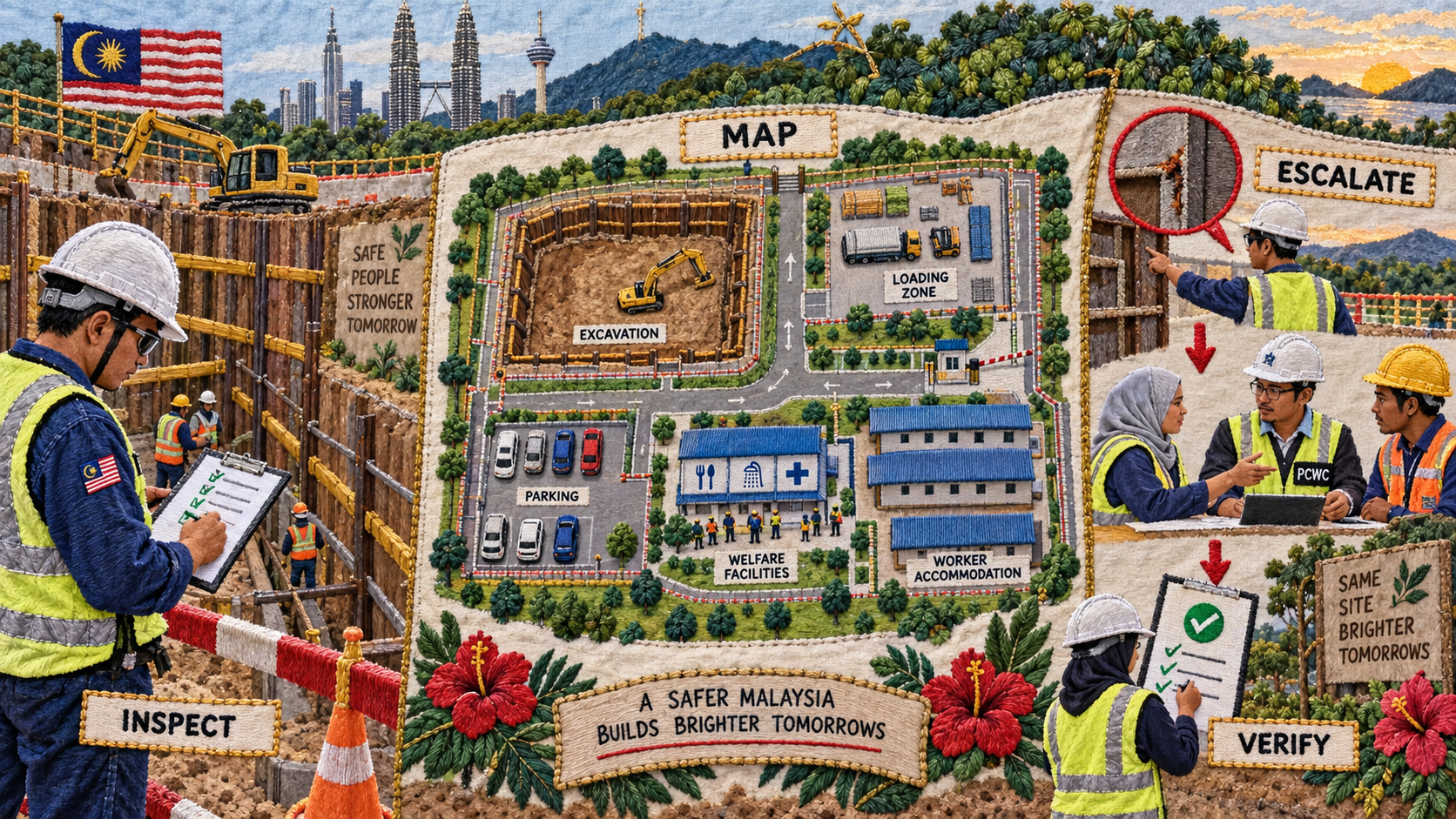
Connect inspection reports, whole-workplace mapping and SSS supervision to action, escalation and verified closure.
Ir. Ts. Dr. Mohamad Syamir bin Senin.
Garis Panduan CDM Edisi 2026
CDM 2026 · 51 of 52
Duty-Holder Checklists and RAG: How to Use Them Without Fooling Yourself
Use Appendices 1 and 2 as evidence-led decision controls with owners and dates—not decorative status colours.
Ir. Ts. Dr. Mohamad Syamir bin Senin.
Garis Panduan CDM Edisi 2026
CDM 2026 · 50 of 52
Third and Fourth Schedules: Notification and Work Involving Particular Risks
Practical guidance for completing project notification and connecting work involving particular risks to the PCI and CPP.
Ir. Ts. Dr. Mohamad Syamir bin Senin.