
Garis Panduan CDM Edisi 2026
Nine General Principles of Prevention: A Design Decision Hierarchy
CDM 2026 · 48 of 52
First Schedule guidance for applying the nine principles in sequence, recording options and prioritising collective protection.

SIX-SLIDE BRIEFING
Decision ladder at a glance
Slide 1 / 6
Sequence
Begin with avoidance
Define the activity and try to remove exposure before selecting controls.
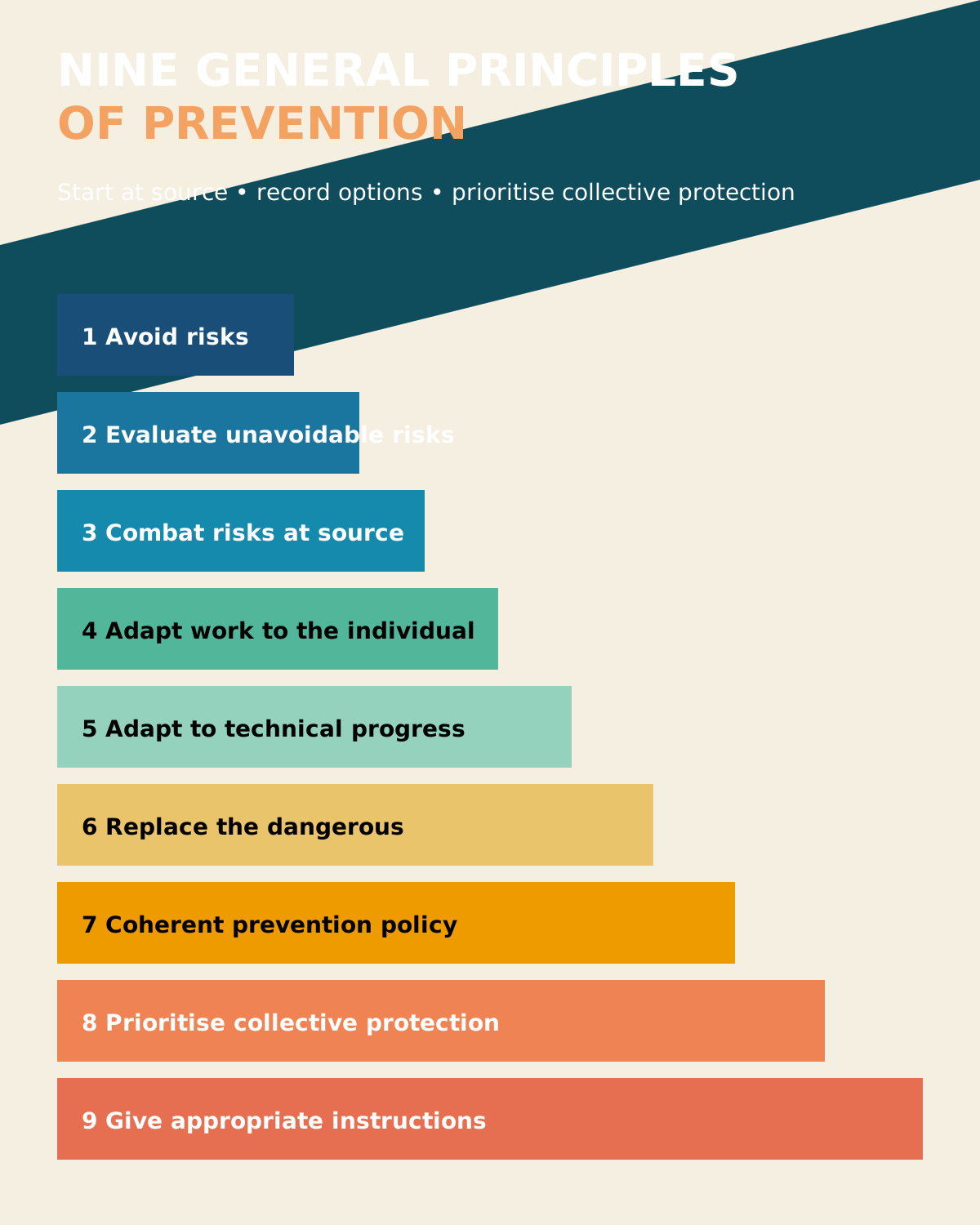
The First Schedule to the Occupational Safety and Health (Construction Work) (Design and Management) Regulations 2024 sets out nine general principles of prevention. They are not a menu from which convenient items are selected at random. They create a decision sequence: avoid risks first, evaluate those that cannot be avoided, combat risks at source, and then establish suitable layers of control. On Malaysian projects, design, technical, organisational and time decisions should demonstrate how that sequence actually influenced the project choice.
The nine principles in working terms
- Avoiding risks. Change the outcome, location, layout, material or method so that the exposure is not created.
- Evaluating the risks which cannot be avoided. Identify who is exposed, when, how often and under what conditions.
- Combating the risks at source. Control the location or condition that generates the hazard, not only the person approaching it.
- Adapting the work to the individual. Consider workplace design, choice of work equipment and working and production methods to alleviate monotonous or repetitive work and its health effects.
- Adapting to technical progress. Check whether safer technology, equipment or methods have become reasonably practicable.
- Replacing the dangerous by the non-dangerous or the less dangerous. Compare alternatives and their whole-life risk effects, not installation alone.
- Developing a coherent overall prevention policy. Integrate technology, organisation of work, working conditions, social relationships and the influence of factors related to the working environment.
- Giving collective protective measures priority over individual protective measures. Choose controls that protect everyone without depending entirely on each person's action.
- Giving appropriate instructions to employees. Instructions complement higher controls; they do not replace opportunities for elimination or collective protection.
Contract and workshop language may be simplified, but compliance records should preserve the statutory meaning and terminology. Principle eight does not prohibit PPE. It means collective protective measures should receive priority when controls are selected.
An auditable decision method
Begin with one specific activity or design decision. State the hazard, people who may be affected and life-cycle stage: construction, use, cleaning, maintenance, alteration or demolition. Assemble the PCI, drawings, models, access assumptions, sequence and site constraints. Then test options in the order of the nine principles rather than beginning with PPE.
For every option, record the proposal, contributors, effects on other risks, practicability, decision and reason. “Not practical” without an explanation is not a useful decision record. If an elimination option is rejected, describe the real technical or project constraint and continue to reduction at source. Check whether the control transfers risk to transport, lifting, the public or future maintenance.
The decision needs an owner. The CWD uses its design influence; the PCWD coordinates disciplines; the client provides time, resources and information; the CWC or PCWC contributes buildability knowledge and plans construction controls. This allocation does not allow any party to transfer its duty through meeting minutes.
Fictional example MY-48-01 — assembly at ground level
A fictional learning example, not a real incident or legal determination. An office project initially proposes repeated installation of small facade components from a work platform at every floor. The team records fall, falling-object, material-transfer and repetitive-work risks.
At principle one, the team asks whether work at height can be avoided. The design is divided into modules that can be prefabricated and inspected at ground level before being lifted as units. This removes most repetitive edge installation tasks, but module lifting still creates risks that must be managed. Under principles two and three, the team evaluates the lifting zone, temporary stability, connections and pick-up points, then designs lifting points and connections accessible from protected positions.
Principles four to seven are applied to component weight, reach, mechanical assistance, material selection and the sequence linking production, delivery and installation. For residual risks, edge protection and an exclusion zone protect groups before individual harnesses are considered. Instructions, briefing and competence support that system. The record does not claim all risk was eliminated; it identifies what changed, what remains and who controls each risk.
Practical compliance actions
- Put a general-principles review at concept, detailed-design, change and buildability decision gates.
- Show at least the avoidance, source-control and collective-protection options considered.
- Involve people who understand construction, operation and maintenance before design freeze.
- Use annotated drawings or models to communicate unusual or difficult-to-see residual risks.
- Align decisions with the relevant PCI, CPP and SHF; do not leave conflicting records in separate systems.
- Reopen the review when materials, sequence, access, method or delivery parties change.
Evidence to retain
- A design decision register stating hazard, options, decision, reason, owner and date.
- Workshop minutes recording participating disciplines, assumptions and actions, not attendance alone.
- Option comparisons, sketches, calculations, models or buildability reviews supporting decisions.
- Change records and confirmation that new or transferred risks were evaluated.
- Residual-risk information issued, recipients, date and acknowledgement or follow-up.
- Version links to the PCI, CPP, issued drawings and SHF.
Common failures
- Starting with harnesses, procedures or briefings without testing design elimination.
- Treating the nine principles as nine equal controls and choosing the easiest.
- Writing “risk accepted” without options, reasons or decision authority.
- Removing one risk while transferring it to lifting, logistics or maintenance.
- Treating worker instructions as a substitute for collective protection.
- Failing to review after a design or sequence change.
- Maintaining a register that no longer matches current drawings and site conditions.
Project meeting checklist
- Are the activity, affected people and life-cycle stage stated?
- Did the team attempt to avoid risk before considering PPE?
- Were unavoidable risks evaluated against actual working conditions?
- Do controls act at source and adapt work to the individual?
- Were technical progress and substitution options reviewed?
- Is prevention integrated with design, organisation, time and working conditions?
- Was collective protection given priority?
- Are appropriate instructions provided for residual risks?
- Can the reason, owner, version and information recipients be traced?
Primary JKKP/DOSH references
- Occupational Safety and Health (Construction Work) (Design and Management) Regulations 2024, P.U. (A) 147, particularly the First Schedule and provisions applying the general principles of prevention.
- Guidelines on Occupational Safety and Health (Construction Work) (Design and Management) 2026, DOSH Malaysia, explanation of the First Schedule and application of the general principles.
This guidance supports project implementation and does not replace the legal text, professional advice or a DOSH determination on project-specific facts.
Related articles
Garis Panduan CDM Edisi 2026
CDM 2026 · 52 of 52
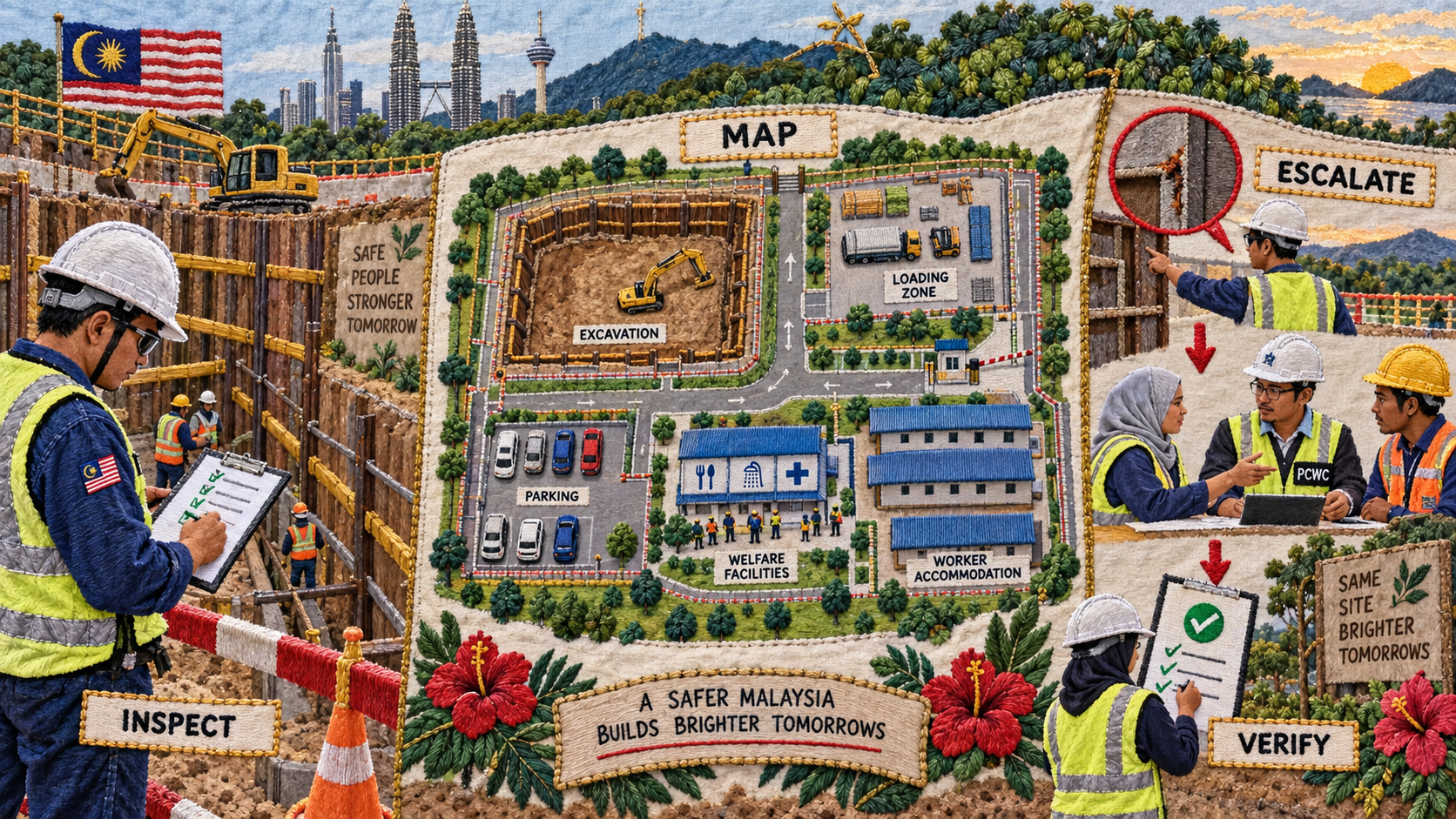
Practical Appendices: Excavation Inspection, Site Scope and Supervisor Guidance
Connect inspection reports, whole-workplace mapping and SSS supervision to action, escalation and verified closure.
Ir. Ts. Dr. Mohamad Syamir bin Senin.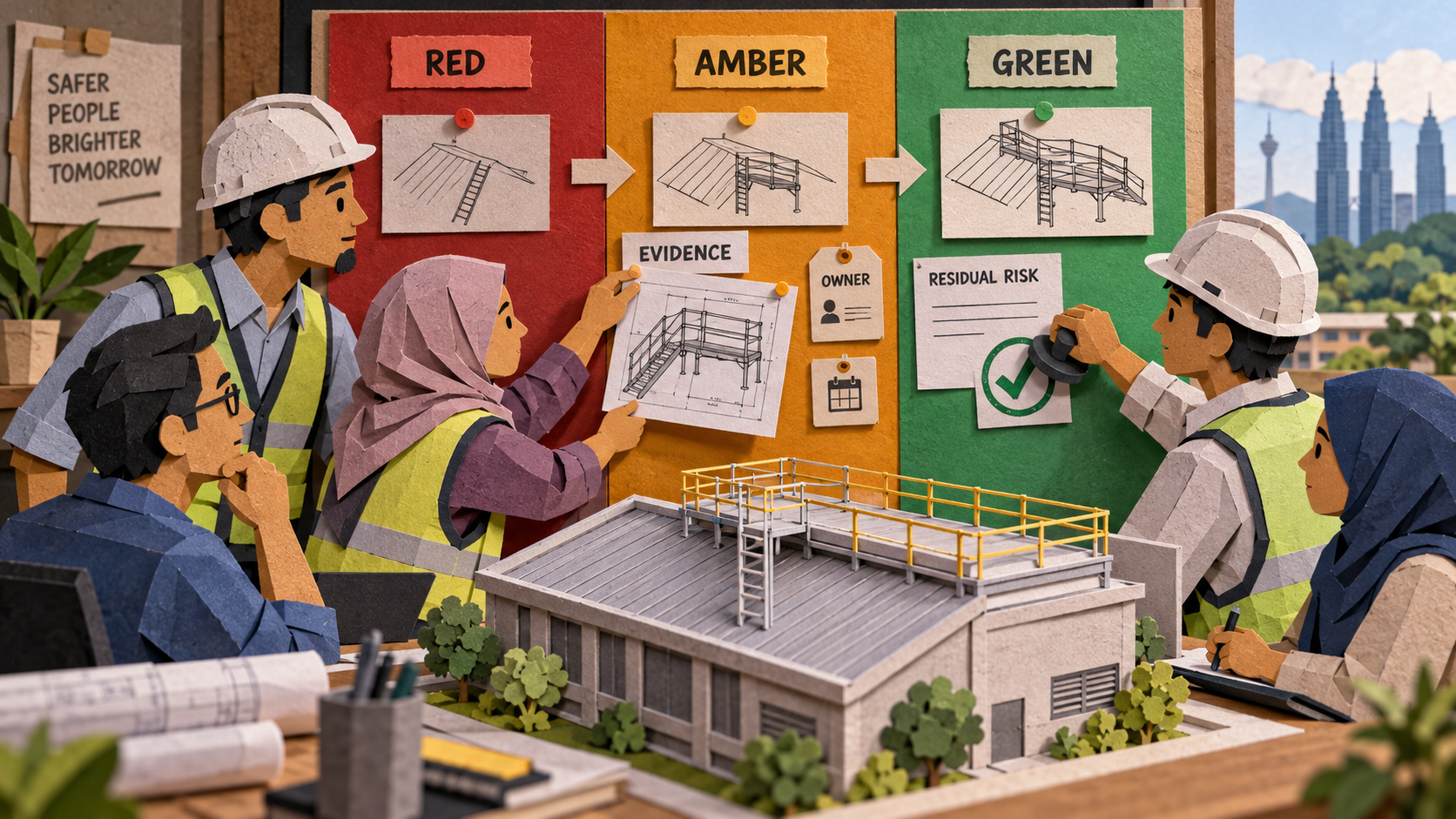
Garis Panduan CDM Edisi 2026
CDM 2026 · 51 of 52
Duty-Holder Checklists and RAG: How to Use Them Without Fooling Yourself
Use Appendices 1 and 2 as evidence-led decision controls with owners and dates—not decorative status colours.
Ir. Ts. Dr. Mohamad Syamir bin Senin.
Garis Panduan CDM Edisi 2026
CDM 2026 · 50 of 52
Third and Fourth Schedules: Notification and Work Involving Particular Risks
Practical guidance for completing project notification and connecting work involving particular risks to the PCI and CPP.
Ir. Ts. Dr. Mohamad Syamir bin Senin.